

Every year, the world spends roughly $3 trillion on research and development. That spending produces an extraordinary amount of knowledge: hundreds of millions of scientific papers containing the results of decades of experiments, observations, and analysis.
Yet for all the sophistication of modern AI, most of that knowledge remains trapped inside documents.
That creates a peculiar problem. We have more scientific information available to AI than ever before, but getting AI to understand and use that information reliably is still a major challenge.
Ask an AI whether a particular treatment works, whether a genetic variant has a measurable effect, or whether a scientific finding has been replicated, and it can often produce an impressive answer.
The problem is knowing whether the answer accurately represents the literature. A model can omit an important qualification, confuse a correlation with a causal relationship, cite the wrong paper, or turn a tentative result into something that sounds established.
The papers themselves contain the evidence. The difficulty is extracting it without losing the context that makes it meaningful.
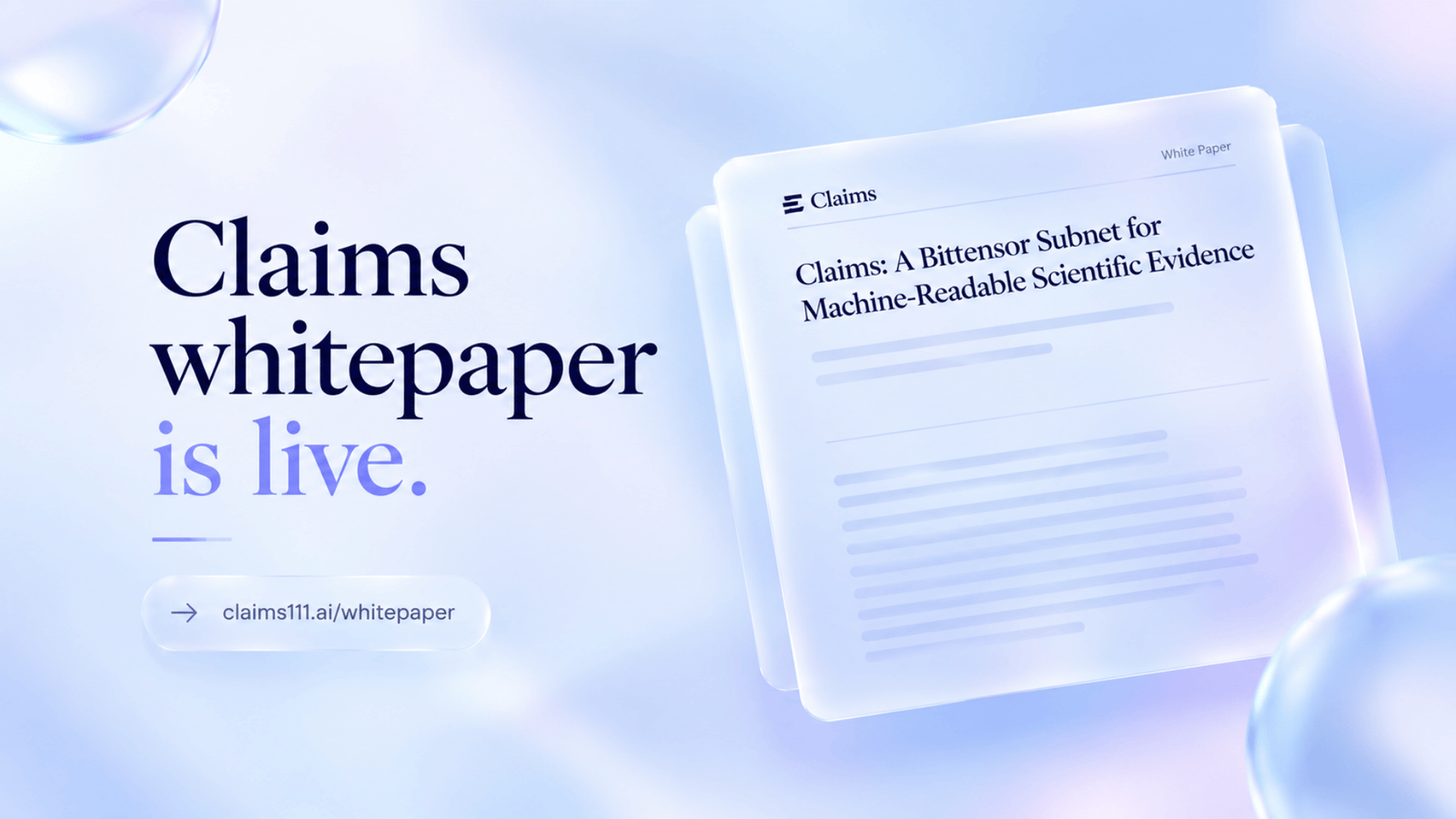
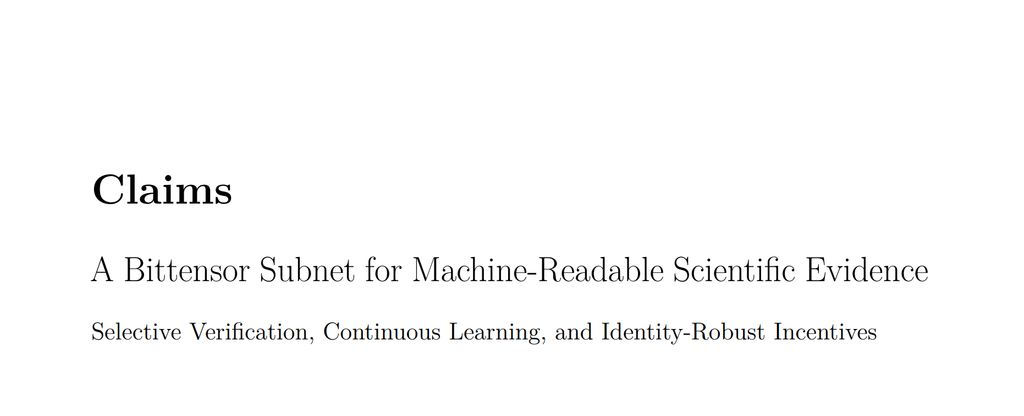
This is the problem Claims, Bittensor Subnet 111, is trying to address.
From papers to claims
A scientific paper is designed to communicate with another human scientist. It is not designed to be easily consumed as structured data by a machine.
Buried inside a paper might be a statement that a treatment reduced hospitalizations by a certain amount in a particular population. Elsewhere are the sample size, confidence interval, methodology, and limitations that determine how that statement should be interpreted.
Claims wants to turn those pieces into a structured representation of the scientific record.
Instead of simply summarizing a paper, the system extracts the important claims made by the authors and links them to the evidence supporting those claims. Crucially, that evidence remains connected to the original source.
The distinction is important. Claims is not trying to tell you that a scientific finding is true. It is trying to tell you, in a machine-readable and auditable form, what the paper claimed and what evidence the paper presented for it.
The result is intended to become a claim-evidence graph in which findings from different papers can eventually be connected. One study may support another. A later study may contradict it. All these are represented in the graph.
As opposed to allowing all of those differences to disappear into an AI-generated paragraph, the underlying evidence remains visible. That makes the source itself part of the product.
Not another AI research assistant
Claims enters a market that is already developing rapidly.
Semantic Scholar has indexed more than 200 million academic papers and provides AI-powered tools for discovering and navigating scientific literature.
Scite goes further into citation intelligence, allowing researchers to examine whether later research supports or contradicts previous findings.
Elicit now offers an extensive workflow for systematic reviews, including paper screening, data extraction and evidence synthesis, with extracted information linked back to supporting passages in the source.
These products demonstrate that there is already significant demand for AI that can make scientific research easier to navigate.
Claims (SN111) is approaching the problem at a different level.
Rather than primarily building another interface for searching and summarizing papers, it is trying to create the structured evidence layer underneath those applications. Its goal is to convert scientific literature into a dataset of claims, evidence, and provenance that machines can reason over and other applications can consume.
The distinction is similar to the difference between a search engine and a database. A search engine helps you find the relevant document. Claims is interested in what can be extracted from that document and represented in a form that remains useful after the original prose has been removed.
That does not make existing tools obsolete. In fact, the opportunity may be complementary. Research assistants can use structured claim-evidence data (from Claims) to produce better answers, while researchers can use products such as Scite or Elicit to investigate and validate the underlying literature.
The main point is that scientific AI may need more than access to papers. It needs a reliable representation of what those papers really contain.
Why Bittensor matters
This is where Claims becomes more interesting than a conventional scientific-data company.
Turning hundreds of millions of papers into high-quality structured evidence is not something a small team can simply do by hand. It requires a continuous supply of extraction systems, evaluation, and correction.
Claims therefore treats scientific extraction as a competitive market.
On Subnet 111, miners receive paper-extraction tasks and produce structured claim-evidence records. Validators evaluate those records, checking whether claims are grounded in the source, whether the evidence actually supports them, and whether important information has been missed.
The best-performing work receives rewards, called emissions.
By this, Bittensor provides the economic mechanism through which independent participants can compete to produce better scientific data.
The bet Claims (SN111) is making
Science already has an enormous knowledge archive. The problem is that much of it remains locked inside papers written for humans.
Claims is betting that the next step is not simply building better systems for searching that archive, but converting it into something machines can inspect, compare, and reason over without losing the connection to the original evidence.
In other words, the subnet aims to turn scientific papers into structured claims, connect those claims to their evidence, and build an open market that continuously improves the quality of that data.
If it works, the result would provide an evidence layer that makes the scientific record easier for both humans and machines to interrogate.
➛ Read more about Claims (SN111) here.
Enjoyed this article? Join our newsletter
Get the latest TAO & Bittensor news straight to your inbox.
We respect your privacy. Unsubscribe anytime.
Enjoyed this article?
Join our newsletter
Get the latest TAO & Bittensor news straight to your inbox — every morning before markets open.

No comments yet — be the first.