


You spot Const at the coffee station between panels, Mark Jeffrey is heading toward the same elevator you are, James Altucher is checking his phone in the hallway, and Sami Kassab is standing alone for the first time all conference.
The window is 120 seconds long, and what comes out of your mouth in that window decides whether the next 30 days include a real meeting or a polite no-reply.
This is the four-part elevator pitch that works when the stakes are real, plus a worked example that anyone can borrow the shape of.
The Four Parts That Do the Actual Work
Every landing pitch runs the same structure. Miss any of the four and the whole thing loses its landing.
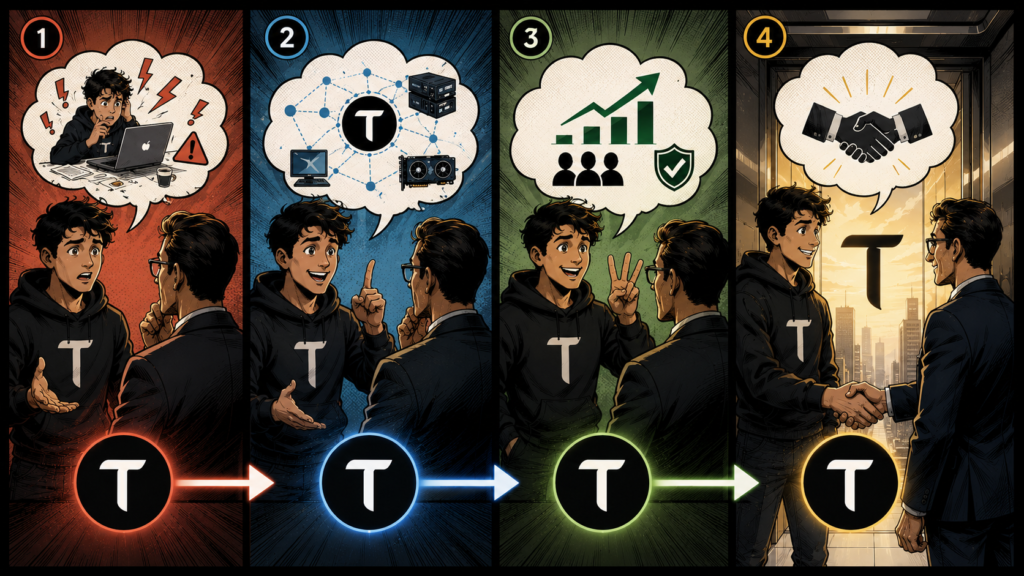
1. The Problem: One sentence naming a ‘pain’ the listener can relate with. Do not teach it to them, name it and let them nod.
2. The Solution: What you propose, in the words a smart friend outside the ecosystem would understand. No “leveraging distributed intelligence,” no “protocol-native primitives.” Just: “we let people rent GPUs by the hour without an account.”
3. The Result: Numbers, named customers, or on-chain proof. The evidence that what you just described is real and already working. Skip this step and the whole pitch becomes a wish.
4. The Call to Action: One specific ask: Fifteen minutes next week, a warm intro to someone in their network, a DM follow-up on a specific day. “Never ask for money in the elevator!”
Rehearsed cleanly, the whole thing takes 75 to 120 seconds. Anything longer and the door opens before you land.
Read the Room Before You Open Your Mouth
The same subnet idea pitched three different ways would surely land three different results. Who you are talking to decides which of the four parts you weigh heaviest:
1. A protocol architect like Const: Lead with the mechanism. What does your incentive design solve that others cannot? You might need to skip the customer story until they ask for it.
2. A media or narrative figure like Mark Jeffrey or James Altucher: Lead with the story arc like what thesis the subnet idea represents, and where it sits in the bigger picture of where Bittensor is going.
4. A researcher or analyst like Sami Kassab: Lead with data: Buyback ratios, revenue numbers, benchmark scores, on-chain metrics. That is what earns the second sentence.
5. A capital allocator like Barry Silbert: Lead with market size and value flow like what the addressable market is, why only Bittensor can unlock it, and how the value flows back to $TAO.
The four parts stay constant, what changes is which one you open with.
The Mistakes That Kill Elevator Pitches
Most bad pitches fail the same way, and once you learn to spot the pattern, you stop making it.
1. Too much backstory: Nobody in the elevator needs to know how you got into crypto or why you left your last job. Get to what you built or want to build!
2. Too much jargon: “Emissions-optimized subnet with a novel Yuma consensus vector” tells the listener nothing. Say what you actually do.
3. No proof: “We are going to disrupt X” without a single number is a wish. “We processed 400 GPU rentals last month” is a signal.
4. Weak ask: “Let me know what you think” is not a call to action. “Can we grab 15 minutes next Tuesday?” is.
The pitch is a filter: Clean lands the meeting, and muddy earns the polite nod on the way out of the elevator.
A Worked Example: Lium (SN51)
Watch how quickly the structure moves when it is written cleanly. The whole pitch below runs under 90 seconds spoken at normal pace.
1. Problem: “Every AI developer in 2026 knows what renting a GPU compute feels like: sign up, verify identity, prepay, wait for provisioning, and then discover the pricing is opaque and the machine is not what they thought they were getting.”
2. Solution: “Lium is a decentralized GPU marketplace on Bittensor where developers rent an H100 or an RTX 5090 in under a minute. No signup, no KYC, transparent per-hour pricing, and confidential compute now live on select nodes so workloads stay encrypted from the operator hosting them.”
3. Result: “Revenue and GPU supply both more than doubled in the past month. Lium (SN51) is a Bittensor subnet that ships hardware-verified confidential compute, and the alpha buybacks running through the subnet are funded entirely from real GPU rental revenue rather than treasury operations.”
4. Call to Action: “Would it make sense to grab 15 minutes next Tuesday? I would love to walk through the buyback dashboard and show you how the numbers are trending.”
No jargon, every claim verifiable on-chain or in the public dashboard. The request is specific and easy to say yes to.
Great Products Need Great Pitches
The best subnet founders/supporters treat their elevator pitch the way they treat their subnet: iterate constantly, watch what lands, and cut what doesn’t. The goal is not to win the meeting inside the elevator; the goal is to be interesting enough in 120 seconds that the person leaves the elevator willing to give you 15 minutes later.
Practice out loud, time yourself, and ask a friend to play Const or James Altucher so you can test the pitch under pressure. The version that survives repeated real-world reps is the one most likely to earn a seat in the rooms where the biggest deals get made.
Enjoyed this article? Join our newsletter
Get the latest TAO & Bittensor news straight to your inbox.
We respect your privacy. Unsubscribe anytime.
Enjoyed this article?
Join our newsletter
Get the latest TAO & Bittensor news straight to your inbox — every morning before markets open.



No comments yet — be the first.