


The most valuable AI model is rarely the smartest one. It is the one that actually runs under the hardware you have, which is the premise the True Performance Network (TPN) is built on.
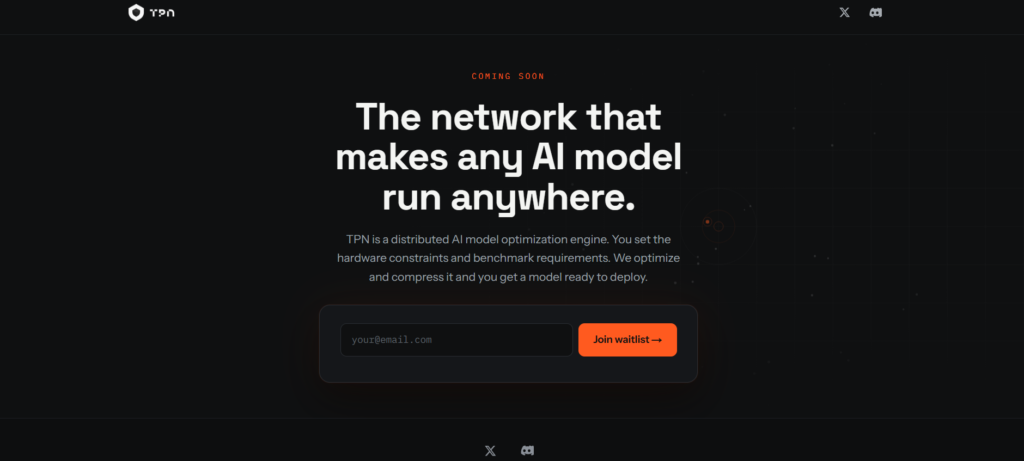
On Bittensor Subnet 65, TPN runs competitions where miners race to produce the most efficient version of a designated model, with every result verified on-chain and delivered to whoever requested it.
The newly released litepaper lays out the full mechanism, and its most interesting feature is how thoroughly it makes copying a rival’s work impossible.
Two Ways to Ask the Same Question
Every model carries two properties worth optimizing: how well it performs and how much hardware it demands; and TPN shapes each competition around whichever one the user actually cares about.
That produces two distinct requests running through the same underlying system.
1. Shrink it without losing quality: A lab that built a model can ask for the smallest, most efficient version that still clears a set of minimum benchmark scores, so the performance floor becomes the binding constraint.
2. Get the most from fixed hardware: An enterprise working within defined limits can ask for the highest-scoring model that fits inside them, so the hardware ceiling binds and benchmark performance becomes the objective.
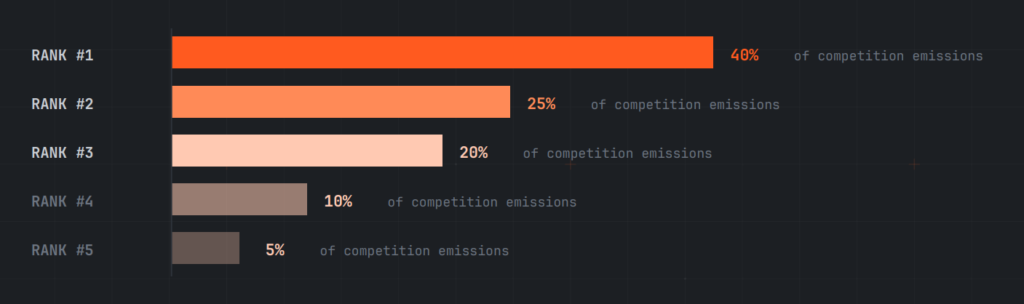
The first competition, TPN-001, makes the abstraction concrete. Miners derive a compressed model in GGUF format, clear floors across benchmarks such as MMLU, GSM8K, and HellaSwag, and the top five split the emissions at 40%, 25%, 20%, 10%, and 5%, while everyone below that line earns nothing.
The Sealed Envelope That Kills Copycats
Any open competition with visible entries invites a lazy strategy, where a miner simply waits for a strong submission to appear, copies it, and resubmits it under their own name.
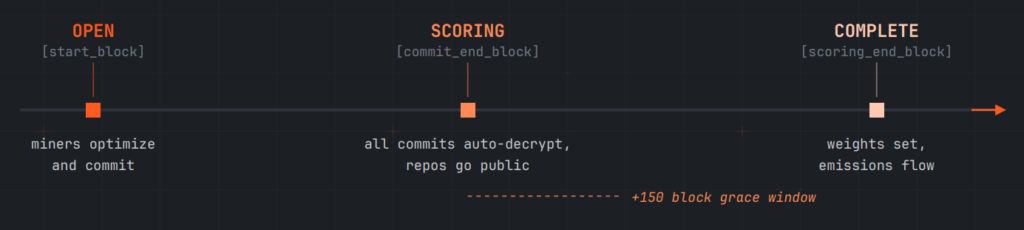
TPN closes that gap at the protocol level, before a single model is evaluated, by sealing every entry in time-locked encryption that no one can open early.

1. Everything is sealed on-chain: A commit encrypts the repository name, filename, file hash, size, exact version, and the miner’s self-reported benchmark claims into one locked envelope.
2. The chain opens every envelope at once: At a fixed block, all commits decrypt simultaneously with no reveal transaction required, so neither validators nor rivals can see anything ahead of the deadline.
3. Only the sealed file counts: Each commit pins one specific version by its cryptographic hash, so swapping in a better model after the reveal produces a mismatch and an immediate permanent ban.
Those self-reported claims carry a second function beyond the seal, since validators evaluate submissions in order of claimed efficiency. An honest, confident miner gets checked first, while one who lowballs their own scores risks never being evaluated before the scoring window closes.
Six Gates Between a Submission and a Reward
Once repositories go public, the validator verifies every entry against six sequential gates, and a submission that fails any single gate stops there rather than moving on.
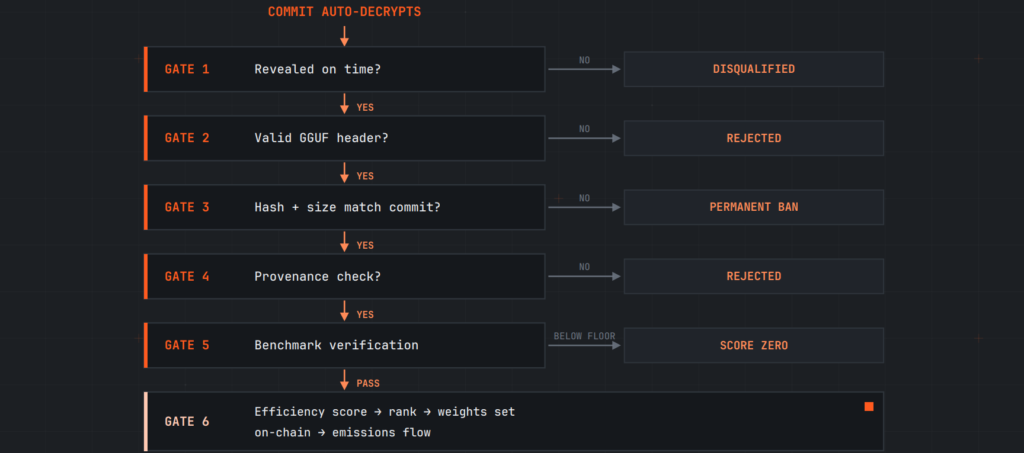
1. Revealed on time, or the miner who never made their repo public within the grace window is disqualified before anything is downloaded.
2. Valid format, meaning the file is reachable and carries a legitimate GGUF header.
3. Hash and size match the seal, since any mismatch against the sealed commit is treated as file-swapping and earns a permanent ban.
4. Provenance holds, so the model must provably descend from the base model, checked by reading its internal structure rather than running it.
5. Benchmarks verify independently, where a fresh GPU pod runs the real benchmarks and the self-reported claims only ever set evaluation order.
6. Floors, rank, and emissions, where clearing every floor is mandatory before submissions rank by efficiency and convert into on-chain emission weights.
The provenance gate rewards a closer look, because it compares embedding geometry using a measure that stays stable under exactly the transformations compression causes.
A genuine compressed derivative lands near a perfect match, while an independently trained imposter falls well below the acceptance line, all without the validator having to run the model at all.
Why the Math Rewards Shrinking Hard
TPN measures efficiency by dividing a model’s verified benchmark performance by its file size, making compression a core part of the incentive. Since benchmark scores are already compressed into a narrow range between zero and one, even small reductions in model size can have a much larger impact than modest gains in accuracy.
To ensure those efficiency scores remain credible, TPN pairs sealed model commitments with a content-addressed cache that prevents identical weights from being benchmarked more than once. The real test now is whether the subnet can maintain this discipline while running multiple competitions simultaneously without compromising the integrity of its scoring system.
➛ Peruse the Litepaper 1.0 Here and Read More on TPN (SN65) Here:
Enjoyed this article? Join our newsletter
Get the latest TAO & Bittensor news straight to your inbox.
We respect your privacy. Unsubscribe anytime.
Enjoyed this article?
Join our newsletter
Get the latest TAO & Bittensor news straight to your inbox — every morning before markets open.



No comments yet — be the first.