


A profitable product is usually a reason to keep building. For the team behind True Performance Network (TPN), it prompted a closer examination of the opportunity ahead.
Speaking on Episode 106 of the Ventura Labs Podcast, co-founder Mentor Palokaj explained why the team moved away from a working decentralized VPN to focus on compressing large language models. The decision centred on whether the business could deliver the scale of growth they sought.
The team’s first venture was a fully compliant TAO-to-EVM bridge developed in the Netherlands. After that product became obsolete, it built Taofu, a fundraising platform for tokenizing subnet ownership stakes. The concept attracted considerable discussion, but actual usage remained limited.
The decentralized VPN that followed achieved stronger traction. It reached app stores, attracted reliable miners, secured paying users, and became profitable. Nevertheless, during a six-hour review around May, the founders concluded that AI model compression better matched their expertise and ambitions.
Mentor described the willingness to pivot as a practical response to market feedback, available capital, and the team’s interests. Maintaining trust remained central to that process. His advice to “be a cockroach” captured the importance of surviving and adapting while acting in good faith.
Today, TPN (SN65) operates with the goal of making language models perform effectively within specific hardware constraints. The process starts with a model, a target device, and the capabilities the user wants to preserve. Compression then seeks the best balance between memory requirements, retained intelligence, and inference speed.
Quantization is one of the main techniques involved. By reducing the numerical precision used to represent model weights, it lowers the memory needed to run a model. Mentor explained that moderate reductions, such as moving from 16-bit to 8-bit precision, can preserve much of its capability, although the outcome depends on the model and task.
More advanced approaches include mixed-precision schemes that protect parts of a model that are particularly sensitive to compression. Quantization-aware distillation adds another method, using the original model as a teacher to help a compressed student reproduce its behaviour.
Evaluating the result is a central challenge. A compressed model can perform well on familiar public benchmarks without retaining the broader capabilities users expect. Repeated optimization against known questions can also make benchmark scores less informative about performance on unfamiliar tasks.
TPN (SN65)’s response combines task-based evaluation with measures of behavioural fidelity. Mentor described Fluid Bench as a generative meta-benchmark that samples knowledge points to produce questions whose exact form is unknown in advance. The approach is intended to make it harder to optimize solely for a fixed question set.
The team also uses KL divergence to compare the original and compressed models’ full next-token probability distributions. This assesses how closely their predictions align, complementing benchmark results rather than replacing them. According to Mentor, miners can choose different trade-offs between task scores and similarity to the original model.
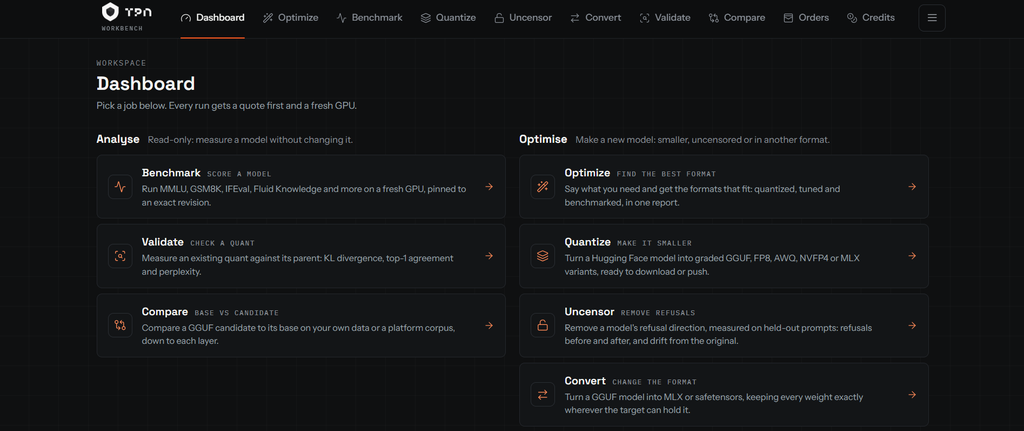
TPN’s public workbench at TPN Bench makes these choices accessible through a configurable workflow. Users submit a Hugging Face model, specify hardware constraints and acceptable loss percentages, and receive a matrix of quantized or distilled variants. They can rank the results by their preferred metrics, with Mentor highlighting the “Optimize” feature as particularly useful.
The appropriate compression level depends on the application. A demanding coding workflow may prioritize maximum capability, while an autonomous robot or offline device may accept a larger performance reduction to operate within limited memory and power budgets. Mentor cited battery-powered smart doorbells as an example of highly compressed neural networks serving a narrowly defined purpose.
The team is monitoring more aggressive techniques, including ternary weights represented as −1, 0, and +1. The discussion also covered parameter-space rotation methods that make distributions easier to quantize, followed by compensating input transformations. Mentor said these approaches had not been integrated because the supporting tooling remained immature.
In the long run, TPN plans to explore domain-specialized models that preserve strength in selected areas while accepting weaker performance elsewhere. A model intended for poetry, for example, might have little need for strong coding abilities. That would allow compression and specialization to be guided by a particular use case.
For now, the priority is establishing reliable evaluation and fair incentives for miners producing compressed models. Mentor saw that foundation as the necessary step before expanding into targeted fine-tuning and specialization. TPN’s immediate task is to demonstrate that its compression process can deliver dependable results for users within Bittensor and the wider AI market.
Enjoyed this article? Join our newsletter
Get the latest TAO & Bittensor news straight to your inbox.
We respect your privacy. Unsubscribe anytime.
Enjoyed this article?
Join our newsletter
Get the latest TAO & Bittensor news straight to your inbox — every morning before markets open.


No comments yet — be the first.