


The founders of Djinn Protocol, Philip Maymin, Harry Crane, and Iosif Gershteyn, sat down for the 96th Ventura Labs podcast to walk through how their subnet turns a stubborn old problem into a trustless marketplace.
As Maymin put it, this was likely the deepest they’ve ever gone on a pod.
Here’s what got covered, what’s already live, and what’s coming.
The Core Problem: Being Good Gets You Banned
The founding insight comes from years running Analytics.Bet, where the team taught people to become profitable long-term sports bettors.
The trap: once you win consistently, sportsbooks flag you as a “sharp” and limit or ban you. Meanwhile, losing accounts are welcomed to keep playing.
The old workaround was purely logistical: get friends, family, and eventually vetted strangers to place bets on your behalf. But that approach:
- Runs on trust, which is risky and hard to scale
- Turns a betting operation into a personnel management operation
- Hits a ceiling, because even the biggest syndicates top out at roughly 1,000 accounts
Djinn’s answer is to unbundle information from execution, a phrase the team returned to again and again. The person with the winning insight and the person with account access no longer need to be the same person.
Genius, Idiot, and the Uber Analogy
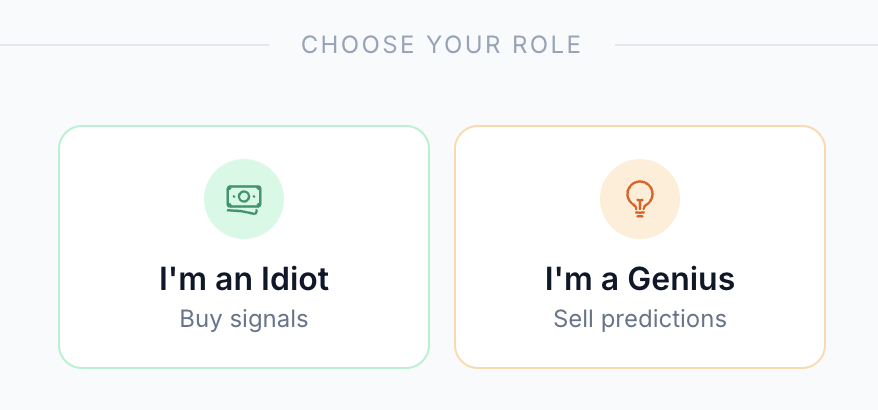
Djinn’s marketplace has two user types, and neither actually sits on the subnet itself:
- Geniuses: the sharps with an edge but no market access. They sell encrypted signals.
- Idiots: anyone with a working, unbanned betting account. They buy signals and execute.
The team’s called Djin an Uber for betting accounts. You don’t need to be a gambler; if you can log in and place a bet, you can earn passively by executing signals from the network.
The addressable pool for this is over 500 million dormant sportsbook accounts worldwide.
How a Signal Flows
Walking through the live demo at djinn.gg, the mechanics look like this:
- The Genius creates a signal: picks the game, line, notional size, and fee. Everything is encrypted locally in the browser. No one else (not miners, not validators, not the Djinn team) can see it.
- The signal is hidden among decoys: a single real pick is buried among hundreds or a thousand fake ones. Only which index is real needs to stay secret.
- Miners attest the lines are executable: using TLS Notary, they cryptographically prove a given line was tradable at a real book at a real time. No fantasy “+1 billion on heads” bets.
- Validators run multi-party computation: using Shamir secret sharing, they collectively verify whether the real signal won without any single validator ever learning which pick it was.
- The Idiot buys and decrypts: the signal reveals only in the buyer’s browser. They then execute wherever they like (Polymarket, a sportsbook, wherever they still have access).
The recurring line from Maymin: ignore the secrecy part and it’s simple; the secrecy is the entire hard problem, and where validators earn their keep.
The Warranty: Skin in the Game
This is what separates Djinn from the “tout” economy of screenshotted wins and hidden losses. Every signal carries a warranty percentage backed by Genius collateral.
- Accountability is measured over a sequence of signals (the sweet spot is about 10 genius–idiot pairs), not any single bet because even a 5% edge still loses ~45% of the time.
- If the Genius underperforms, the Idiot is made whole up to the purchase price in USDC, with anything beyond that refunded as Djinn credits.
- A backing above 100% (the demo showed 125%) signals a Genius willing to pay back more than the loss, which is a credibility flag for buyers.
The key incentive: shills won’t use a system that forces them to guarantee an edge they don’t have. Real geniuses will, and they price the fee just under their edge, leaving something on the table so their quality score stays attractive.
The presumption baked into the design: you bet roughly the amount you buy the signal for. Buy a $100 notional signal, bet $100. That’s what keeps the warranty aligned with your real exposure.
Why Miners and Validators; Not Just Djinn
A natural question the hosts pressed: why not route everything through Djinn’s own servers? Two reasons:
- Trust: if Djinn notarizes its own lines, it’s “shaking its own hand.” Decentralized peer notarization (miners on different IPs verifying each other against a third-party source) makes the proof believable.
- Leakage: a centralized operator could front-run, resell, or get hacked. Bittensor’s architecture removes that single point of failure.
On the concern that a majority-stake validator could unmask signals: the team says no. Weight-setting uses stake, but the MPC is stateless and equal-weighted, it just needs a threshold of distinct validators (currently 3, so 2-of-3 can compute). Stake gives you no advantage in the secret-sharing step. The founders also noted they run one validator for now for smoke-testing but explicitly want to stop running any at all over time.
Achievements So Far
- The system is live and working. The code is shipped, signals are being created, graded, and settled on-chain during the current World Cup window.
- A previously discovered exploit (where a party running both a Genius and a validator could extract a sliver of information) was found and closed roughly 2–3 weeks before the podcast recording.
- By the team’s own claim, Djinn is among the most technically active subnets. Most GitHub commits, most lines of code, and one of the most decentralized by ownership and miner distribution (they place themselves at #1 or #2). They call it “the people’s subnet.”
- For prior context TaoDaily readers will recall: SN103 also set a Bitstarter record, raising 600 TAO in 51 minutes at launch.
What’s on the Roadmap
The vision extends well past sports betting, which the founders called the ideal wedge, not the endgame. The name Djinn means “spirit”, moving valuable information from one place to another.
Near term:
- Deepening integrations and partnerships across the Bittensor ecosystem, hinting at sports-specific and investment-related subnets as natural first partners, with formal announcements pending.
- Continued iteration toward a future where Djinn runs no validators of its own.
Bonus: The Three Ways to Beat the Line
When the host pushed for the actual edge, Crane and Maymin gave the speed-course version. There are only three ways to win in sports betting or any market:
- Better information: knowing something before it’s public (e.g., an injury). Guaranteed to win, hardest to source.
- Better execution: acting on public information faster than everyone else. Scalable, but you have to be the fastest.
- Better opinion: same public information, better analysis. This is where statistics and their expertise live.
Find the one you’re good at, they said, and stick to it.
Important Note: Djinn does not execute bets, custody funds, or promise returns; it coordinates information, incentives, and accountability. As always, nothing here is financial advice, and users are responsible for compliance in their own jurisdictions.
Enjoyed this article? Join our newsletter
Get the latest TAO & Bittensor news straight to your inbox.
We respect your privacy. Unsubscribe anytime.
Enjoyed this article?
Join our newsletter
Get the latest TAO & Bittensor news straight to your inbox — every morning before markets open.

No comments yet — be the first.