

Two Bittensor subnets, Cacheon (SN14) and Instant (SN46), are pushing the boundaries of AI inference speed. A recent comparison of both projects using the same long prompt showed Cacheon recording higher throughput, lower initial latency, and a slightly faster overall response time.
Both projects are working to solve an important problem in artificial intelligence: making AI models respond faster and operate more efficiently.
What Cacheon and Instant Do
Cacheon (SN14) focuses on making existing AI models faster and cheaper to run. It rewards developers who improve how AI models process requests without compromising the quality of their answers. The subnet has already demonstrated its technology commercially, recently improving Affine (SN120)’s King model throughput by 40.9%.
Instant (SN46) is building a decentralized network for high-speed AI inference. It connects computing hardware from independent operators and uses specialized software to deliver fast AI responses. Its longer-term ambitions include using advanced hardware such as analog computing chips to achieve even greater speeds.
Cacheon vs Instant Performance Comparison
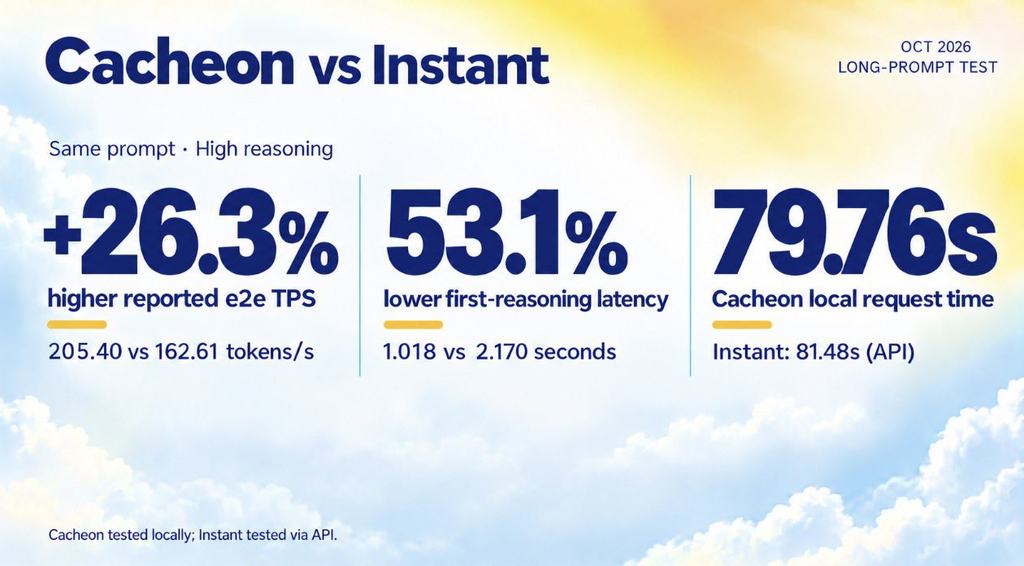
The October 2026 test compared Cacheon’s GLM-5.3 model against Instant’s GLM-5.3-Flash, using the same long prompt under high-reasoning settings.
| Performance metric | Cacheon (SN14) | Instant (SN46) |
|---|---|---|
| End-to-end throughput | 205.40 tokens/s | 162.61 tokens/s |
| First-reasoning latency | 1.018 seconds | 2.170 seconds |
| Total request time | 79.76 seconds | 81.48 seconds |
| AI model | GLM-5.3 | GLM-5.3-Flash |
| Hardware | 4× NVIDIA B300 | 2× NVIDIA B300 |
| Testing method | Local | API |
1. Throughput: Cacheon leads by 26.3%. Throughput measures how many tokens an AI system processes each second. Cacheon recorded 205.40 tokens per second compared with Instant’s 162.61, meaning it delivered more output per second during the test.
2. First-reasoning latency: Cacheon leads by 53.1%. This measures how quickly the AI begins producing its reasoning after receiving a request. Cacheon took 1.018 seconds, while Instant took 2.170 seconds. Lower latency means users spend less time waiting for the AI to begin responding.
3. Total response time: Cacheon finishes 1.72 seconds earlier. Cacheon completed the request in 79.76 seconds, compared with Instant’s 81.48 seconds. The difference was relatively small, with both systems completing the task in around 80 seconds.
However, this was not a direct comparison under identical conditions. Cacheon used a larger model, twice as many GPUs, and local testing, while Instant used a different model and was measured through its API. These differences mean the results cannot establish which subnet is generally faster or more efficient.
Why This Competition Matters for AI
What makes this comparison interesting is that both subnets are approaching the same challenge in different ways. Cacheon is finding ways to extract more performance from existing AI models, while Instant is building infrastructure to deliver faster inference through a decentralized network.
As AI models become increasingly powerful, making them faster, cheaper, and more accessible is just as important as improving their intelligence. Competition between projects like Cacheon and Instant encourages continuous innovation, helping advance the infrastructure needed to bring powerful AI to more people.
Enjoyed this article? Join our newsletter
Get the latest TAO & Bittensor news straight to your inbox.
We respect your privacy. Unsubscribe anytime.
Enjoyed this article?
Join our newsletter
Get the latest TAO & Bittensor news straight to your inbox — every morning before markets open.


No comments yet — be the first.