


A new kind of artificial intelligence is finding its way into Bittensor, and it could change how AI systems make decisions. Called Jev, the model is designed to make fast, inexpensive decisions without generating text like ChatGPT. Already, projects across Bittensor are exploring how to use it for robotics, AI memory compression, and specialized decision-making.
Jev was introduced on September 15, 2026, by TypeSafe AI, a company founded by former OpenAI researcher Diogo Almeida, who contributed to the research behind ChatGPT. TypeSafe describes Jev as the first System One model, a new category of AI built to make decisions that software can act on immediately.
What Makes Jev Different From Other AI Models?
Most AI models people interact with today are generative. They produce answers, write content, generate code, or explain information. Jev does something different. It examines information and makes specific decisions based on options provided to it, without producing lengthy responses.
Think of Jev as an AI that answers multiple-choice questions instead of writing essays. Imagine showing an AI a picture of an apple and asking whether it is ripe, unripe, or rotten. ChatGPT might describe the apple and explain its answer, but Jev simply picks one of the options and tells you how confident it is. Now imagine doing this thousands of times for different questions, from deciding which customer needs help to choosing a robot’s next movement. That’s what Jev is built for: making quick, specific decisions without wasting time generating long explanations.
For example, a company could give Jev a customer complaint and ask whether it should go to billing, technical support, or sales. Jev would select the most appropriate department and provide probabilities indicating how confident it is in the available choices.
Its decisions generally fall into three categories: choosing between available options, assigning scores, and estimating the probability that something is true. These results come in a structured format that applications can use directly, without having to interpret a written response.
According to TypeSafe AI’s launch announcement, Jev typically responds within 70–500 milliseconds and costs $0.042 per million input tokens, with no additional output-token charge. This makes it particularly attractive for applications that need to make thousands or millions of small decisions quickly.
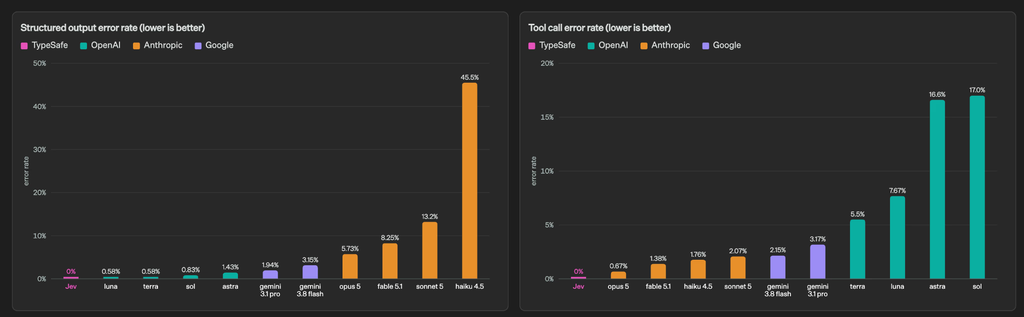
Importantly, Jev is not designed to replace generative AI. Instead, the two can work together, with generative models handling complex tasks and Jev making the smaller decisions that keep applications running efficiently.
Why Jev Matters for Bittensor
Bittensor is a decentralized network designed to make the development of artificial intelligence more open and competitive. Instead of relying entirely on a handful of large technology companies, it allows independent participants to contribute models, computing resources, and other AI services through specialized networks called subnets.
Each subnet focuses on a particular problem, while contributors compete to produce useful results and earn rewards through Bittensor’s incentive system.
Jev’s arrival is particularly interesting because its emphasis on speed, efficiency, and specialized intelligence aligns with what many Bittensor subnets are trying to achieve. Instead of building increasingly large models for every task, subnet participants can explore smaller, specialized systems that solve particular problems more efficiently.
Three examples are already showing how this could work.
How Bittensor Subnets Are Using Jev

Zils is exploring custom decision models. Zils.ai is developing a platform that allows users to train specialized AI models using examples of decisions they have already made. It allows businesses to train models specifically to classify customer requests, identify problems, or determine the next action in a workflow.
In a reported experiment involving 500 customer-support conversations, a Zils-trained model achieved 79.2% accuracy in selecting the next action, compared with 70.6% for Jev 1.13.0. Although this comparison has not been independently verified, it illustrates the potential advantage of training decision models for specific tasks without relying on one general-purpose model.
SOMA (SN114) is bringing Jev into AI context compression. SOMA focuses on reducing the amount of information AI agents need to process without compromising their ability to complete tasks. This matters because agents often carry large amounts of conversation history and other information, increasing operating costs.
In an announcement, SOMA confirmed that Jev was available to its miners. This gives participants another tool for making intelligent compression decisions, potentially helping them determine which information is worth preserving and which can be removed to reduce costs.
OpenRoboto (SN80) has tested Jev in robotic control. In a physics simulation, OpenRoboto compared Jev with GPT-6 Astra and GPT-4.1 mini while controlling a virtual robotic arm tasked with picking up an apple and placing it on a plate.
Jev completed the task in approximately 182 seconds, compared with 707 seconds for GPT-6 Astra, while GPT-4.1 mini failed to complete it within the permitted cycles. Jev also incurred roughly 1/315th of Astra’s API cost.
This experiment demonstrated how fast decision-making could improve the efficiency of robotic systems that require repeated actions.
What This Means for Bittensor’s Future
These developments suggest that Bittensor could become an important environment for experimenting with decision-focused AI. Through its competitive subnet structure, developers can explore different ways to train, improve, and apply models like Jev across practical use cases.
There are still limitations to consider. Jev’s structured outputs do not guarantee correct decisions, and performance in controlled experiments may not translate directly into every real-world application. Its underlying model also remains proprietary to TypeSafe AI.
Nevertheless, the opportunities are becoming clearer. From robots making faster movements to AI agents managing information more efficiently, Bittensor participants are beginning to explore an increasingly important part of AI: making the right decisions at the right speed and cost.
According to Mark Jeffrey, the Jevolution may only be getting started.
Enjoyed this article? Join our newsletter
Get the latest TAO & Bittensor news straight to your inbox.
We respect your privacy. Unsubscribe anytime.
Enjoyed this article?
Join our newsletter
Get the latest TAO & Bittensor news straight to your inbox — every morning before markets open.



No comments yet — be the first.