


The debate around AI regulation focuses on safety, innovation, and the risks posed by increasingly capable models. But a question that deserves attention is who benefits when compliance becomes expensive.
The odds of an AI safety bill passing in the United States before 2027 currently sit around 21%. Whatever happens next, companies will respond to new rules according to their incentives.

That makes game theory useful. Large AI companies, lobbyists, regulators, and politicians do not need a grand plan to produce concentrated power when their incentives already reward actions that reinforce it.
When Regulation Becomes a Competitive Advantage
For an established AI company, regulation can become more than a compliance burden to being a competitive moat. New requirements can bring higher costs for audits, reporting, safety infrastructure, licensing, specialized personnel, and computing resources.
Large companies may be able to absorb those expenses while smaller competitors struggle to keep up. The incentives can therefore line up quickly:
1. Large companies gain protection from new competition.
2. Lobbyists gain revenue from influencing policy.
3. Politicians gain political and financial support.
4. Regulators gain greater authority over a growing industry.
Nobody needs to act corruptly for the outcome to become concentrated power. Individual decisions can produce the same result.
The Lobbying Flywheel
Once regulation begins protecting incumbents, the incentives can reinforce one another. Higher barriers make competition more expensive, while reduced competition protects incumbent revenue. More revenue creates greater resources for lobbying, which can help shape additional rules.
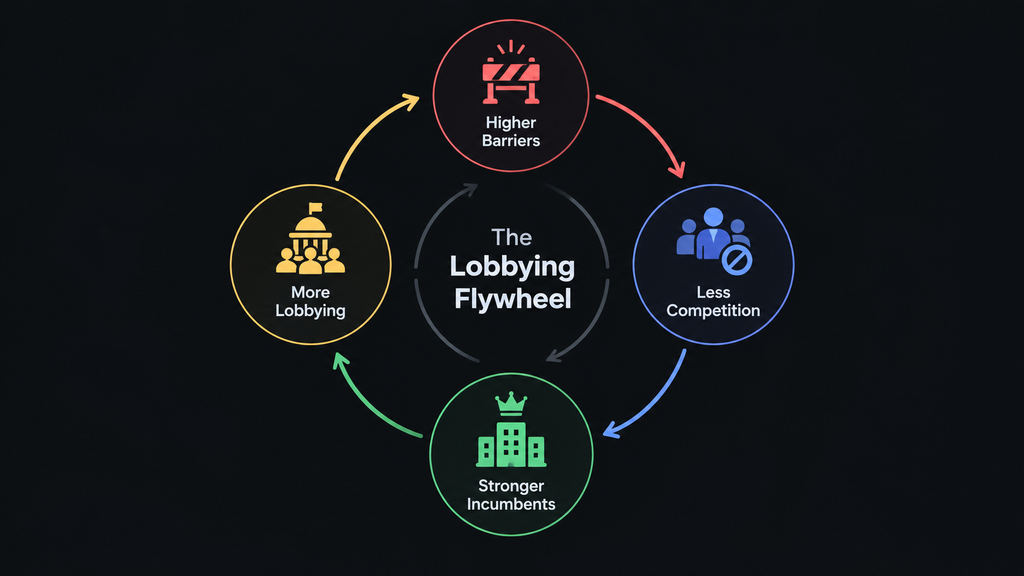
That creates a flywheel where higher barriers lead to less competition, then to stronger incumbents, more lobbying, and finally, back to higher barriers.
The pattern becomes especially powerful in AI because the underlying industry already rewards scale through access to capital, computing infrastructure, data, and specialized talent.
The question is therefore not simply whether regulation is good or bad. It is who can afford to comply with it.
Bittensor Starts With a Different Assumption
Bittensor approaches coordination from almost the opposite direction. A subnet does not assume that every participant will behave altruistically. Miners want rewards, validators want influence and returns, stakers seek attractive opportunities, and subnet owners want emissions and adoption.
Participants are expected to push those incentives as far as they can. A miner might discover a weakness in a scoring mechanism, while a validator might optimize around the reward structure.
Someone may find a way to earn more rewards without producing the outcome the subnet wants. Those behaviors expose weaknesses in the mechanism. The response to them is always ‘iteration,’ and not supposed to be ‘shame.’
Incentives Become the Feedback Loop
This creates a different kind of flywheel. Participants compete for rewards, their behavior reveals weaknesses, and mechanisms are adjusted. Those mechanisms change participant behavior, creating new conditions for participants to test.
The system evolves under pressure from the same actors trying to maximize their own returns.
That is important because decentralized networks cannot depend entirely on one organization deciding how everyone should behave. The mechanism has to withstand participants who are actively looking for advantages. In that sense, self-interest becomes a source of stress testing.
Decentralization Changes the Game
A centralized AI platform can ultimately be influenced through its owners, executives, regulators, or other concentrated points of control. A decentralized network attempts to distribute those points of control across participants and mechanisms.
That does not make Bittensor immune to capture or flawed incentives. Decentralization does not eliminate human self-interest. It changes where that self-interest operates.
Instead of assuming participants will behave perfectly, Bittensor attempts to create an environment where competitive behavior helps expose weaknesses and improve the network.
The Bigger AI Question
AI regulation will remain a major issue as governments confront increasingly capable models. The question is whether new rules improve safety or simply make competition more expensive.
That is where Bittensor offers a different path. Its incentive-driven architecture lets participants compete, expose weaknesses, and improve the system without relying on a central gatekeeper.
The lobbying flywheel concentrates power. Bittensor is testing whether competition can distribute it.
➛ Read More on the US Confronting Anthropic’s Models:
Enjoyed this article? Join our newsletter
Get the latest TAO & Bittensor news straight to your inbox.
We respect your privacy. Unsubscribe anytime.
Enjoyed this article?
Join our newsletter
Get the latest TAO & Bittensor news straight to your inbox — every morning before markets open.



No comments yet — be the first.