

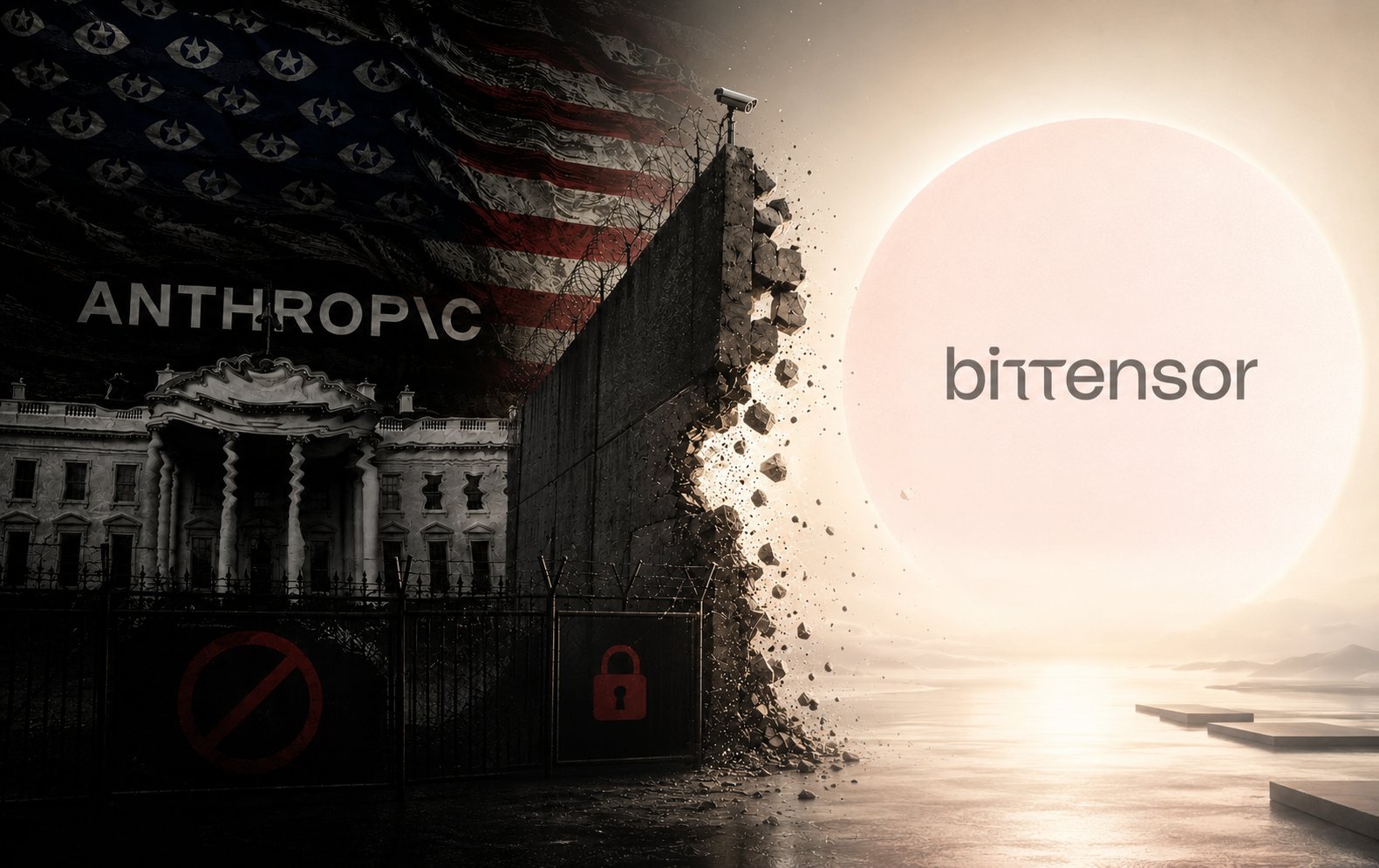
A government cut access to the two most capable AI models on the planet in one evening. It needed a letter and a deadline. No vote or warning to the hundreds of millions of people who woke up the next day locked out.
For everyone who has ever argued that AI should not sit behind one company’s control, the US government’s move made that argument relevant, and the crypto market read it that way within hours.
What happened
The US government issued an export control directive ordering Anthropic to suspend all access to Claude Fable 5 and Claude Mythos 5 for any foreign national inside or outside the United States, including Anthropic’s own foreign-national employees.
Anthropic received the order at 5:21pm ET Friday and said the only way to comply was to abruptly disable Fable 5 and Mythos 5 for all customers. Every other Claude model, including Opus 4.8, stayed live.
The stated reason was national security. The government believes it has become aware of a method of bypassing, or “jailbreaking” Fable 5. The company pushed back in the same statement, saying it reviewed a demonstration of the technique and found it surfaced only a few previously known, minor vulnerabilities that other publicly available models can find too.
Anthropic complied while disagreeing that a narrow jailbreak justifies recalling a model deployed to hundreds of millions of users, warning that the same standard applied industry-wide would essentially halt all new model deployments for all frontier model providers.
The Commerce Department issued the order. The Pentagon backed it with CIO Kirsten Davies posted that the Defense Department was prioritizing national security and the security of our warfighters.
Anthropic also noted it believes the same jailbreak could pull comparable capabilities from other public models like OpenAI’s GPT-5.5, which face no equivalent export control.
Not everyone in the policy world saw discipline. Dean Ball, an AI policy expert who briefly served in the Trump administration, called the move cartoonish and questioned the logic of an administration willing to export advanced chips to China while barring every non-American on earth from its best models.
Why TAO moved
Popular Bittensor accounts on X did not wait for the dust to settle. TAO.com, posted as the news broke: “If AI is going to run the economy, you cannot have it gated behind one API, one vendor, one jurisdiction, or one policy mood.”
A centralized model, however powerful, has a single point of failure that a network of subnets does not. One directive, one compliance decision, and the most capable AI on the market goes dark for an entire class of users.
Bittensor’s architecture, where no single company or jurisdiction controls access, cannot be switched off by a letter the same way a corporate API can.
The market priced it fast. TAO was trading around $210–215 when the news broke and then went up roughly 25% on the day, changing hands in the $250–275 range across major exchanges. Trading volume spiked into the move.
The levels
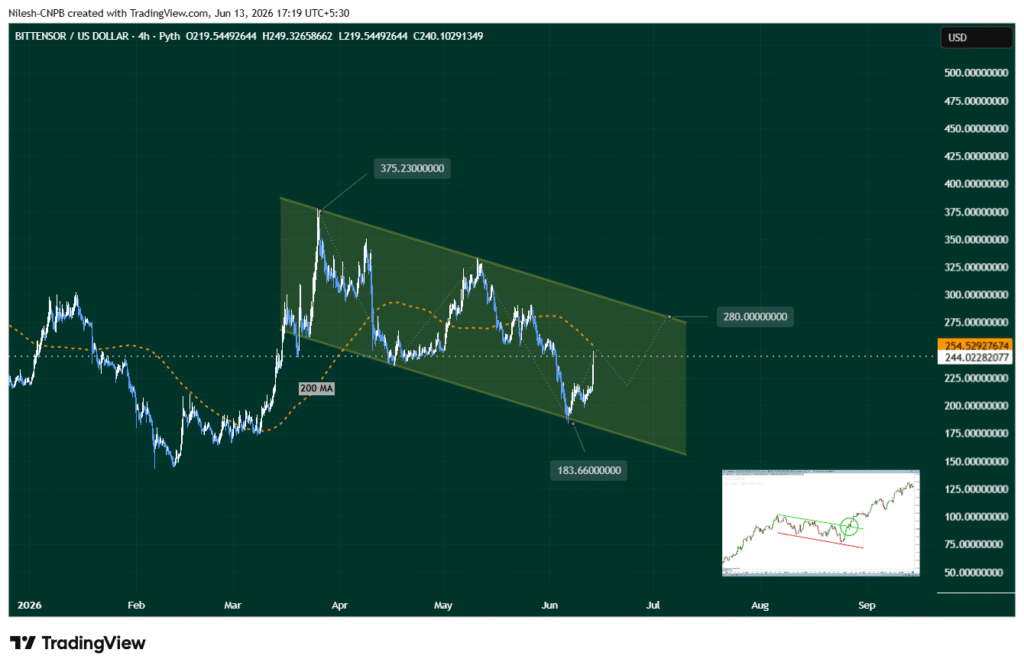
On the 4-hour chart, TAO has spent weeks inside a descending channel, two parallel downward-sloping trendlines containing an extended correction. The bounce came off the channel floor near $184, the most critical support in the current structure, where buyers defended aggressively.
The immediate test is the 200-hour moving average at $254.52, sitting right at current price. A clean, sustained reclaim there is the first real signal that the bounce is becoming a reversal rather than a relief rally. Above that, the channel’s upper boundary near $280 is the next target; a break above it would invalidate the descending channel entirely.
Failure to hold the 200-hour MA points back toward $219 support, and a break below $219 says the bounce has run out of fuel and the channel is reasserting itself.
Where we’re headed
Strip out the chart, and the story still resonates, because the Anthropic incident was a precedent. This is one of the first times export controls have been applied directly to AI model access, treating a frontier model like a dual-use technology, the way Washington already treats advanced semiconductors and encryption.
For decentralized AI, that is the clearest real-world validation the sector has gotten. The argument was always that decentralized AI matters because centralized AI can be restricted. That stopped being a whiteboard hypothetical, and the world is increasingly looking towards Bittensor as a viable alternative.
Cover image source: DreadBongo
Enjoyed this article? Join our newsletter
Get the latest TAO & Bittensor news straight to your inbox.
We respect your privacy. Unsubscribe anytime.
Enjoyed this article?
Join our newsletter
Get the latest TAO & Bittensor news straight to your inbox — every morning before markets open.

No comments yet — be the first.