


SimpleSwap is now live on Bittensor.ai, empowering users to swap from 2,800+ cryptocurrencies directly into TAO without going through a centralized exchange.
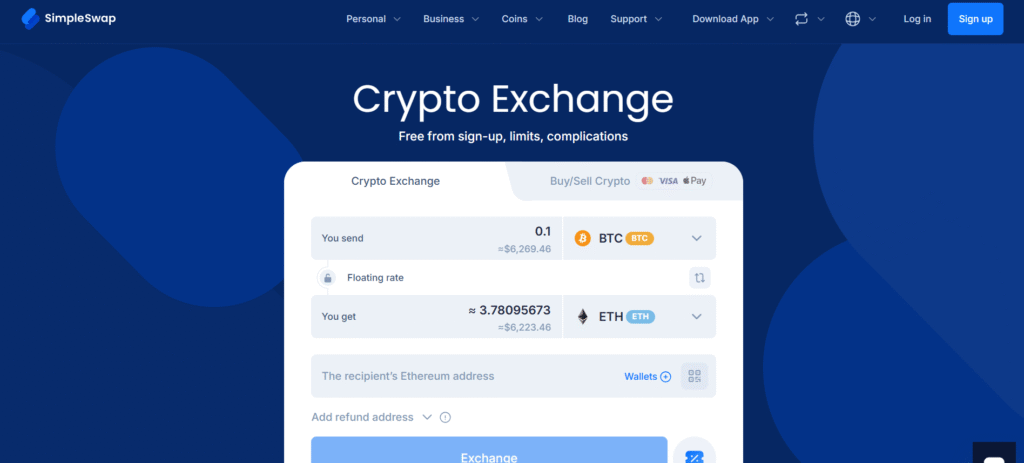
$TAO arrives in the user’s self-custody wallet in a single transaction, ready to stake into any subnet on arrival. For a network where subnet positioning is increasingly time-sensitive, removing the exchange step matters more than it looks.
The Bottleneck Was Never Technical
The technical barrier to Bittensor has been low for a long time. The subnet interface is accessible, staking is documented, and the community is active. What stood between holding capital in one asset and being able to stake it into a subnet was operational.
The old path looked like this:
1. Open an account on a centralized exchange.
2. Complete KYC verification.
3. Deposit funds.
4. Execute the trade.
5. Wait for withdrawal processing.
6. Receive $TAO in a self-custody wallet.
For someone already holding $ETH, $USDC, or any other asset in their own wallet, that path added hours of friction with no technical justification.
What the Integration Does
The new flow collapses the entire path into one transaction:
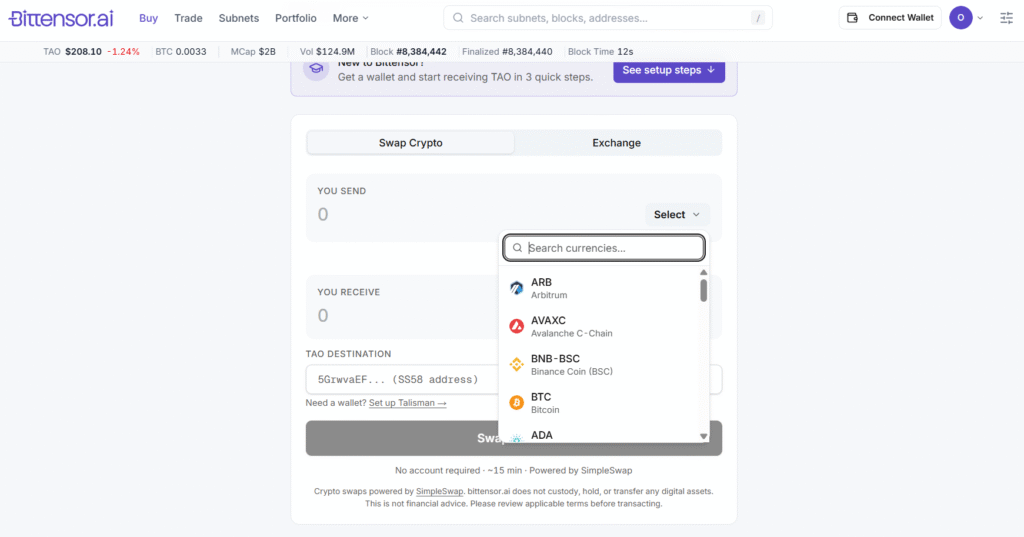
a. Visit Bittensor.AI, pick the source asset and input transaction volume. Any of 2,800+ supported cryptocurrencies.
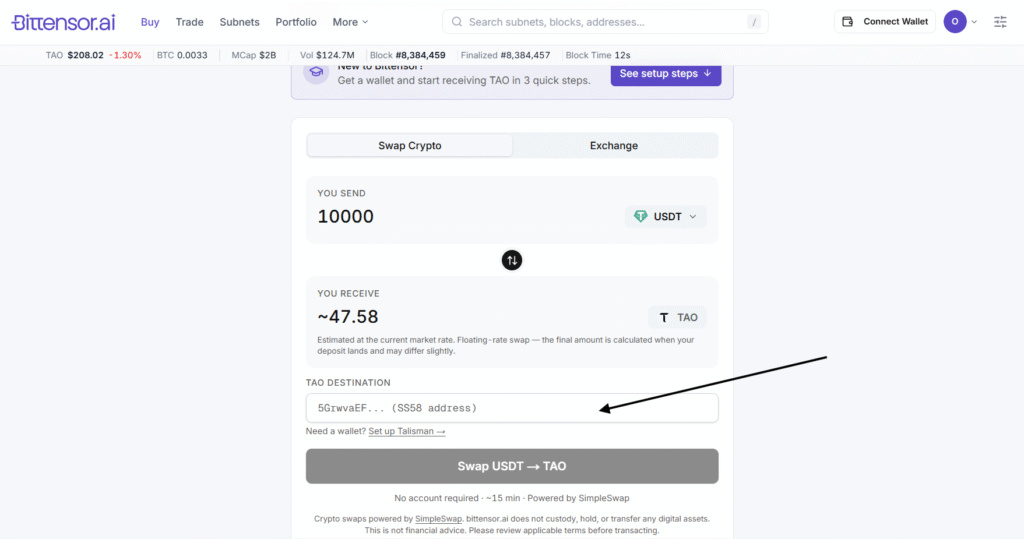
b. Enter the destination $TAO wallet address. Self-custody, not an exchange.
c. Send the deposit. Single transaction.
d. $TAO arrives in the wallet. Ready to stake into any subnet immediately.
The Routing Layer Behind It
SimpleSwap does not run its own order book as each swap is routed across a provider network rather than executed against a single venue:
a. 20+ CEX and DEX providers sit behind the integration.
b. The platform scans available liquidity the moment a user initiates a swap.
c. It routes through the best price for that specific pair at that moment.
d. Aggregated liquidity reduces slippage on larger swaps compared to routing through any single provider.
The routing engine handles execution, and the user only sees the final $TAO delivered to their wallet. Thus, users do not pick a venue or compare prices manually.
Why This Maps Onto Bittensor Specifically
This is the part of the integration that aligns with how Bittensor actually works:
a. $TAO on a centralized exchange cannot stake into all 128 subnets. Only $TAO in a self-custody wallet can participate in the network.
b. Every swap delivers $TAO directly to the wallet address the user provides. No platform balance to top up. No withdrawal step afterward.
c. The relationship ends when the swap completes; No ongoing custody, no holding account, and no intermediate balance to manage.
For a network where staking is the unit of activity, that direct-to-wallet design is what makes the integration usable. A swap product that delivers $TAO into a custodial balance would not solve the actual problem.
Three Groups That Benefit Most
The integration creates clean wins for three categories of Bittensor users:
a. Traders timing subnet launches. Early participants in new subnets capture better emission rates. The window can be hours. Direct wallet-to-wallet swaps decide who hits the window and who misses it.
b. Long-term $TAO holders managing positions. Capital can move between assets without routing through an exchange. The aggregated liquidity model handles larger swaps with less price impact than a single venue would offer.
c. Self-custody-native participants. AI researchers, developers, and users who never opened a CEX account now have a path into $TAO that matches how they already operate. For this group, the previous path was not just inconvenient but genuinely unavailable.
Enjoyed this article? Join our newsletter
Get the latest TAO & Bittensor news straight to your inbox.
We respect your privacy. Unsubscribe anytime.
Enjoyed this article?
Join our newsletter
Get the latest TAO & Bittensor news straight to your inbox — every morning before markets open.


No comments yet — be the first.