


Beam (SN105) completed the first decentralized subnet-to-subnet data transfer, moving 107GB from Cloudflare R2 to Hippius (SN75) in about 6 minutes.
The team also unveiled Beam Tunnels, a new feature for connecting private enterprise infrastructure to the Beam network. It allows organizations to expose on-prem systems, private data lakes, and internal warehouses securely.
Together, the updates strengthen Beam’s role as the programmable bandwidth layer connecting Bittensor subnets, storage, AI workloads, and enterprises.
The Subnet-to-Subnet Transfer
The 107GB transfer between R2 and Hippius through Beam is a working proof that decentralized storage networks can talk to centralized cloud storage in production.
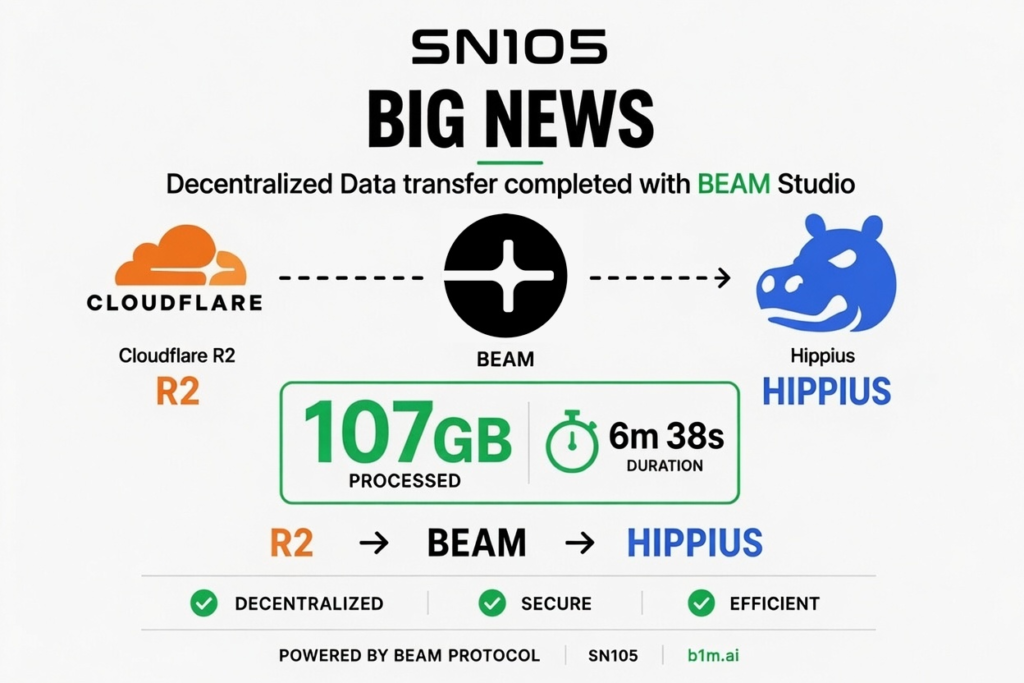
1. Route: Cloudflare R2 to Beam to Hippius (SN75).
2. Volume: 107GB in one orchestrated transfer.
3. Time: Approximately 6 minutes.
4. Baseline: R2 to R2 at the same volume averages around 30 seconds, so significant optimization runway remains.
6. Collaboration: Beam and Hippius continue working together on performance improvements.
The key milestone is that a decentralized storage subnet can now serve as a practical destination for enterprise data movement.
Beam Tunnels: Ngrok for Bittensor
Many organizations store their data on-premises, in private data lakes, or within internal data warehouses instead of public cloud storage. Beam Tunnels extend Beam’s reach to those environments, enabling them to connect directly to the decentralized network.
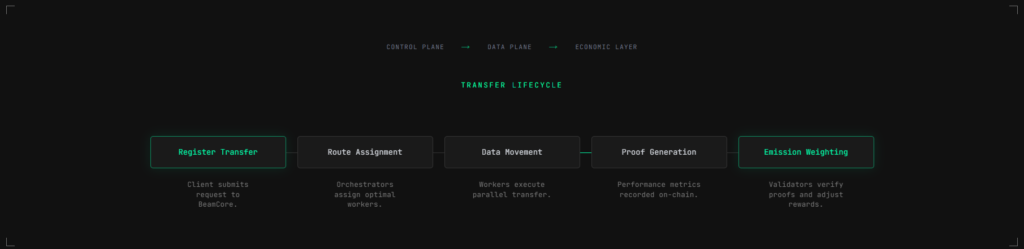
1. Built into Beam Studio: No separate tooling to install.
2. Ngrok-style secure exposure: Private infrastructure becomes accessible through a controlled tunnel.
3. Programmable: Transfers can be scripted, automated, and integrated into workflows.
4. Any source, any destination: On-prem, R2, Hippius, S3, or anywhere else Beam supports.
Beam wants to be the destination-agnostic transfer layer between wherever an organization stores data and wherever they want to send it, regardless of whether either end is decentralized.
Where This Points
The subnet-to-subnet transfer demonstrates real interoperability across the Bittensor storage ecosystem, moving beyond single-provider benchmarks.
Beam Tunnels extends that capability by connecting private enterprise infrastructure to the decentralized network. Together, these developments position Beam as the programmable bandwidth layer linking subnets, storage providers, AI workloads, and enterprises.
Beam continues to strengthen its infrastructure with each new release, expanding its role across the Bittensor ecosystem.
Enjoyed this article? Join our newsletter
Get the latest TAO & Bittensor news straight to your inbox.
We respect your privacy. Unsubscribe anytime.
Enjoyed this article?
Join our newsletter
Get the latest TAO & Bittensor news straight to your inbox — every morning before markets open.



Be the first to comment