


OpenRoboto may have entered Bittensor only recently, but its first month has already produced a result that changed the subnet’s roadmap.
In a live conversation with Shizzy, OpenRoboto co-founder Cameron said miners have taken the subnet’s starting π0.5 model from roughly 50% to 86.9% success on the LIBERO-Pro benchmark in about one month. The team had initially estimated that reaching this level could take three to five months.
That acceleration has created an unusual problem: the benchmark is becoming too easy.
Cameron said the team is now developing its own benchmark with changing tasks to make overfitting harder and create more headroom for continued improvement.
More importantly, OpenRoboto plans to introduce physical robots into validation, moving beyond simulation to test whether a miner’s improvements can transfer to hardware.
This is significant because the sim-to-real gap remains a major obstacle in robotics. Simulators mostly simplify physical reality, and research has shown they can perform substantially worse when transferred to real hardware.
In one study, controllers that ranked highly in simulation experienced a 57% drop in performance on physical robots, illustrating why simulation scores alone are not enough to establish real-world capability.
The subnet is also building out the data side of this loop. OpenRoboto recently partnered with Axis Robotics, which is supplying more than 3 million multimodal robotics trajectories to its Open Data Pool and supporting its benchmarking infrastructure.
There is an interesting research angle behind that partnership as well. An AXIS research paper reports that continual pretraining on its data improved π0.5’s overall success rate by 5.8%, with particularly strong gains under layout, sensor-noise, and camera perturbations.
Cameron also revealed that OpenRoboto is thinking beyond research benchmarks. When asked what success would look like a year from now, he pointed to two outcomes: materially better robotics foundation models validated on real robots, and commercial relationships with factories and data providers that generate actual revenue.
The takehome from the conversation is therefore not simply that OpenRoboto is training robotics models on Bittensor. Its competitive training loop is improving models quickly enough that the team is having to accelerate the next layer of the system for eventual physical-robot validation.
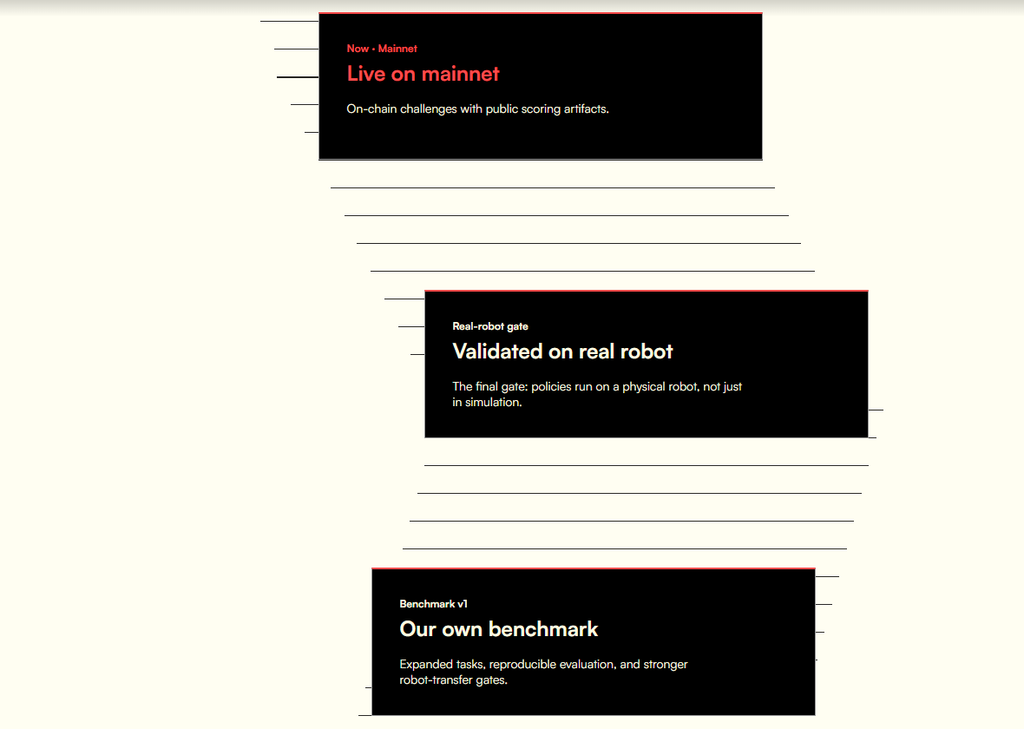
OpenRoboto’s public roadmap now explicitly lists its own benchmark and a real-robot gate as the next stages.
Watch the full conversation on Shizzy Unchained:
Enjoyed this article? Join our newsletter
Get the latest TAO & Bittensor news straight to your inbox.
We respect your privacy. Unsubscribe anytime.
Enjoyed this article?
Join our newsletter
Get the latest TAO & Bittensor news straight to your inbox — every morning before markets open.



No comments yet — be the first.