


Verified compute has become one of the most contested categories on Bittensor, and two subnets are now competing to define what verification actually means. Nodexo (SN106) uses cryptographic proofs of hardware possession combined with a live rental marketplace, while Targon (SN4) uses Intel TDX and secure enclaves to build a confidential computing environment for AI workloads.
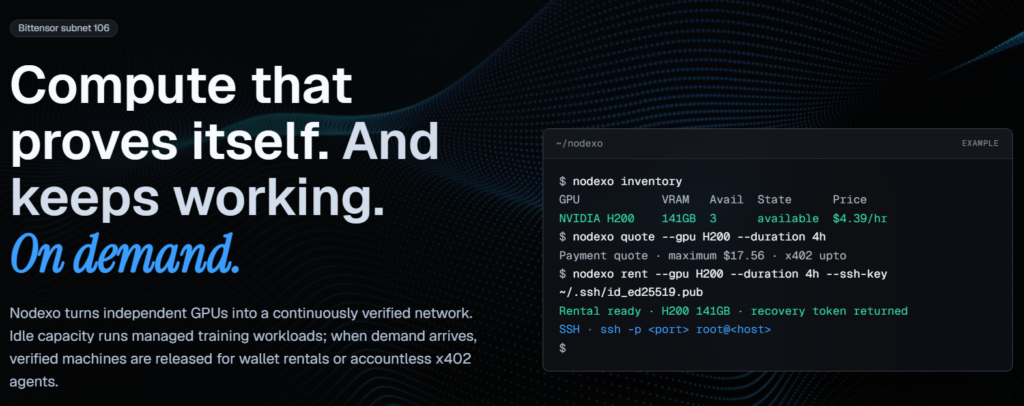
The two have overlapping utility but different security philosophies, market structures, and roadmaps for how compute settles back to $TAO.
Let’s explore each.
The Two Security Models
The core distinction between the subnets is what they choose to prove and how they choose to prove it.
| Nodexo (SN106) | Targon (SN4) | |
| Security approach | Cryptographic proof of hardware possession | Confidential computing via secure enclaves |
| Verification method | Timed challenges + SHA-256 hardware fingerprints | Intel TDX (Trusted Domain Extensions) |
| Hardware layer | Any GPU that passes proof | Intel TDX-compatible + Protected PCIe |
| Validator requirement | CPU-only validators can verify | Specialized hardware for TDX attestation |
| Orchestration | Open architecture | Closed-source orchestration |
Nodexo proves the machine is real and what it claims to be through timed challenges only the claimed hardware class can complete, plus persistent SHA-256 fingerprints binding each machine to its physical components. Confidential computing is available where hardware supports it via TDX, SEV, or NVIDIA CC.
Targon isolates AI workloads at the hardware level through Intel TDX for CPU isolation and Protected PCIe for GPU-side security, with attestation rooted in the chip itself and a closed-source orchestration layer running the confidential computing service.
The Two Market Structures
Nodexo (SN106):
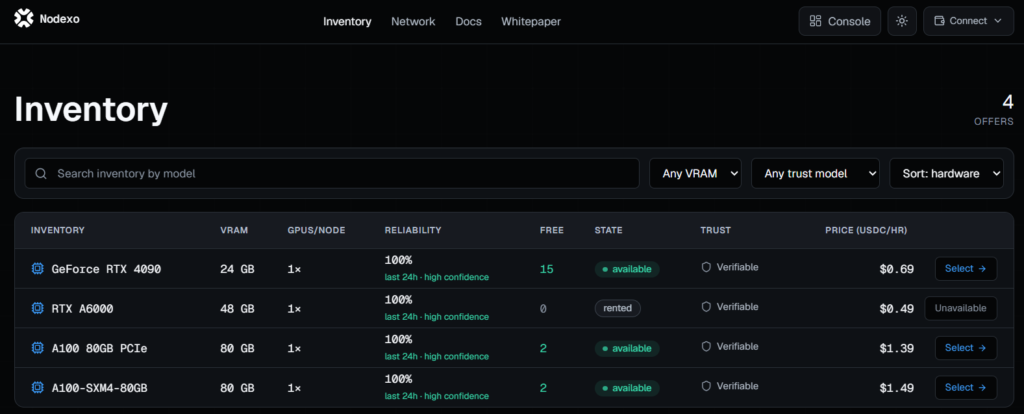
1. Phase 1 (Live): Base compute marketplace with proof of hardware.
2. Phase 2 (Roadmap): Tokenized sub-subnets with their own tokens, creating a market of markets that specialize by model family, GPU class, or region.
3. The value cascade moves from individual sub-tokens, to $SN106, and then, finally, to $TAO.
Targon (SN4):
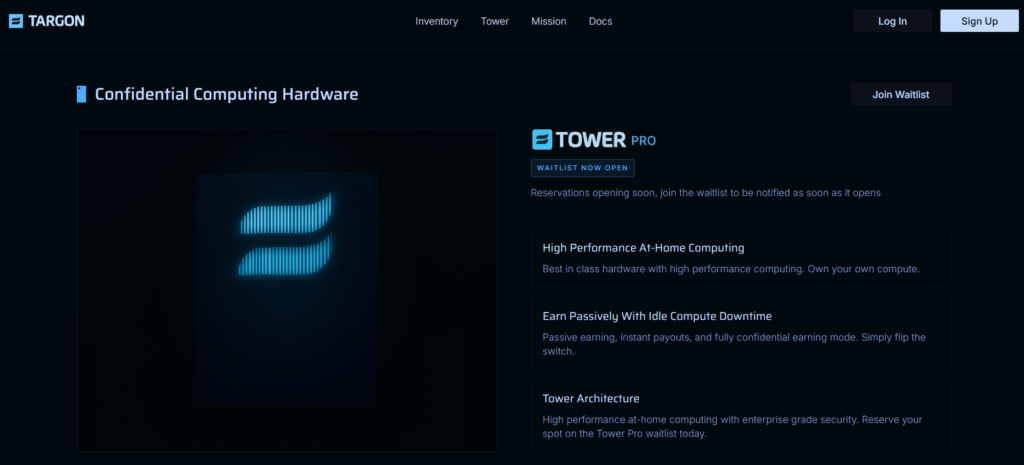
1. Single marketplace with a unified incentive mechanism.
2. $SN4 with value driven by demand for confidential computing.
3. Primary focus on confidential computing services rather than a broader compute layer.
The rental engine runs rentals-first with training as fallback, so idle GPUs run managed training and get instantly released to wallet rentals or accountless x402 agents on demand.
That combination is why Nodexo can claim 100% 24-hour reliability with no empty market.
The Competition Bittensor Was Designed For
Bittensor now has two credible answers to verified compute rather than one.
Nodexo’s cryptographic proofs and open architecture make it easier for anyone to verify and easier for the market to expand into sub-subnets.
Targon’s Intel TDX delivers hardware-level isolation that regulated workloads may specifically require. Different customer segments will land on different answers depending on what they need to prove and to whom.
Two subnets competing to define verified compute is one of the healthier signals the ecosystem has produced.
Enjoyed this article? Join our newsletter
Get the latest TAO & Bittensor news straight to your inbox.
We respect your privacy. Unsubscribe anytime.
Enjoyed this article?
Join our newsletter
Get the latest TAO & Bittensor news straight to your inbox — every morning before markets open.



No comments yet — be the first.