

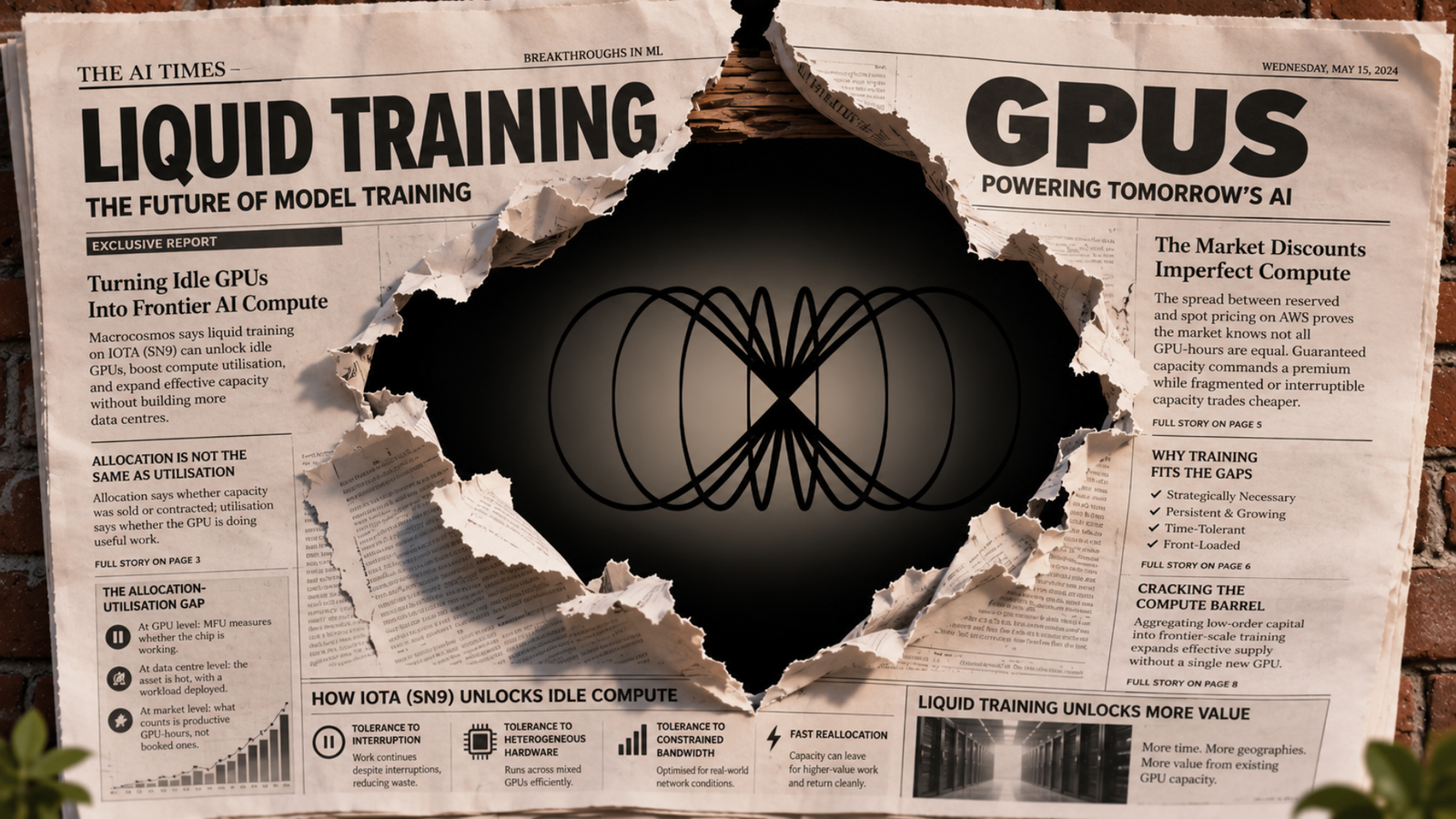
The race to pour concrete and pack sheds with GPUs is a modern gold rush, funded by bond markets straining under new private debt and driven by a fear of being second.
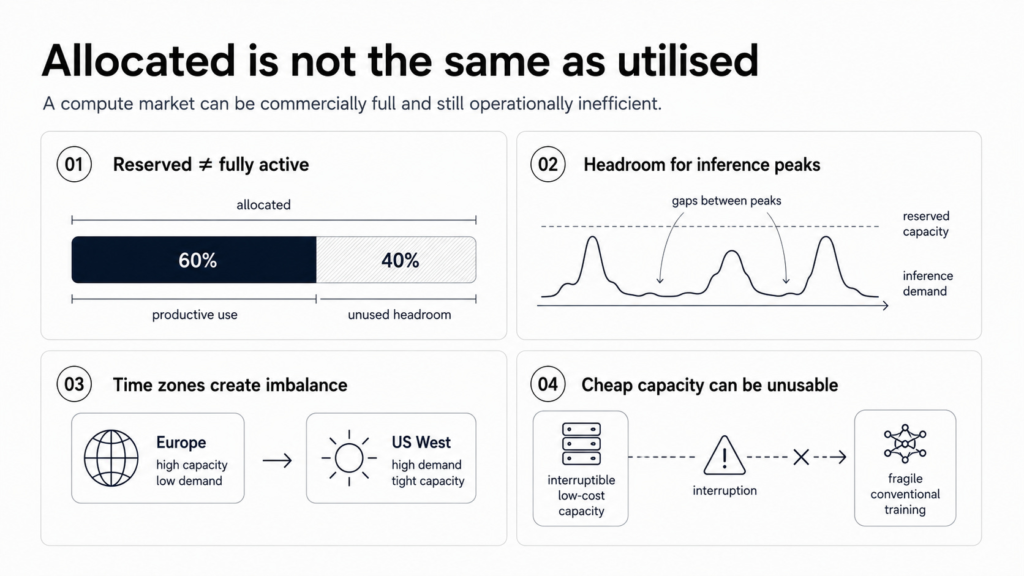
The early bet has paid off, with hockey-stick token utilisation and models scaling faster than anyone forecast. But an uncomfortable arithmetic sits underneath, since even optimised data centres run at 60% to 70% utilisation, with only the best citing figures in the 80s and 90s.
Macrocosmos argues the decisive question is shifting from how much you can build to how much useful work you can extract from what’s installed, and that liquid training on IOTA closes the gap.
Allocation Is Not the Same as Utilisation
That phrase, repeated across conversations with data centre owners and AI labs, sits at the heart of compute economics. Allocation says whether capacity was sold or contracted; utilisation says whether the GPU is doing useful work.
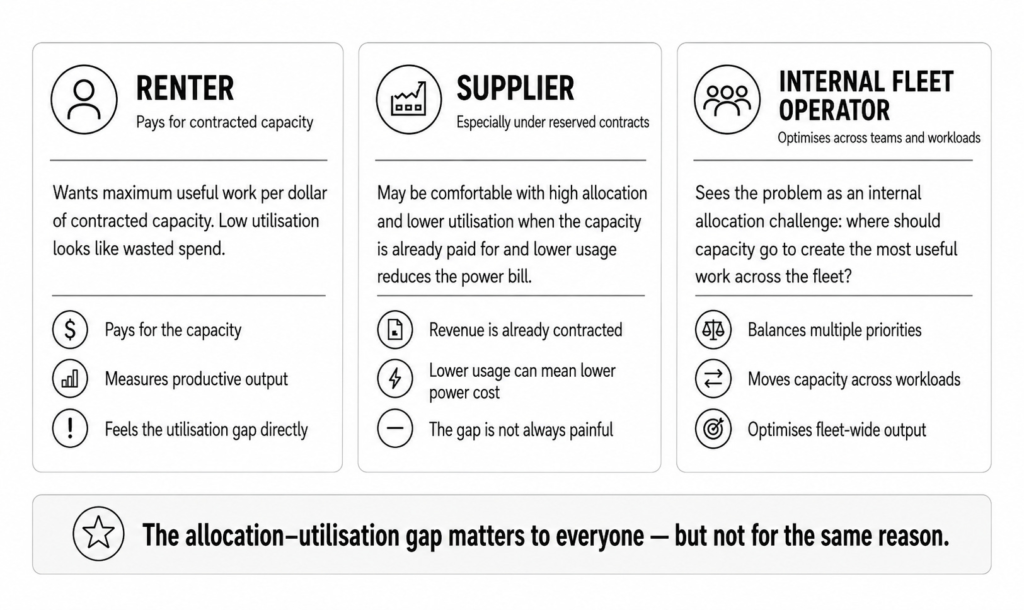
1. At GPU level: MFU (model flop utilisation) measures whether the chip is genuinely working.
2. At data centre level: the asset is hot, with a workload deployed against it.
3. At market level: what counts is productive GPU-hours, not booked ones.
The gap is also unpredictable. Time zones create imbalances, inference is peaky, and regions run oversupplied during local off-hours while constrained during other markets’ working hours, leaving capacity today’s best workloads can’t use.
The Market Already Prices Imperfect Compute
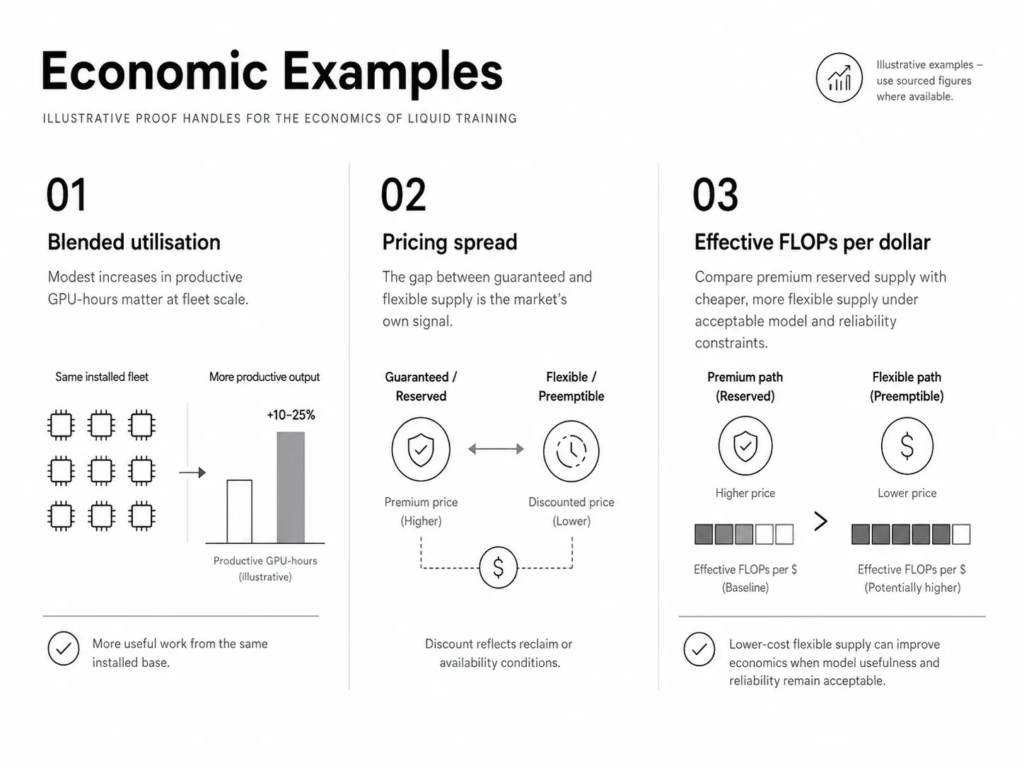
The spread between reserved and spot pricing on AWS proves the market knows not all GPU-hours are equal. Certainty, immediacy, location, hardware generation, reliability, and contract structure all move the price, and guaranteed capacity commands a premium while fragmented or interruptible capacity trades cheaper, precisely because valuable workloads can’t reliably consume it.
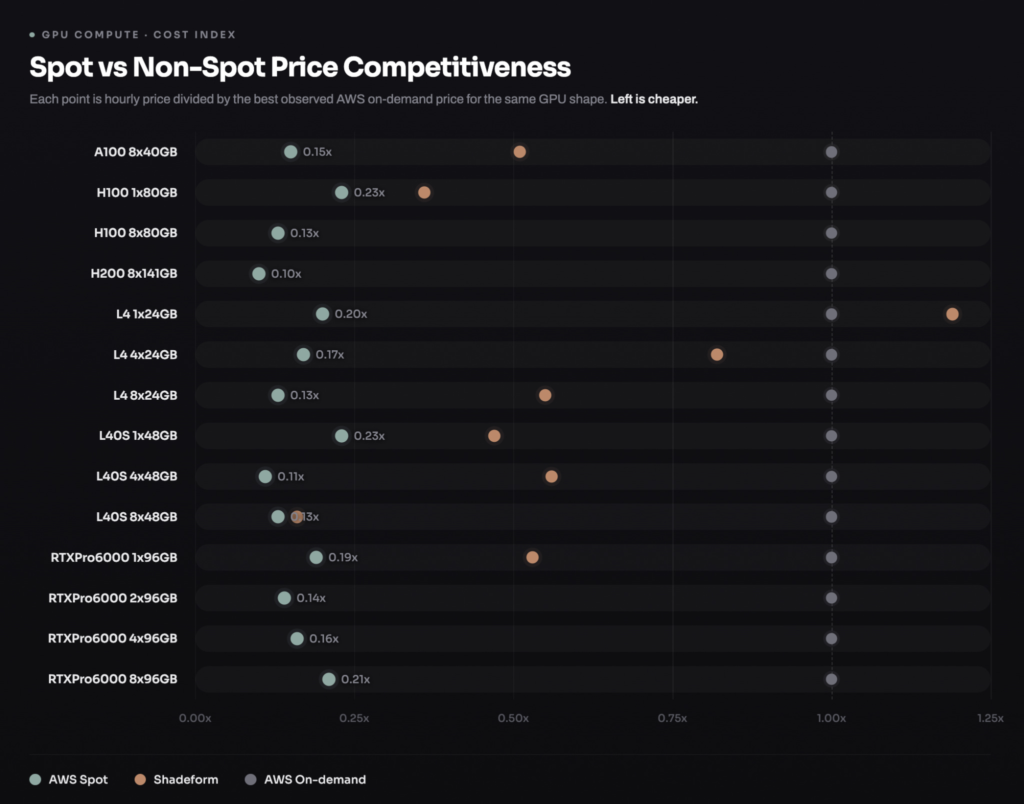
The point isn’t that cheap compute is abundant. It’s that the market discounts imperfect compute and conventional training can’t use enough of it.
Frontier training is a large enough share that making it liquid would lift utilisation for everyone, harvesting the long tail of heterogeneous, off-peak, fractional compute in a squeeze and acting as a floor bid in a glut.
Why Training Fits the Gaps
Training’s properties suit this supply structurally, not incidentally.
1. Strategically Necessary: it creates the models that become inference, applications, agents, and APIs.
2. Persistent: pre-training, fine-tuning, evaluation, and research never run out, with training compute set to grow at double-digit rates into the 2030s.
3. Time-Tolerant: measured in days and months rather than seconds, unlike inference.
4. Front-Loaded: pretraining is getting longer, since stronger base models make downstream work cheaper.
The obstacle is rigidity. Conventional training wants stable availability, homogeneous hardware, and strong networking, so dropped or reallocated nodes surface as delay and wasted work, meaning interruptible compute is only cheap on paper.
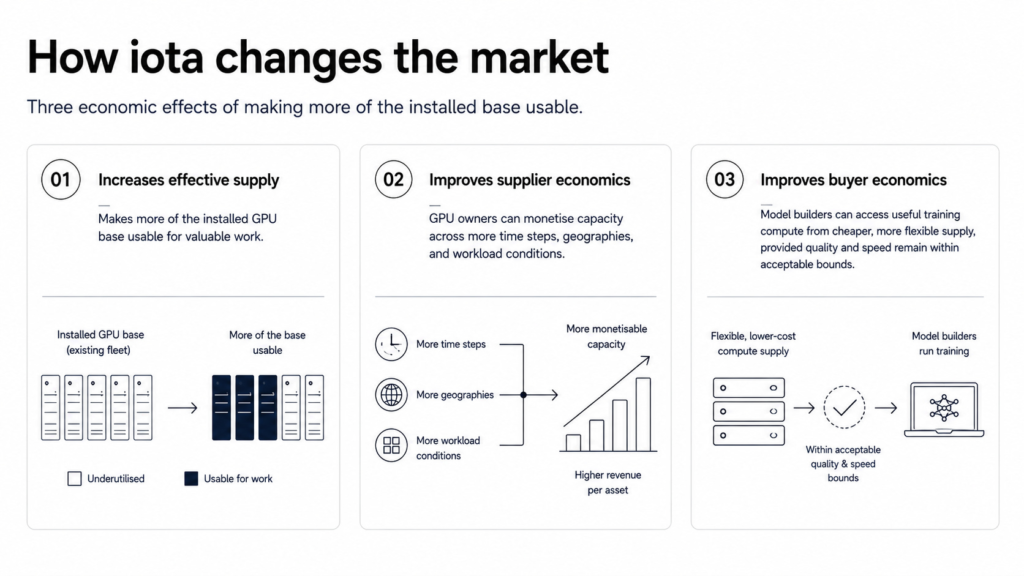
Macrocosmos’ approach to liquid training, IOTA (SN9) reshapes the workload to fit those gaps, which demands four properties:
1. Tolerance to interruption
2. Tolerance to heterogeneous hardware
3. Tolerance to constrained bandwidth
4. Fast reallocation, so capacity can leave for higher-value work and return cleanly
Macrocosmos points to its Orion 100B work as an early read, where preserving meaningful co-located throughput while buying compute at a material discount makes the economics attractive fast.
Cracking the Compute Barrel
The thesis reduces to one claim: aggregating low-order capital into a higher-order commodity, frontier-scale training flops, expands effective supply without manufacturing a single new GPU.
Suppliers monetise across more time steps and geographies, builders gain another route to capacity, and sovereign participants aggregate compute the way hyperscalers aggregate campuses.
The direction isn’t unique to IOTA, since Google’s Kubernetes-native scheduling and aggregators like Shadeform point the same way, toward compute that is liquid, workload-aware, and actively routed. Macrocosmos closes on an oil analogy: as plastics and fuel classes transformed crude, cracking processes are emerging for compute, and the next phase of the race will not only be built but refined.
Enjoyed this article? Join our newsletter
Get the latest TAO & Bittensor news straight to your inbox.
We respect your privacy. Unsubscribe anytime.
Enjoyed this article?
Join our newsletter
Get the latest TAO & Bittensor news straight to your inbox — every morning before markets open.



No comments yet — be the first.