

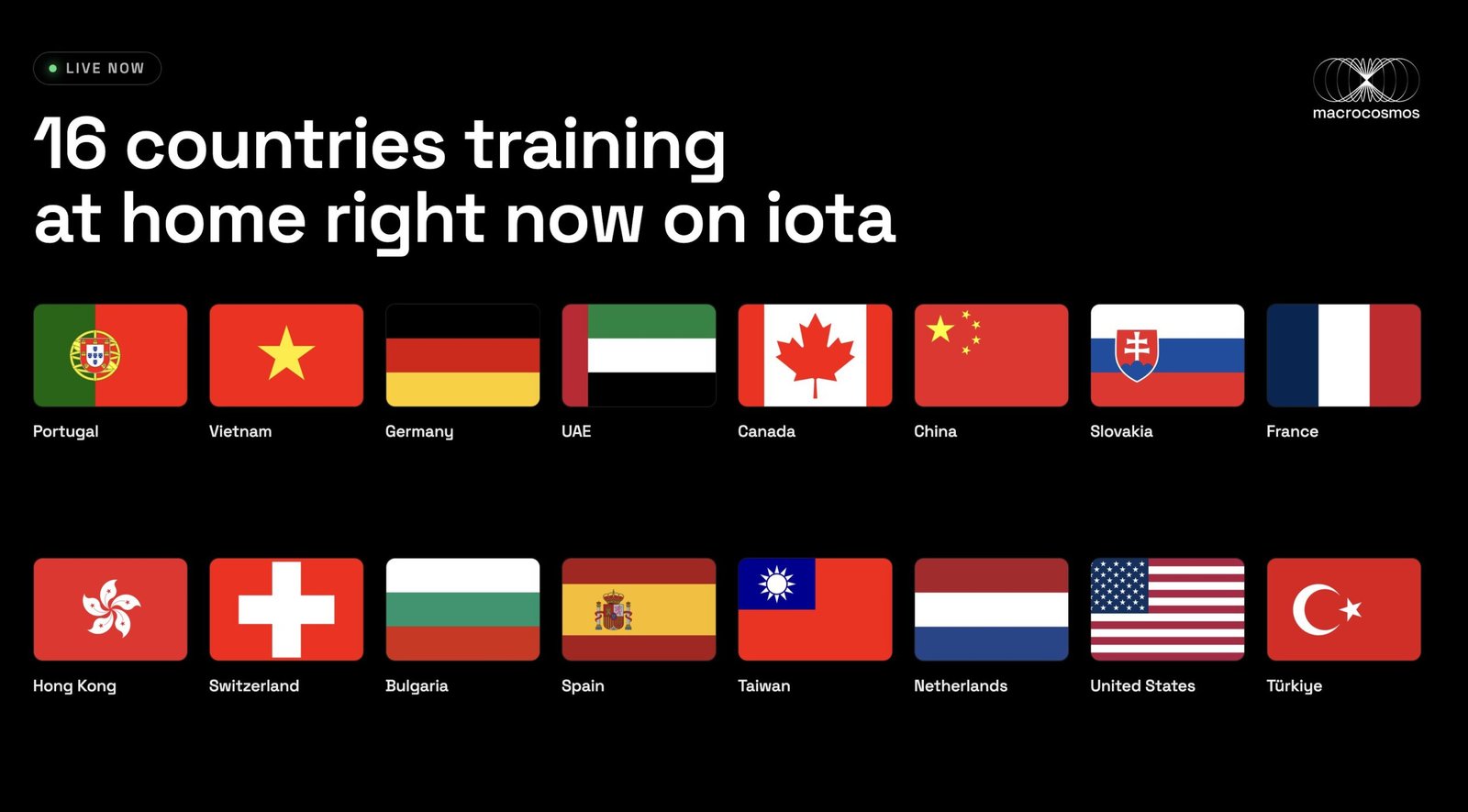
IOTA’s consumer training app is no longer a regional experiment. Contributors across 16 countries and three continents are now feeding compute into the same swarm, according to a dashboard update from the SN9 team. The milestone caps a rollout that started narrow and widened fast.
Train at Home now stands as one of the clearest live demonstrations of permissionless AI pretraining on Bittensor.
What is Train at Home?
Train at Home is the consumer-facing arm of IOTA, the Incentivised Orchestrated Training Architecture running on Subnet 9. Instead of requiring a data center, the system splits a large model into layers and distributes those layers across thousands of ordinary machines. Each participant trains a slice, the network stitches the pieces back together, and rewards flow proportionally based on actual contribution.
The architecture leans on two techniques borrowed from large-scale AI labs:
- Pipeline parallelism — different machines handle different stages of the model, assembly-line style
- Data parallelism — multiple machines process different data batches simultaneously
- Fault tolerance — the system is built to absorb devices going offline or varying wildly in power, since home hardware is inherently unreliable
The Hardware Bar
Train at Home was opened to the public in February 2026 after a waved rollout that began with a live demo in December 2025. Minimum requirements according to Macrocosmos documentation:
- macOS: Apple Silicon, 8GB memory minimum
- Linux: 16GB VRAM and 16GB RAM minimum
- Disk: 10GB free, up to 30GB depending on the model currently in training
- Network: stable connection required; intermittent links stall contribution
- Power: machine must stay plugged in and awake to keep contributing
No machine learning background is required. The orchestrator handles layer assignment and reward calculation, so contributors only need to keep the app running on their machines.
Why the Global Spread Matters
Most decentralized compute projects in crypto have chased inference, not training. Running an already-built model is comparatively cheap to distribute. Training one from scratch, especially at billion-parameter scale, has historically stayed locked behind data-center budgets. IOTA’s pitch is that idle consumer GPUs, aggregated at scale, can chip away at that gap.
Sixteen countries across three continents is a meaningful spread for a beta-phase consumer app. It signals that Train at Home has moved past early adopters and into broader organic pickup.
For TAO holders, wider participation cuts both ways. More active nodes strengthens the network’s decentralization story and its case as a legitimate pretraining alternative to centralized labs. It also means there’s more attention to Bittensor as more folks from all over the world discover the subnet’s product.
Enjoyed this article? Join our newsletter
Get the latest TAO & Bittensor news straight to your inbox.
We respect your privacy. Unsubscribe anytime.
Enjoyed this article?
Join our newsletter
Get the latest TAO & Bittensor news straight to your inbox — every morning before markets open.
[…] 24 September, IOTA (SN9) brought attention back to the June 2026 run, in which Macrocosmos trained a 100-billion-parameter model across five US data centres, using […]
[…] Macrocosmos announced the IOTA SDK at Exploit Summit in Montreal, introducing a simpler way for developers to run existing AI training workloads across IOTA (SN9). […]