


J.P. Morgan Asset Management has published its first long-term return forecast for Bitcoin, projecting 10% annualized returns over the next decade, higher than its expectations for U.S. stocks, bonds, and gold.
The projection appears in the firm’s 2027 Long-Term Capital Market Assumptions report, released in October 2026. It marks the first time Bitcoin has received a formal return forecast in the report’s 31-year history.
Bitcoin’s Projected Returns Compared With Traditional Assets
Under JPMorgan’s base-case scenario, Bitcoin is expected to outperform several major asset classes over the long term.
| Asset | Projected annual return |
|---|---|
| Bitcoin | 10.0% |
| U.S. REITs | 8.2% |
| U.S. small-cap stocks | 7.7% |
| U.S. large-cap stocks | 7.5% |
| U.S. aggregate bonds | 5.6% |
| Gold | 5.5% |
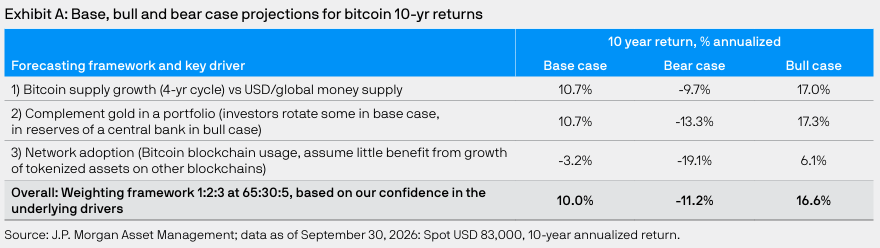
The forecast is based on three factors: Bitcoin’s supply growth relative to global money supply, its potential role alongside gold, and adoption of the Bitcoin network.
JPMorgan’s scenario analysis projects 16.6% annual returns in a bull case and -11.2% in a bear case, demonstrating the considerable uncertainty surrounding Bitcoin’s long-term performance.
High Volatility Remains a Major Concern
Despite its positive base-case forecast, JPMorgan has not included Bitcoin in its main portfolio allocation models.
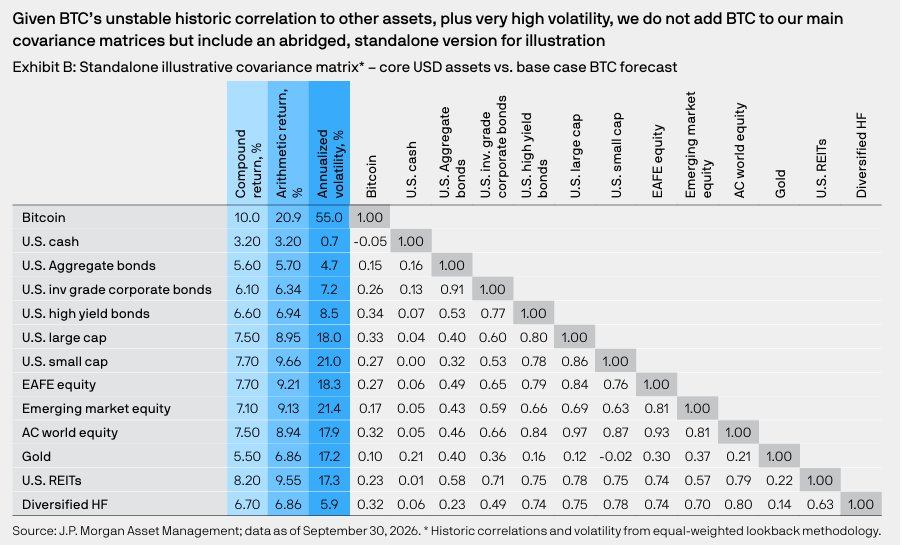
The firm projects annualized Bitcoin volatility of 55%, significantly higher than traditional assets. It also cites Bitcoin’s unstable historical correlations with other asset classes as a major obstacle to treating it as a reliable portfolio diversifier.
Instead, Bitcoin appears in a separate illustrative risk-and-correlation matrix.
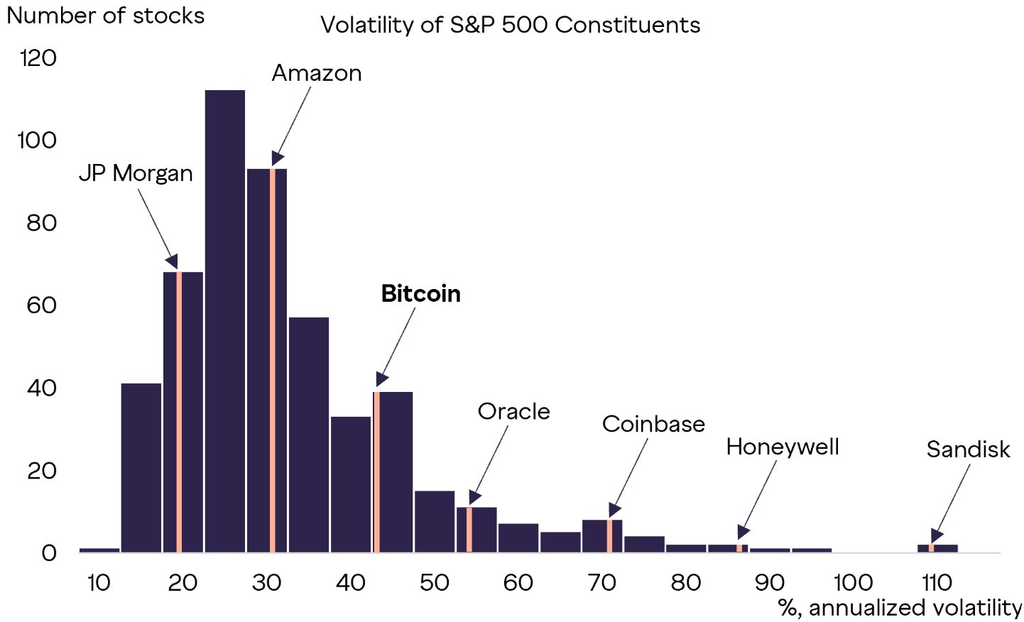
However, Bitcoin’s historical volatility has declined. According to Grayscale, its one-year realized volatility has fallen to approximately 43%, compared with 81% five years ago, placing it within the volatility range of numerous S&P 500 constituents.
A Milestone for Bitcoin’s Institutional Recognition
The inclusion is notable given JPMorgan Chase CEO Jamie Dimon’s longstanding criticism of Bitcoin, which he previously dismissed as a speculative asset with little practical value.
While JPMorgan Asset Management has not recommended a strategic Bitcoin allocation, its decision to formally model the asset reflects growing institutional attention to Bitcoin’s long-term investment potential.
JPMorgan’s decision to include Bitcoin in its long-term forecasts marks another step in the asset’s growing institutional recognition. While volatility remains a concern, the move shows how Bitcoin is increasingly being evaluated alongside traditional investment assets.
Enjoyed this article? Join our newsletter
Get the latest TAO & Bittensor news straight to your inbox.
We respect your privacy. Unsubscribe anytime.
Enjoyed this article?
Join our newsletter
Get the latest TAO & Bittensor news straight to your inbox — every morning before markets open.



No comments yet — be the first.