


Quantum computing is often seen as a distant threat that will one day shatter SHA-256, empty Satoshi’s BTC wallet, and upend cryptography.
On Shizzy Unchained, Bob Wald of qBitTensor Labs, argued that the technology is already here, already useful in limited ways, and already running on Bittensor through Quantum Compute (SN48) and Enigma (SN63).
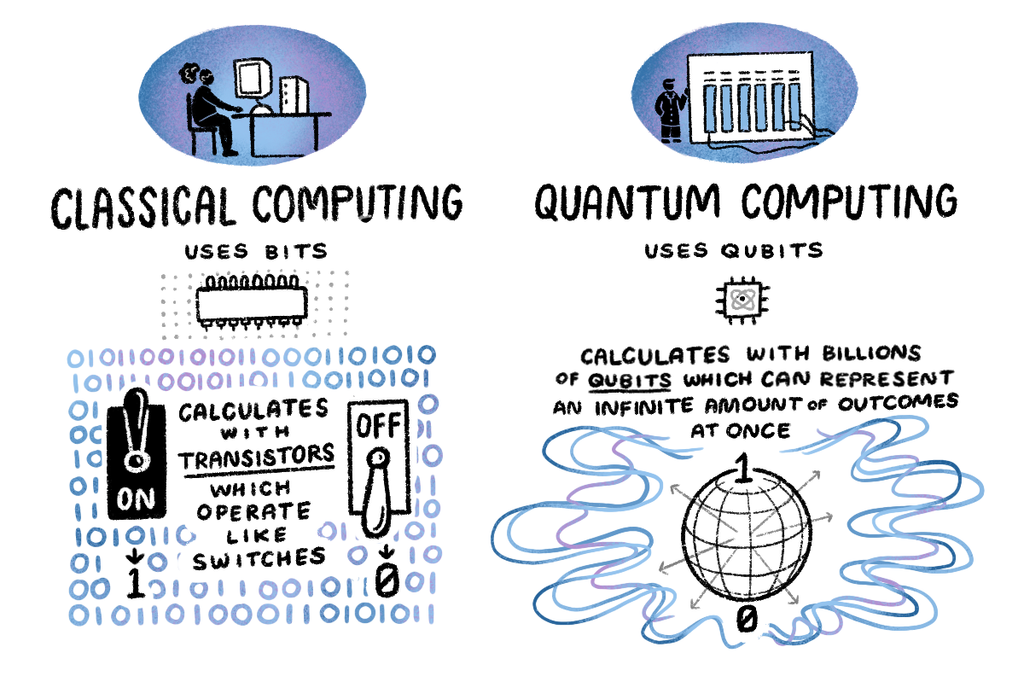
Unlike traditional computers that process information using bits representing either 0 or 1, quantum computers use qubits, which can exist in combinations of both states. They also use a phenomenon called entanglement, which creates correlations between qubits.
These properties allow quantum computers to solve certain problems more efficiently than conventional machines. However, today’s quantum computers remain relatively small and prone to errors, limiting the problems they can solve reliably.
Quantum Compute (SN48) is making this technology more accessible through OpenQuantum, a platform that connects researchers, students, developers, and businesses to real quantum computing hardware. Users can access machines from different providers through a single interface, with every account receiving $50 in free computing credits every 90 days.
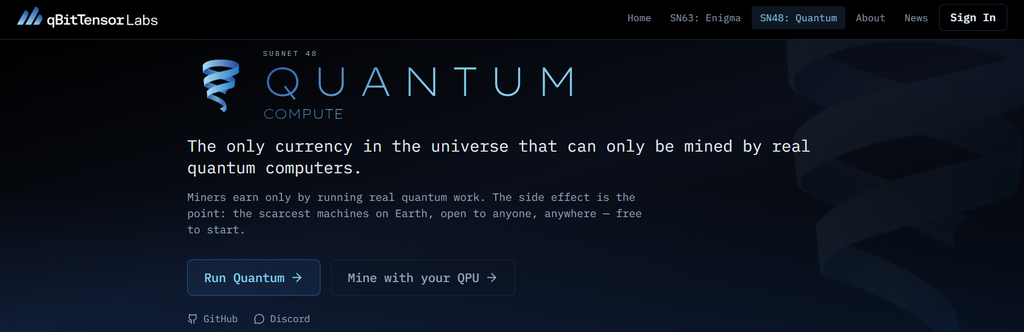
The subnet uses Bittensor’s incentive system to subsidize computing costs. Miners purchase access to real quantum computers, execute jobs submitted by users, and receive alpha token rewards for successfully completing them.
Users can choose between subsidized public computing, where jobs pass through the decentralized network, and private computing, where sensitive information stays outside the network at standard commercial rates. Miners must also provide verified results from approved hardware providers.
SN48’s incentive structure encourages miners to retain their alpha tokens, with those who consistently sell their rewards potentially receiving fewer jobs. Revenue generated through public computing is also intended to fund token buybacks. According to Bob, the computing jobs come from actual customers using OpenQuantum, meaning the subnet rewards miners for delivering services that people need.
While SN48 focuses on computing access, Enigma (SN63) operates as a decentralized research network that rewards people for solving difficult scientific and mathematical problems. The subnet channels emissions into a multi-signature treasury managed by validators, with prizes awarded for successful solutions that are subsequently made publicly available.
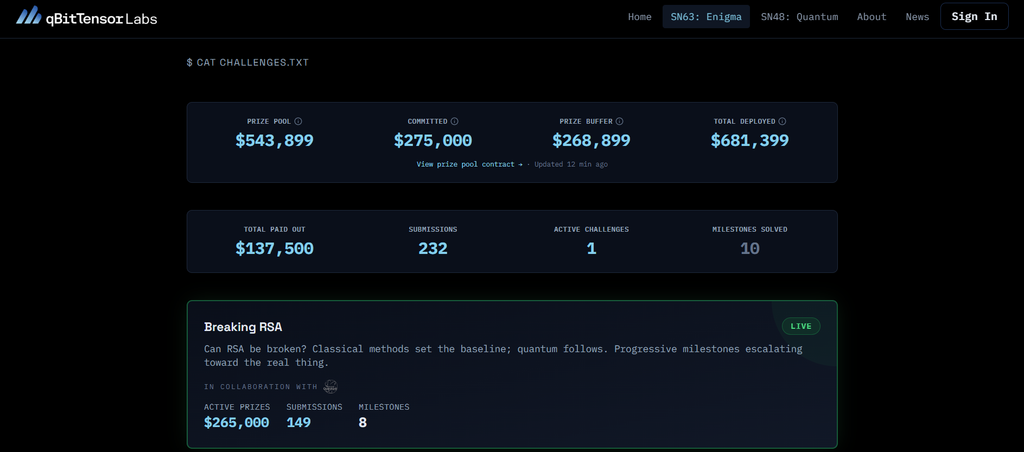
One of Enigma’s main research areas involves breaking RSA encryption, a widely used cryptographic system whose security depends on the difficulty of factoring extremely large numbers.
Bob said miners have already demonstrated the ability to crack 512-bit RSA keys in approximately four hours using a single high-end GPU. Enigma is now offering a $250,000 prize for breaking 1024-bit RSA, a significantly harder challenge that remains beyond practical reach using known general-purpose methods.
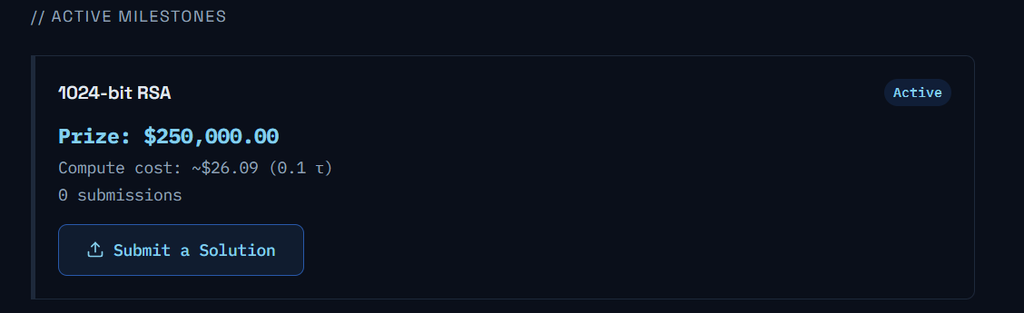
Bob described the challenge as a warning system for the cryptography industry. An efficient solution could reveal a major mathematical breakthrough or unexpected advances in computing capabilities. Participants can use either classical or quantum computers.
Enigma is also working with partners such as BlueQubit on challenges involving quantum advantage, including research into whether conventional computers can efficiently simulate certain quantum calculations.
The conversation also addressed concerns about quantum computing’s potential impact on Bitcoin. Bob explained that the greater concern is not SHA-256, the hashing algorithm used in Bitcoin mining, but elliptic-curve cryptography (ECC), which Bitcoin uses to verify digital signatures and ownership of funds.
A sufficiently powerful quantum computer could potentially derive private keys from exposed public keys, putting vulnerable Bitcoin addresses at risk.
Bob discussed estimates suggesting that attacking Bitcoin’s elliptic-curve cryptography could require approximately 1,200 to 1,800 logical qubits. However, building reliable, error-corrected quantum computers at that scale remains a major technical challenge, and there is no established timeline for when such attacks might become practical.
Meanwhile, post-quantum cryptography standards already exist, with the US National Institute of Standards and Technology finalizing its first three standards in 2024. Bob suggested that Bitcoin’s decentralized governance could make adopting new cryptographic protections more complicated, while Bittensor may be able to coordinate upgrades more quickly.
Beyond cryptography, Bob sees a commercial opportunity in making quantum computing accessible to more people. His operations are divided between Quantum Rings, a traditional technology company responsible for OpenQuantum and customer acquisition, and qBitTensor Labs, which manages the Bittensor subnets.
This arrangement allows customers to access quantum computing services without needing to interact directly with cryptocurrency.
According to Bob, approximately 90% of OpenQuantum’s traffic was being routed through SN48 at the time of the conversation, with demand growing as subsidized computing makes the service more affordable. The company is also collecting quantum computing usage data that could help train AI systems to write quantum software.
Future plans include expanding access to GPU-based quantum simulations, which remain important while physical quantum hardware continues to develop.
By October 2027, Bob hopes to establish OpenQuantum as a leading platform for accessing quantum computing resources.
For Bittensor, SN48 and SN63 demonstrate two different applications of decentralized incentives: one lowers the cost of accessing specialized hardware, while the other funds research into difficult technical problems.
Quantum computing still has significant limitations, but through these subnets, Bittensor is already helping researchers access real machines and advance work in the field.
➛ Explore qBitTensor Labs’ Ecosystem Here.
Enjoyed this article? Join our newsletter
Get the latest TAO & Bittensor news straight to your inbox.
We respect your privacy. Unsubscribe anytime.
Enjoyed this article?
Join our newsletter
Get the latest TAO & Bittensor news straight to your inbox — every morning before markets open.
No comments yet — be the first.