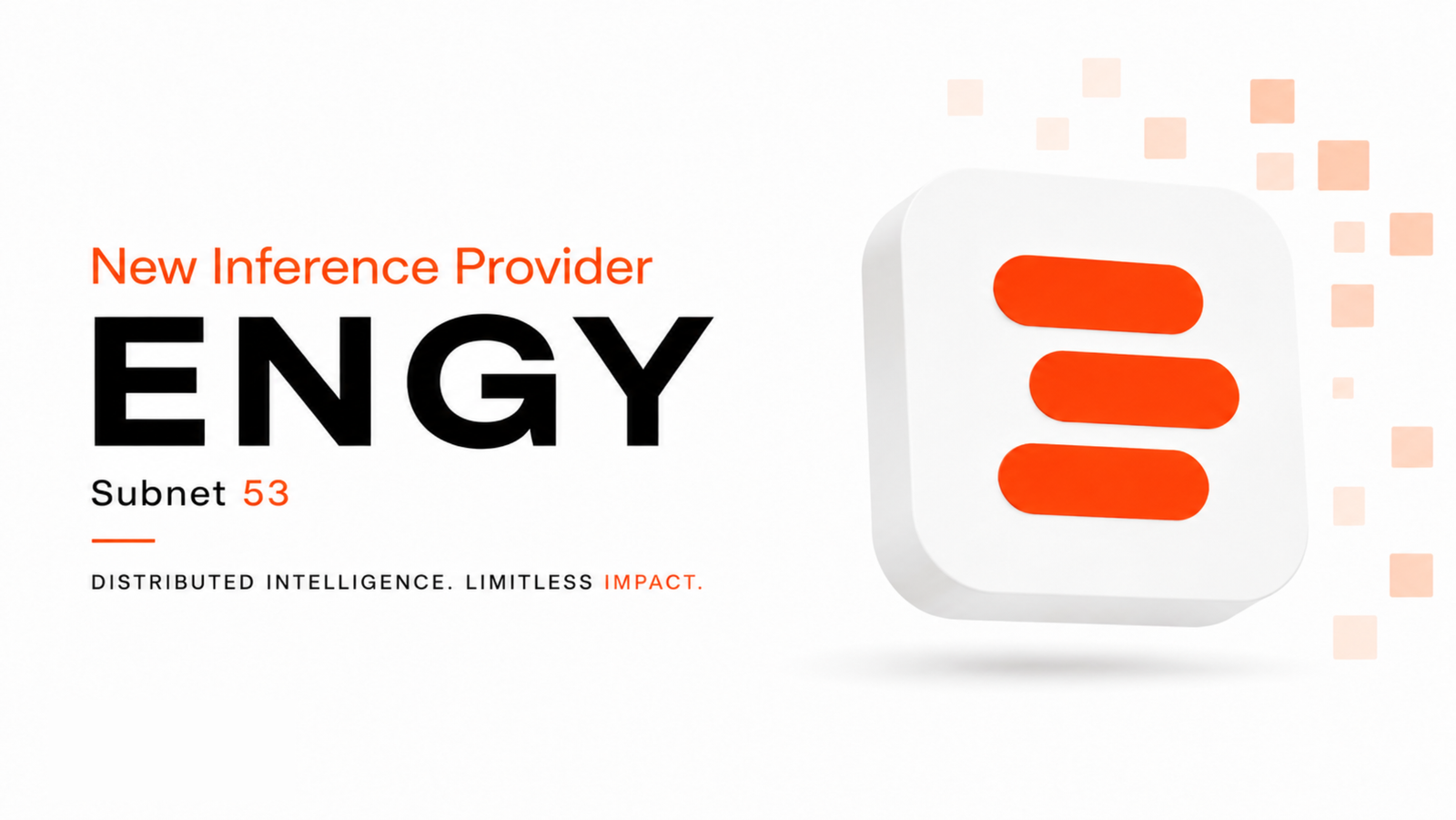
Engy (Bittensor Subnet 53) is making two significant changes following weeks of community criticism around whitelist centralization, value accrual, and its ability to serve enterprise customers.
The subnet has introduced a usage-driven Buy Back & Burn program and redesigned how miners can access its frontier model workloads.
Together, the changes attempt to address one of the biggest questions surrounding Engy: how do you balance Bittensor’s permissionless ethos with the reliability requirements of real customers?
Engy Will Buy Back and Burn Based on Real Usage
Engy says it has attracted more than $150,000 in user deposits so far (as at 11th August 2026).
Rather than committing to a fixed amount of emissions for buybacks, the new program will base buyback-and-burn activity on actual user consumption.
More usage → more buybacks → more alpha burned.
That creates a direct connection between demand for Engy’s services and the supply of its subnet token.
This is particularly relevant given recent questions about whether revenue generated by a subnet ultimately creates value for its token holders or simply funds operations and infrastructure.
Engy says the program may be adjusted as the network evolves, with additional details to follow.
For Bittensor folks, the important distinction is that the burn is intended to be usage-driven rather than emission-driven.
Frontier Model Mining Gets Two Paths
The second major change concerns access to Engy’s frontier model workloads.
Engy has faced criticism over its whitelist system, with community members arguing that restricting access to mining on the subnet creates a centralized allocation mechanism inside a network built around permissionless participation.
The new system creates two distinct paths.
1. Permissionless TEE Mining
Miners with qualifying Trusted Execution Environment (TEE) infrastructure can now participate without going through whitelist approval.
The initial supported configurations include:
- GLM-5.2: 8 × H200
- Kimi K3: 8 × B300
- DeepSeek V4 Flash: 8 × H100
This gives miners a permissionless route into frontier model mining while preserving the security and privacy requirements Engy says are necessary for its workloads.
2. Enterprise Whitelist
The whitelist is not disappearing. Instead, Engy is repositioning it as a higher-assurance lane for enterprise workloads that require stronger guarantees around reliability, privacy, and Zero Data Retention (ZDR).
Applicants must have:
- A registered company entity
- The ability to sign a formal service agreement covering ZDR, privacy, and SLAs
- At least $1 million worth of stable GPU capacity (for instance, 250 RTX 5090s or 16 B300s).
The goal is to provide enterprise customers with more predictable capacity, stronger SLA guarantees, and dedicated support for ZDR traffic.
Current frontier-model whitelisting will close before the end of the current epoch, with the new system launching in the next epoch.
Why This Matters
The changes directly address three of the biggest criticisms Engy has faced recently.
Centralization: Qualified miners now have a permissionless route into frontier workloads through TEEs, while the whitelist is reserved for a clearly defined enterprise tier.
Value accrual: The Buy Back & Burn program connects token burns to actual customer consumption rather than simply allocating emissions toward burns.
Enterprise readiness: The stricter whitelist requirements create a mechanism for Engy to guarantee capacity and service levels to customers that need enterprise-grade infrastructure.
The Remaining Question: Execution
There is still some friction to address.
One recent user reported paying in TAO for Engy credits without receiving them and said they had not received support after roughly 9–10 hours. Other community feedback has also pointed to response times as an area that needs improvement.
That matters because Engy is increasingly positioning itself as an infrastructure provider for real users and businesses. Competitive pricing and strong technical verification are valuable, but reliable customer support becomes equally important as usage scales.
The subnet has already attracted attention for offering frontier open models at competitive prices, cryptographically verifying the model being served, and demonstrating early signs of real demand.
Now, the test is whether these latest changes can translate that traction into a sustainable network.
More on Engy below:
Enjoyed this article? Join our newsletter
Get the latest TAO & Bittensor news straight to your inbox.
We respect your privacy. Unsubscribe anytime.
Enjoyed this article?
Join our newsletter
Get the latest TAO & Bittensor news straight to your inbox — every morning before markets open.



Be the first to comment