

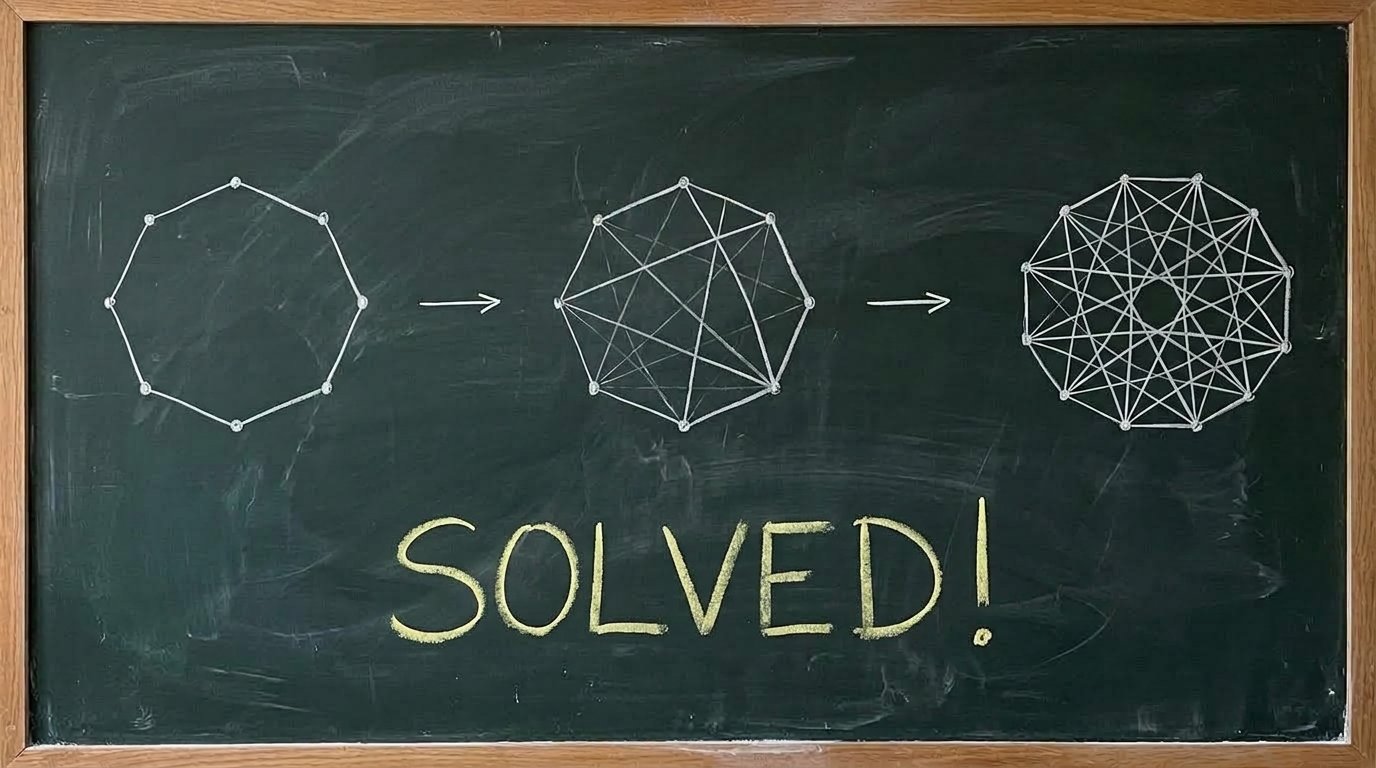
A 66-year-old mathematical conjecture has fallen.
Today, Conjectures.io announced that miners on Bittensor Subnet 66 had solved Erdős Problem 96, a question about how many pairs of points in a convex shape can be exactly one unit apart.
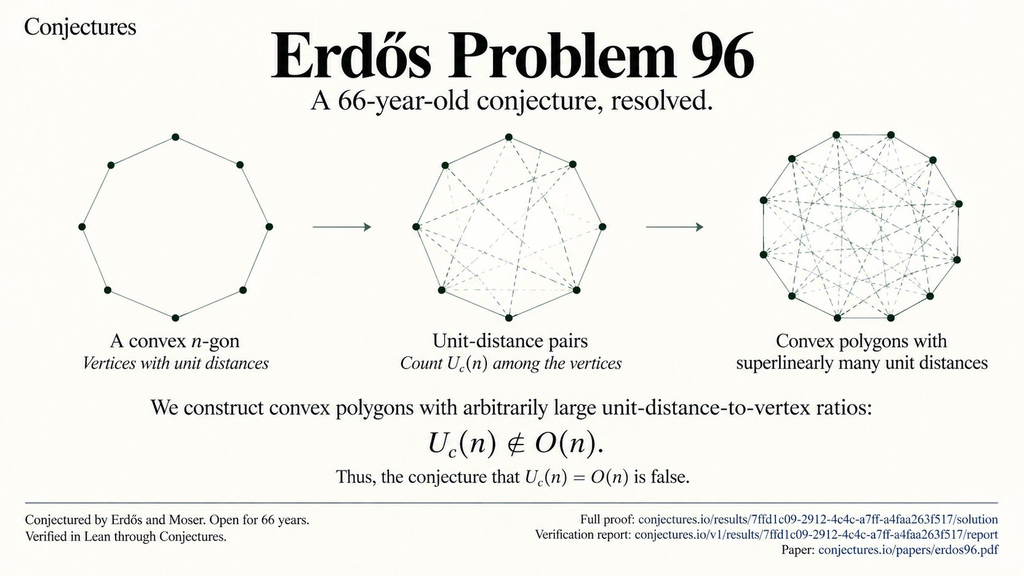
The original conjecture said there should be a limit on how many pairs of corners can be exactly one unit apart. The miners found shapes that go beyond that limit, showing that the old conjecture was wrong.
The Problem
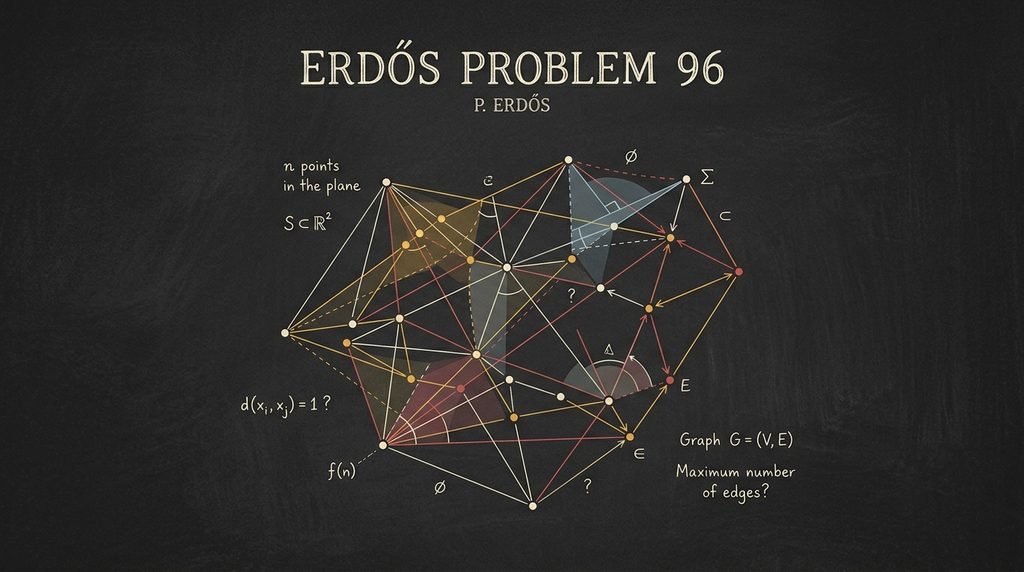
Imagine the corners of a convex polygon, with no inward dents. Erdős and Moser asked how many pairs of corners could be exactly one unit apart.
Their conjecture was that the number of these unit-distance pairs should grow at most linearly with the number of corners.
For decades, mathematicians could construct polygons with increasingly many unit-distance pairs, but only in roughly linear quantities. Meanwhile, the strongest general upper bounds were considerably larger, leaving the conjecture unresolved.
Subnet 66 miners found a way around the presumed limit.
Their construction produces strictly convex polygons with superlinearly many unit-distance pairs. As the polygons become larger, the number of unit-distance pairs grows faster than any fixed multiple of the number of vertices.
That directly disproves the old linear conjecture.
A Bittensor Subnet for Solving Mathematics
The result comes from Conjectures, Bittensor Subnet 66, which turns difficult mathematical problems into competitive computational tasks.
The subnet takes open problems, formalizes them into statements that can be checked by a proof assistant such as Lean, and attaches incentives to finding a valid solution. Miners compete to produce the mathematical result, while the submitted proof can then be mechanically verified.
The important distinction is that miners are not rewarded simply for attempting a problem. The finished proof has to check out.
That creates an unusual model for mathematical research. Bittensor’s incentive and competition layer can coordinate independent researchers and AI systems around the same open problem, while formal verification provides a definitive test for whether the claimed result is valid.
For Erdős Problem 96, the submitted work was verified in Lean through Conjectures.
From Conjecture to Counterexample
The breakthrough comes from a construction that pushes the geometry in a direction the original conjecture ruled out. By carefully arranging the corners, the researchers were able to create increasingly large convex polygons with disproportionately more unit-distance pairs.
The result has been formally verified in Lean, meaning the proof was checked by a computer rather than relying only on human review. Conjectures has published the full paper alongside the verified proof.
For Bittensor, the result is another example of what a subnet can do when an open research problem is converted into a measurable, verifiable competition, turning a question that was unresolved for decades into a result that a computer can independently check.
More on Conjectures (SN66) below:
Enjoyed this article? Join our newsletter
Get the latest TAO & Bittensor news straight to your inbox.
We respect your privacy. Unsubscribe anytime.
Enjoyed this article?
Join our newsletter
Get the latest TAO & Bittensor news straight to your inbox — every morning before markets open.



No comments yet — be the first.