

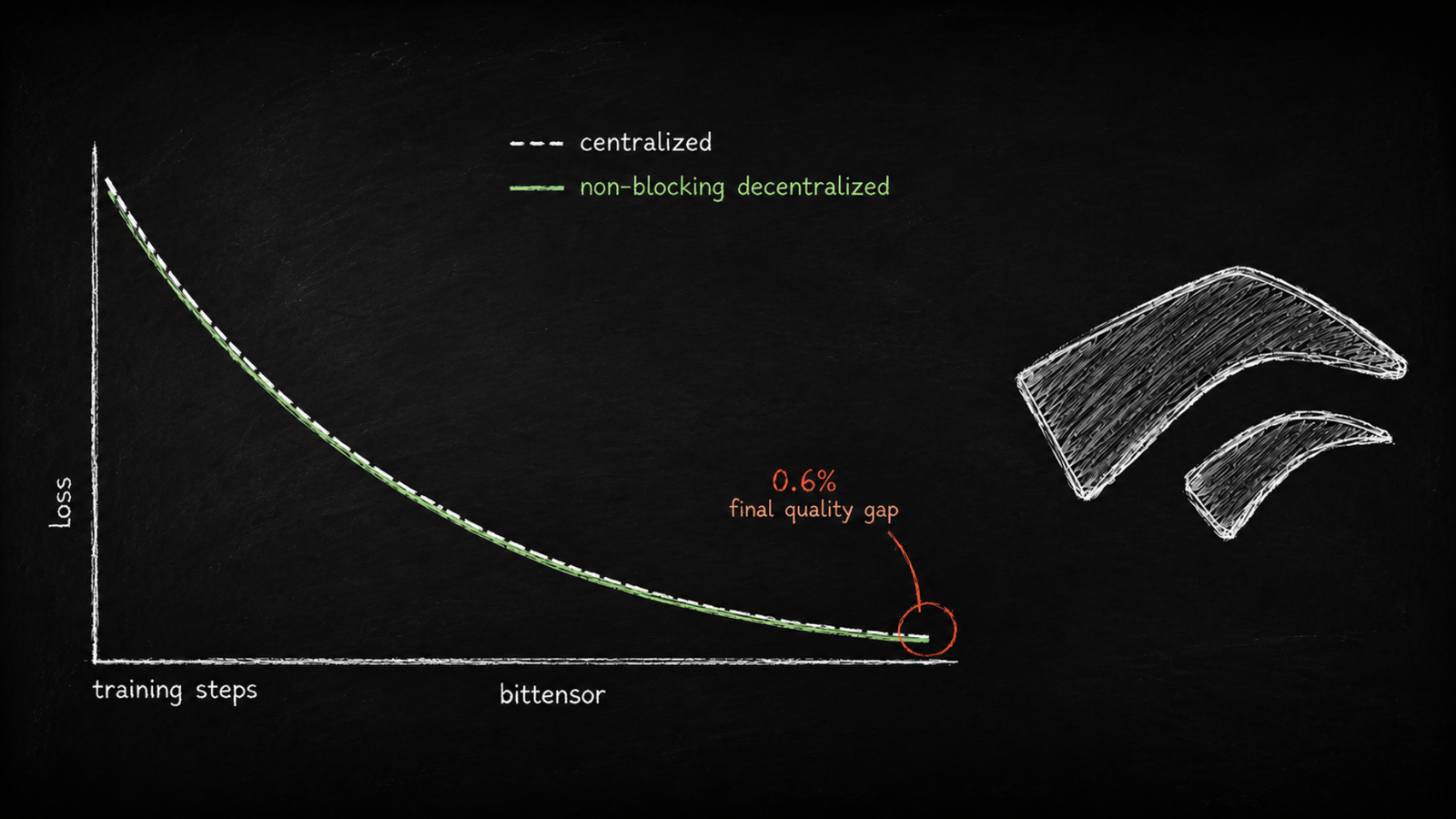
Parallax by Chutes (SN64) just achieved fully non-blocking decentralized training on a recurrent model, landing within 0.6% of the centralized baseline at matched steps. Decentralized training has always forced a tradeoff between speed and quality, where GPUs either pause to sync (slow and expensive) or skip the sync (quality drops).
Parallax eliminated the tradeoff by running the test on a pure recurrent architecture, Gated DeltaNet, which is the hardest possible case because every training step depends sequentially on the one before it. To the team’s knowledge, this is the first published result of decentralized non-blocking training holding up on a recurrent architecture.
The Tradeoff Parallax Eliminated
Training a model across GPUs in different physical locations has always sat on a spectrum between two bad options. This run showed the choice is not fixed.
1. Option A: Blocking synchronization. GPUs pause to sync with each other. Accurate but slow and expensive.
2. Option B: Skip synchronization. GPUs keep training without pausing. Fast, but quality drops.
3. Parallax’s result. No blocking, no meaningful quality loss, and within 0.6% of the centralized baseline at matched steps.
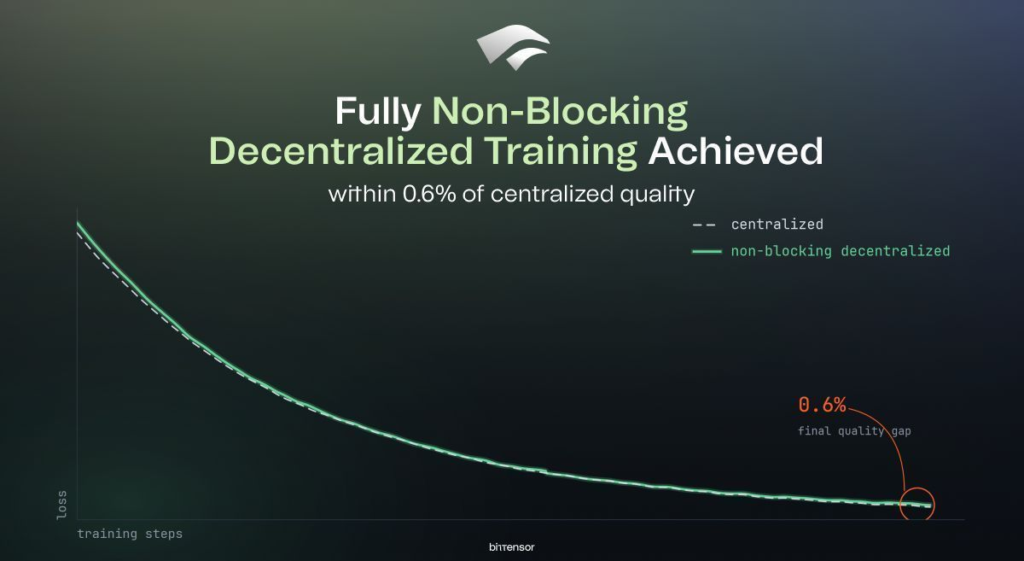
Most decentralized training research to date has traded speed for accuracy or the reverse. Parallax’s demonstration says neither has to be given up, at least on the architecture designed to be hardest to solve.
Why Recurrent Was the Deliberate Test Case
The team ran the test on Gated DeltaNet, a pure recurrent model with no transformer or mixture-of-experts layers to soften the result. That was intentional.
1. Recurrent models are sequential by nature. Every step depends on the one before it, which makes them the hardest architecture to train without tight synchronization.
2. Transformers are far easier to parallelize. They allow much more work to happen in parallel across GPUs without the sequential dependency.
3. The logic behind the choice. If non-blocking decentralized training holds on the hardest case, the easier architectures should follow.
Gated DeltaNet is Parallax’s current target architecture, and the result is an in-progress research direction rather than a finished system. The signal from the run is that decentralized training can compete with centralized training on architectures the field had assumed would resist decentralization altogether.
Why This Matters For Parallax
The Parallax thesis is more useful work per watt and strong training that does not depend on owning a datacenter. A recurrent model also drops the key-value cache that grows with every token, which is part of why the architecture is attractive to the team in the first place.
1. No datacenter dependency. Getting recurrent models to train decentralized without blocking and without a quality penalty moves toward training strong models on hardware people already have.
2. Efficiency at the kernel layer. The MSA (MiniMax Sparse Attention) kernels are open source, part of the same push to do more with less.
3. Research direction, not final product. The team is treating this as an ongoing research signal rather than a shipped system, with more results to share as the work continues.
The First Result on the Hardest Architecture
Parallax’s demonstration is one of the cleaner proofs that decentralized training can hold its own against centralized training when the architecture and the synchronization approach are designed for it. The 0.6% gap at matched steps is small enough to be inside the noise of most benchmarks, and the fact that it landed on the hardest possible case signals that the easier ones should be within reach.
For an ecosystem where compute concentration has been the structural bottleneck for AI research outside the largest labs, non-blocking recurrent training on hardware people already own is exactly the kind of primitive that changes what’s possible.
➛ Read More on Parallax Here:
Enjoyed this article? Join our newsletter
Get the latest TAO & Bittensor news straight to your inbox.
We respect your privacy. Unsubscribe anytime.
Enjoyed this article?
Join our newsletter
Get the latest TAO & Bittensor news straight to your inbox — every morning before markets open.



No comments yet — be the first.