


Cathedral spent four months rebuilding the deprecated SN39 into a working, verified compute product. Over time, the team shipped five public repositories, 1,092 commits, and over 550,000 lines of code.
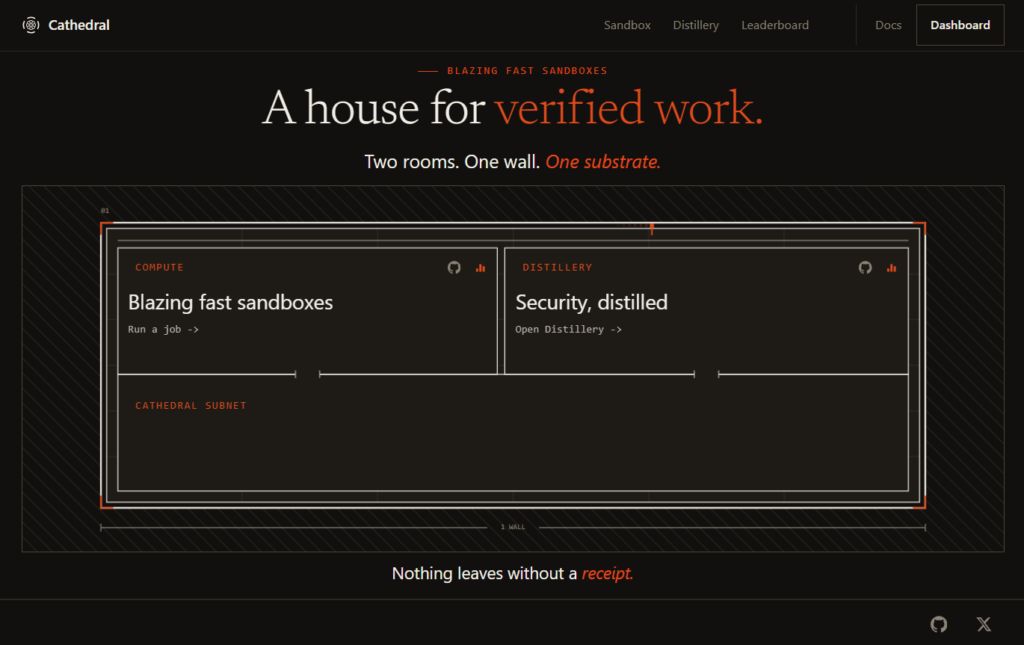
Now live, it runs workloads inside Intel TDX confidential sandboxes for $0.20 per verified execution. Each job produces a signed receipt with hardware attestation evidence, while an offline verifier lets anyone independently confirm the result; the first test run is free.
What Got Built
Four months of open development produced a working product with a real audit trail behind it.
1. 1,092 commits of public development history.
2. Over 550,000 total lines of code written.
3. 408,000 lines of Python active in production today.
4. Hardware-isolated Intel TDX confidential sandboxes: Fresh sandbox per verified execution.
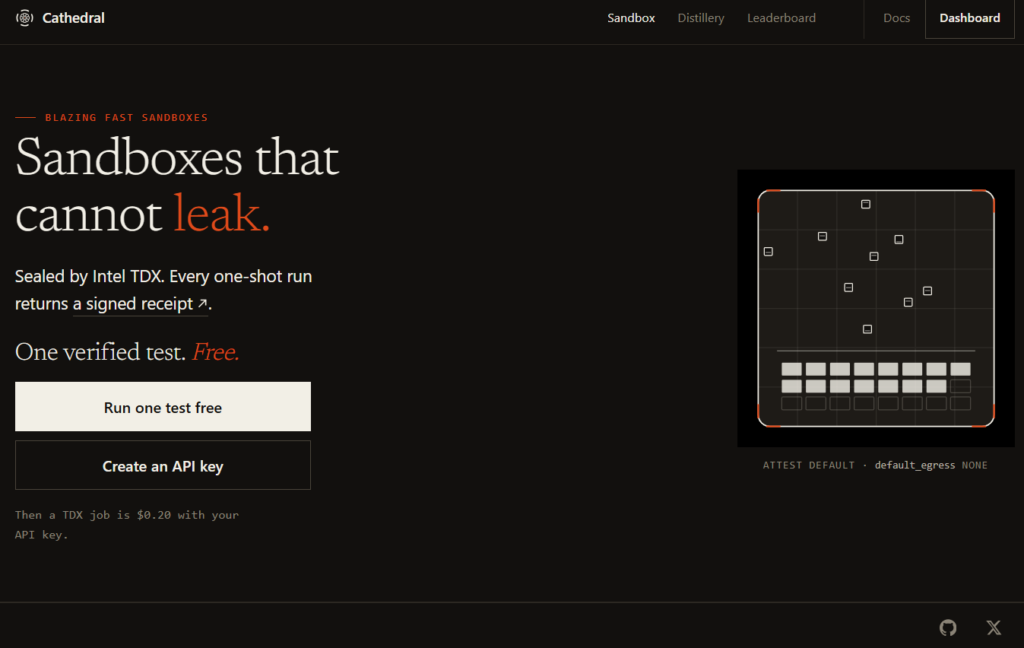
5. $0.20 per verified execution: Pricing improves as miner supply comes online.
6. Signed receipts bind hardware attestation evidence: Every job produces cryptographic proof of what ran.
7. Offline verifier shipped: Anyone can validate a receipt without trusting Cathedral.
8. The Distillery runs alongside the sandbox: Idle sandboxes automatically rotate to running agent training environments, turning wasted CPU cycles into verified post-training evaluation data.
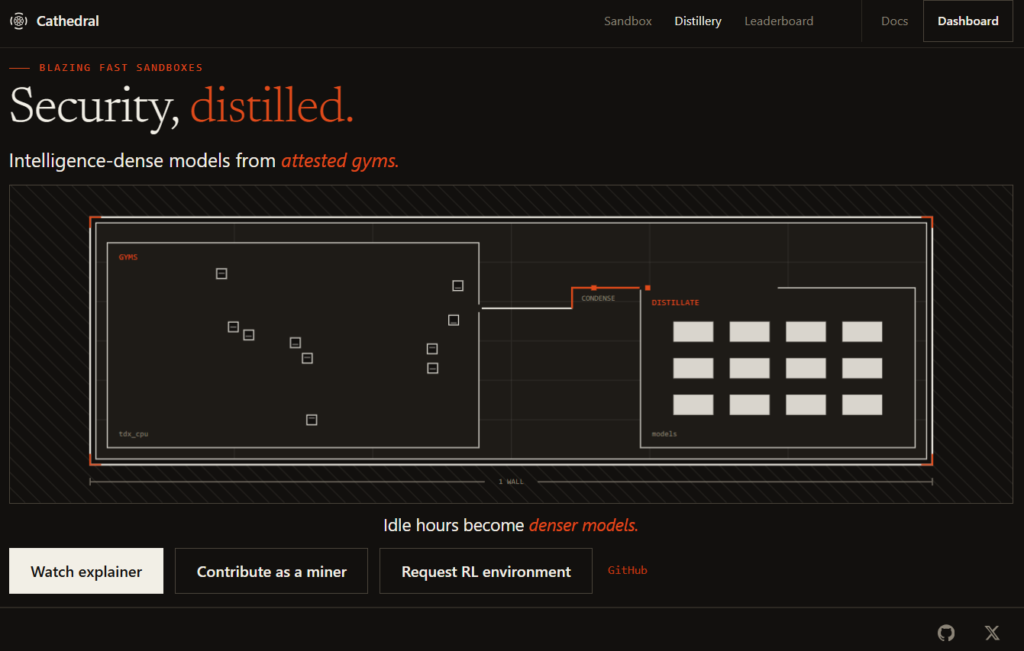
Everything is open source, publicly auditable, and independently verifiable.
The Token vs the Product
Building on a deprecated slot with a validator permit and zero emissions taught the team two lessons that pull against each other.
1. Lesson one (The product must stand on its own): Cathedral lets developers and enterprises pay cash for verified sandbox compute, with $USDC and $TAO coming next. Cathedral serves as the live demand surface, independent of whether any alpha is minted.
2. Lesson two (The token must make the product do what it cannot do alone): The MVP runs on centralized Intel TDX hardware, stable but physically limited in scale. Cathedral cannot offer the fastest sandboxes worldwide or maintain warm nodes everywhere without millions in capex.
Bittensor’s incentive layer bridges the gap between Cathedral’s current product and its next stage of growth. Emissions coordinate independent miners who absorb keep-alive costs and scale capacity with demand instead of leaving hardware idle.
Where Cathedral Goes From Here
Cathedral is moving to its own dedicated slot with the same name, product, and pace. The netuid 39 transition frees Cathedral to run its incentive design without inheriting old decisions.
A follow-up will detail its path from centralized MVP to globally distributed compute and tackle key limitations. For developers, researchers, and builders who tested the enclaves and challenged the design, the invitation remains open.
Enjoyed this article? Join our newsletter
Get the latest TAO & Bittensor news straight to your inbox.
We respect your privacy. Unsubscribe anytime.
Enjoyed this article?
Join our newsletter
Get the latest TAO & Bittensor news straight to your inbox — every morning before markets open.


No comments yet — be the first.