

Carbon (SN116) has launched its Bittensor subnet on mainnet. It is now a working network for discovering and validating fast physics AI models for engineering.
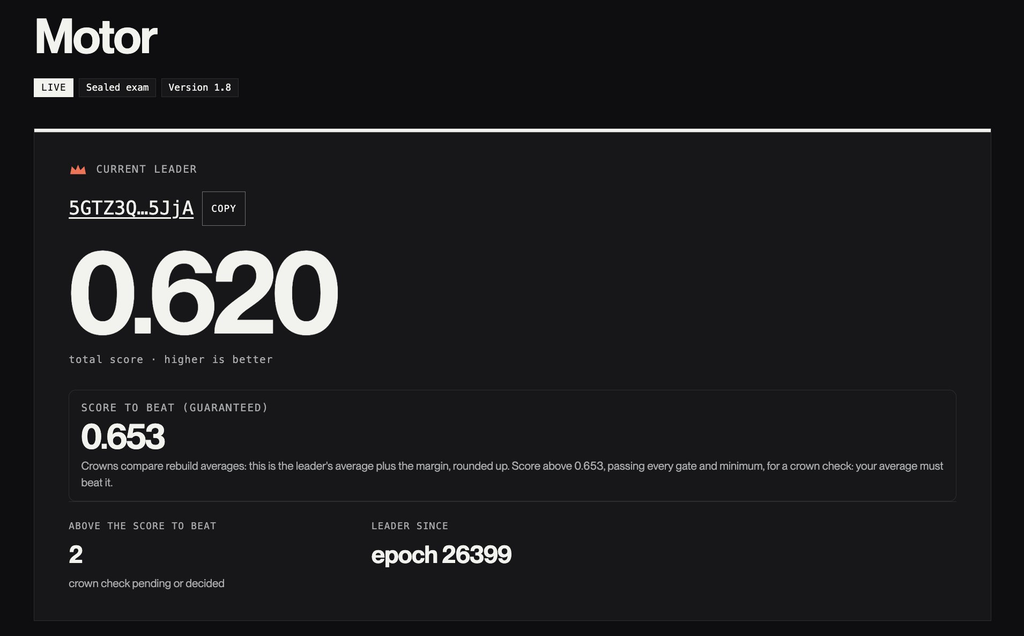
The team announced “Carbon mainnet is live” on November 14. A few hours later it confirmed that the first challenge, which focuses on electric motor design, was already running.
The challenge asks miners to optimise a motor that turns strongly and smoothly. A top performer the team calls “Motor King” has already appeared on the leaderboard.
Carbon is built to fix a familiar problem in engineering. Traditional simulation tools such as CFD and finite element analysis can take one to two days for each design iteration.
Physics AI surrogate models, especially neural operators like Fourier Neural Operators and DeepONet, can produce predictions up to 1,000 times faster. Engineers still hesitate to rely on them, though, because they have little evidence of where these models stay accurate, follow physical laws, or break down.
The subnet deals with this problem by keeping research and grading separate. Miners submit reproducible model-building recipes instead of pre-trained weights. Validators rebuild each model in a controlled environment and test it against reference solvers or real measurements.
Before any accuracy or speed score counts, the model has to pass hard physics gates covering conservation of mass, energy and momentum, boundary conditions and stability.
What comes out is more than a model. Each successful submission ships with an evidence package of performance maps, failure boundaries and qualification reports that engineers can audit before they use the model to replace or speed up a simulation step.
Early target domains include motor design for robotics, cooling-plate optimisation for AI chips, and battery charging and ageing. Aerospace aerodynamics, automotive thermal management, energy systems and semiconductors are planned after those.
Over the longer term, Carbon wants to build an “Evidence Landscape” that shows which methods work under which conditions, and to requalify models as hardware and datasets change.
Carbon won Pitchtensor at Exploit Summit 2026 in Montreal, where the community pledged 500 TAO in under 20 minutes through Bitstarter.
The subnet is developed by Carbon Physics, Inc., co-founded by Ryan Bequette, a former test and verification engineer at the U.S. Air Force, Virgin Galactic and Boeing, and Nick Fitzpatrick. Hiran Sen leads physics modelling and validation.
In the near term, the team plans to release challenges one at a time. Each one will come with an explainer covering the problem, what is being tested, what miners do, what the results mean and who the buyer would be.
The goal is a first portfolio of four to five customer-style challenges showing that miner competition plus independent validation can produce models accurate, fast and well-documented enough for real engineering work.
Carbon is starting with smaller engineering teams of roughly 10 to 50 people who work on specialised problems like cooling systems, rather than with large aerospace and defence primes.
From there it plans to move into paid work through Evidence Audits of existing models and Sponsored Discovery of new ones.
Pricing for comparable projects is expected to be in the mid-five to low-six figures. Revenue will flow back to the subnet through alpha buybacks and burns, so the researchers building the models share in the upside.
With mainnet live and the motor challenge already producing results, Carbon has gone from testnet demos to a working research network.
The coming weeks will test whether open competition and strict independent evidence can deliver models that engineers trust enough to pay for.
For more background, see The TAO Daily’s earlier coverage of Carbon’s validation approach, commercial plans and alpha buyback strategy.
Enjoyed this article? Join our newsletter
Get the latest TAO & Bittensor news straight to your inbox.
We respect your privacy. Unsubscribe anytime.
Enjoyed this article?
Join our newsletter
Get the latest TAO & Bittensor news straight to your inbox — every morning before markets open.
No comments yet — be the first.