


Just 10 days after unveiling Teutonic-I, Bittensor founder Jacob Steeves, known as Const, has announced Teutonic-II-110B, a permissionless training run for a roughly 110-billion-parameter language model on the Teutonic subnet.
The project marks a major expansion of Bittensor’s decentralized AI training efforts, scaling the model size by roughly 10× compared with Teutonic-I.
A 110B Model Trained by an Open Market
Teutonic-II is built around a sparse Mixture-of-Experts (MoE) architecture with approximately 110B total parameters and 7.3B activated parameters per token.
Unlike conventional AI training runs controlled by a single organization, Teutonic allows anyone with the required compute and technical capabilities to compete.
Miners are rewarded for producing measurably better model updates, rather than simply contributing compute.
- ~110B total parameters
- ~7.3B activated parameters per token
- Permissionless participation
- Model checkpoints and the final dataset planned for open release
How Teutonic’s Training Market Works
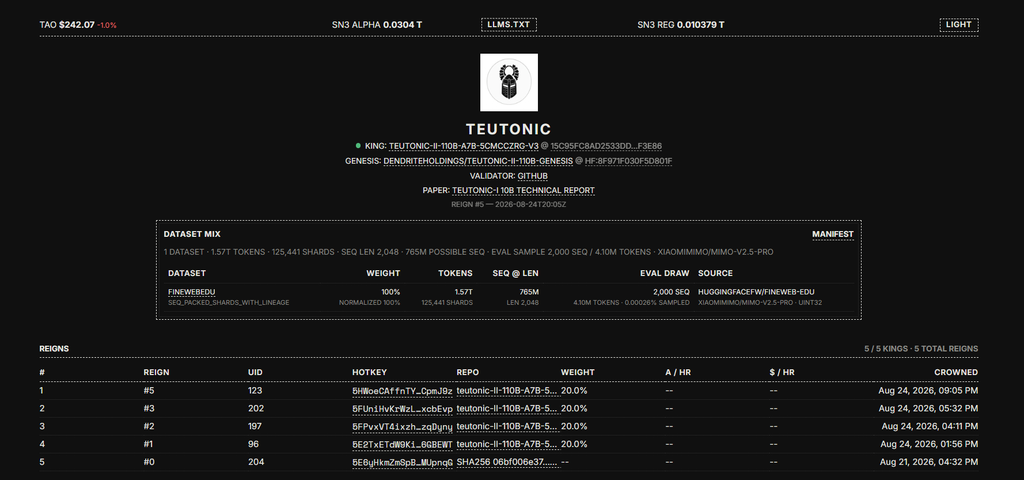
Teutonic uses a continuous king-of-the-hill system.
Participants train challenger models independently and submit them for evaluation against the current best checkpoint. Validators then test both models on a held-out dataset using next-token prediction loss.
A challenger replaces the current model only when it demonstrates a statistically significant improvement.
This creates a market where participants compete to find better:
- Training strategies
- Data and curricula
- Model modifications
- Compute resources
- Optimization techniques
The underlying principle behind Teutonic: capital and technical ingenuity compete to produce measurable improvements in the model.
Building on Teutonic-I
Teutonic-II follows Teutonic-I, which was launched on August 14 after a 70-day decentralized training competition.
Teutonic-I used a 10B-parameter architecture and attracted dozens of independent participants competing through successive model improvements.
Its strongest checkpoint reportedly achieved a 62.28% unweighted average across 11 benchmarks, outperforming larger models including Quasar Preview 18B and Covenant-72B on the evaluation.
Teutonic-II now tests whether the same permissionless training mechanism can scale from 10B to 110B parameters.
A Reminder on the Sequence of Events
Subnet 3 has been through a full ownership change before reaching this point:
- The subnet previously ran as Templar under Covenant AI, the team behind the Covenant-72B model
- Token holders reclaimed the subnet through a community vote after four months
- The new subnet owner then launched Teutonic-I on August 14, 2026, calling it the most performant decentralized language model built to date
- Teutonic-I ran as a 70-day king-of-the-hill contest between June 2 and August 10, spanning 2,163 duels and 203 accepted kings
- The strongest checkpoint scored an unweighted average of 62.28% across 11 benchmarks, ahead of Quasar-Preview 18B and Covenant 72B, leading on 8 of the 11 tasks, including a 75.29% score on MMLU
- About 73 distinct coldkeys took part, with weights published on Hugging Face and the technical report posted at teutonic.ai/paper.html
That contest fixed the architecture at 10 billion parameters, leaving miners free to choose their own datasets, optimizers, and hardware.
One Hundred Ten Billion and Counting
Decentralized networks only compete with closed labs by pooling market-priced incentives across scattered compute and talent.
Teutonic-II is a direct test that an open, incentive-driven market can train frontier-scale AI without a centralized organization controlling the entire process.
The aim of Teutonic is to reach as high as one trillion parameters, well beyond what any current run has attempted.
The dashboard at teutonic.ai is already open for anyone with hardware willing to compete for the daily reward pool.
Enjoyed this article? Join our newsletter
Get the latest TAO & Bittensor news straight to your inbox.
We respect your privacy. Unsubscribe anytime.
Enjoyed this article?
Join our newsletter
Get the latest TAO & Bittensor news straight to your inbox — every morning before markets open.


[…] Teutonic (SN3) is among his preferred subnet plays, alongside Engy (SN53), Targon (SN4), Lium (SN51), GM (SN28), Bitcast (SN93), Minos (SN107), Hippius (SN75), RedTeam (SN61), and Oro (SN15). […]