


For 70 days, roughly 73 independent teams around the world competed to lower the loss on a single language model, each trying to outdo whoever currently held the lead.
This gave rise to Teutonic-I, produced on SN3, a 10-billion-parameter model that outscores every other decentralized model on benchmarks, including some seven times its size.
No one coordinated the training in the usual sense, which is what makes it worth understanding. This is a summary of the technical paper describing how a contest, rather than a company, produced a leading open model.
How the Competition Worked
The training ran as a king-of-the-hill contest, where one model held the crown at any moment and challengers tried to unseat it.
Anyone could take part by downloading the current best model, training an improvement, and submitting it for a head-to-head test.
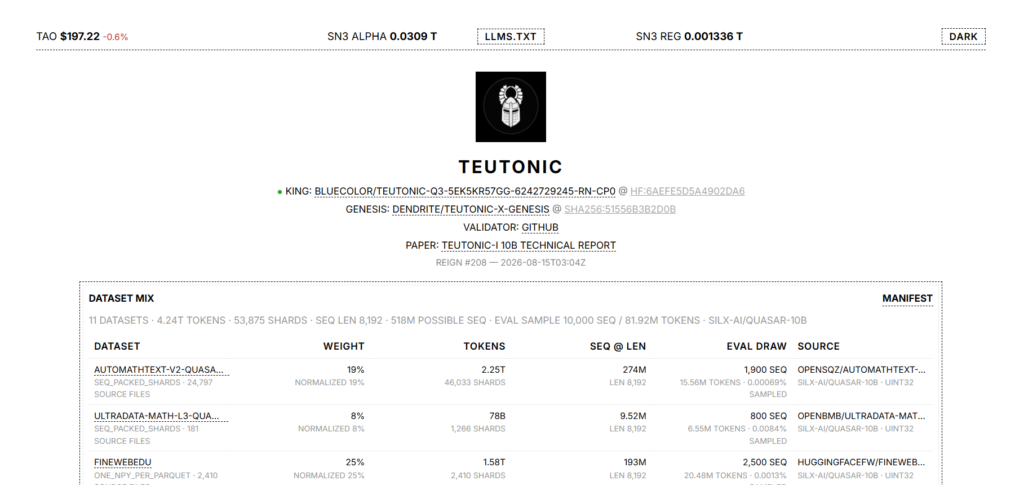
1. One official model at a time: A single checkpoint was designated the king, and every new attempt had to beat it directly.
2. A strict, fair test: The king and challenger were scored on identical text, and a challenger only won if its improvement was both large enough and statistically solid rather than a lucky margin.
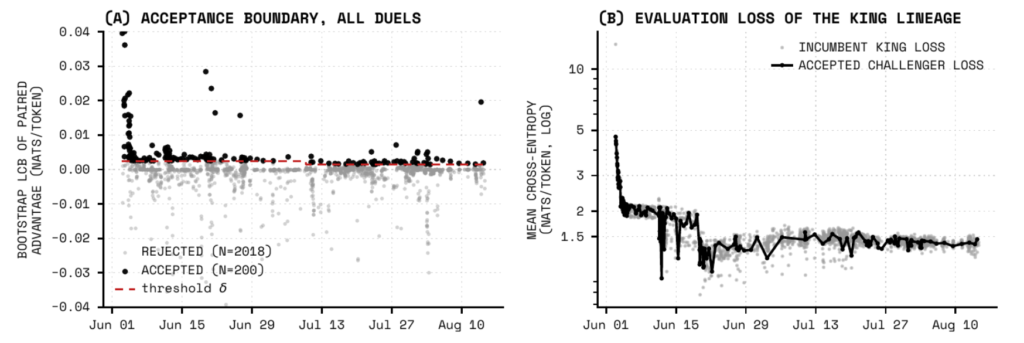
3. Winners became the new baseline: Each accepted model became the starting point for everyone who came after, so progress accumulated as a lineage.
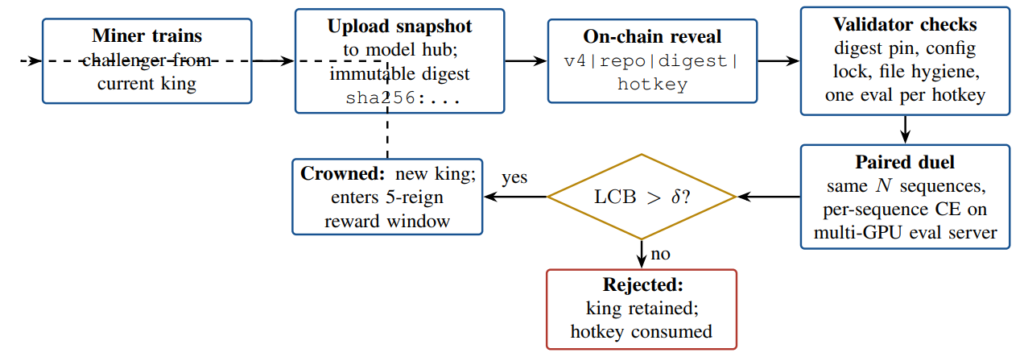
Out of 2,163 completed duels, only 203 challengers were good enough to take the crown, an acceptance rate under 10% that shows how demanding the bar was.
Why Leaving the Method Open Made It Work
Most decentralized training locks every participant into the same recipe. Teutonic did the opposite.
1. No fixed training algorithm: Teams chose their own data, methods, hardware, and duration, bringing whatever innovation fit each stage of the run.
2. The organizers steered only the data: They defined a 4.24-trillion-token corpus and adjusted the mixture over time, and the competitors automatically re-optimized underneath whenever the target shifted.
3. Effort earned nothing on its own: A model got no credit for the work behind it and had to actually outperform the current best, which kept the contest focused on real gains.
This turned training into a live search across strategies, where competition did the coordinating that a central plan usually provides.
What the Results Show
Teutonic-I averaged 62.28% across 11 shared benchmarks and led the field on 8 of them.
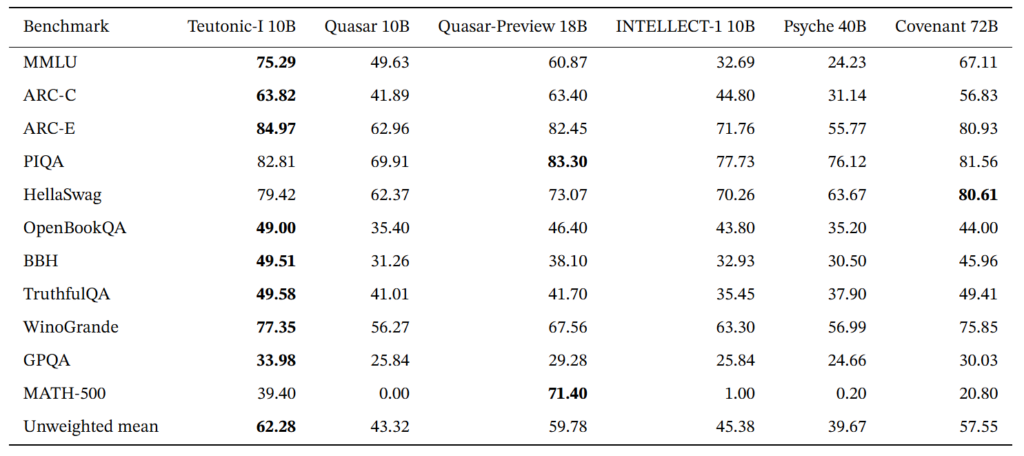
1. It beat far larger models, topping Quasar-Preview 18B and Covenant 72B despite its smaller size, so parameter count alone does not decide performance.
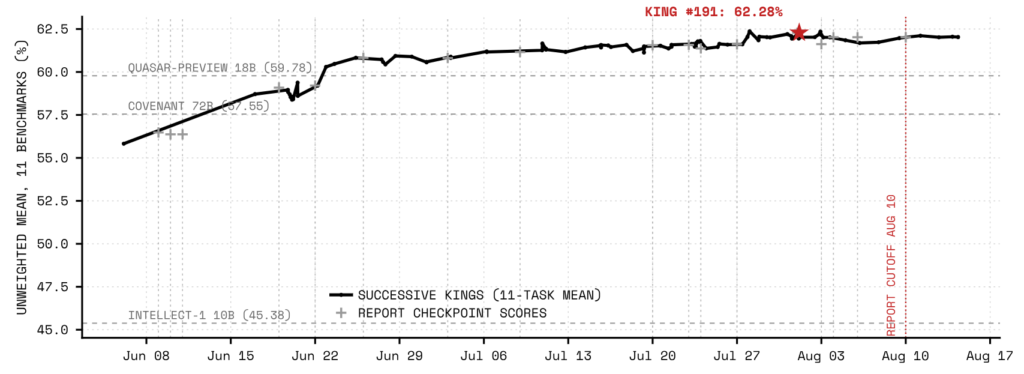
2. Most gains came early, then compounded: The model reached about 56% within the first week, then added roughly six more points over ten weeks through many small accepted improvements.
3. Some skills rose only when steered: Math scores jumped in steps whenever math data entered the mixture, while general knowledge climbed steadily throughout.
The paper is careful about its own limits, noting that the comparison relies on reported benchmark numbers rather than one controlled re-test, and that it cannot separate how much of the win came from the competition itself versus the data and compute the teams brought.
What Gets Left Behind
Once the contest ends, the mechanism leaves behind an open-source model, an open collaboration of skilled engineers drawn in by the reward, and shared ownership of the network tying them together. SN3 was recently taken back by its token holders through a vote, and this release is how the community marked that moment.
The operators say the next competition will target much larger models, potentially around 100 billion parameters. A well-designed contest, with the right thing to optimize and an honest way to measure it, coordinated strangers into building something none of them could have made alone.
➛ Access Teutonics (SN3)’s Technical Paper Here.
Enjoyed this article? Join our newsletter
Get the latest TAO & Bittensor news straight to your inbox.
We respect your privacy. Unsubscribe anytime.
Enjoyed this article?
Join our newsletter
Get the latest TAO & Bittensor news straight to your inbox — every morning before markets open.



[…] 10 days after unveiling Teutonic-I, Bittensor founder Jacob Steeves, known as Const, has announced Teutonic-II-110B, a permissionless […]