


Most people watching Bittensor are counting down to the next TAO halving, but underneath that clock, something else is already happening.
Andy ττ‘s latest tweet walks through a mechanic buried in the emissions documentation that gradually changes how mature subnets use their incoming $TAO, converting more of it from liquidity subsidy into direct purchases of the subnet’s existing alpha.
The first generation of dTAO subnets is already more than halfway into that transition, and Targon (SN4) shows it working in real time with roughly 88% of its $TAO allocation already being routed into automatic $SN4 buys.
How Alpha Gets Created
Every subnet emits alpha in two streams, and the split is what makes the maturity mechanism possible.
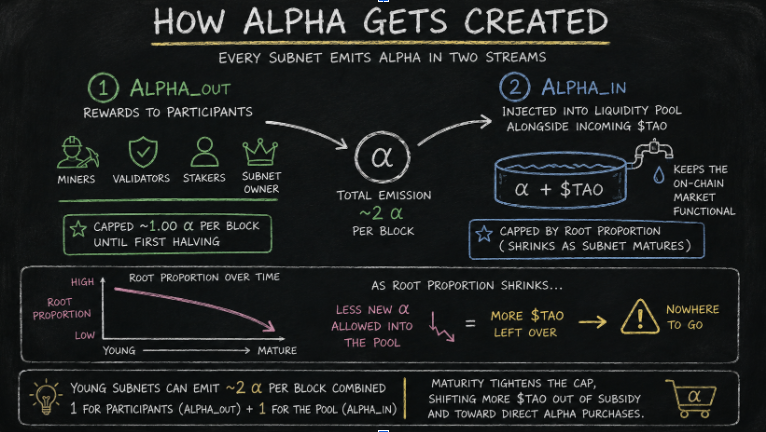
1. alpha_out: Rewards flowing to miners, validators, stakers, and the subnet owner. Capped around 1 alpha per block until the subnet reaches its first halving.
2. alpha_in: alpha injected into the subnet’s liquidity pool alongside incoming $TAO to keep the on-chain market functional.
Young subnets can emit close to 2 alpha per block combined, one for participants and one for the pool.
The alpha_in half is capped by a variable called root proportion, and root proportion shrinks as the subnet matures. Less new alpha allowed into the pool, more $TAO left over with nowhere to go.
Where the Leftover TAO Goes
When the alpha_in cap tightens, the protocol stops creating enough new alpha to pair with the full $TAO allocation. So it uses the excess $TAO to buy existing alpha directly from the subnet’s own pool.
1. Before maturity: $TAO arrives paired with newly minted alpha, both injected into the pool.
2. After maturity: A smaller amount of new alpha still gets injected, but the remainder of the $TAO buys alpha from the market.
3. The shift: The protocol stops relying on new alpha issuance to support the pool and starts converting part of the $TAO subsidy into automated alpha purchases.
The Targon snapshot in Bittensor’s documentation shows this mechanism in action: it received 0.0678 $TAO per block, but the maturity cap allowed only 0.1466 new $SN4 instead of the 1.2524 needed for a price-neutral injection.
The remaining roughly 0.0599 $TAO was used to buy alpha from the pool, meaning around 88% of Targon’s $TAO is already flowing into automatic buys. At 7,200 blocks per day, that amounts to roughly 431 $TAO in daily buy pressure.
Three Clocks Running at Once
Bittensor is not running one scarcity schedule. It is running 128 of them under one hard-capped reserve asset, and three matter most right now.
1. $TAO issuance: $TAO already crossed its first halving at 10.5 million issued. Current base emission is roughly 0.5 $TAO per block, about 3,600 $TAO per day. Next halving arrives near 15.75 million issued.
2. Individual alpha halvings: The oldest dTAO subnets are already past 5.7 million alpha issued. Their first halving hits 10.5 million. Crucially, the first major alpha halving is likely to arrive before the next $TAO halving.
3. The v440 emission gate: v440 concentrated emission toward the head. Below-bar emission across 94 subnets dropped from 38.4% to 12.5%. Top 8 emissions climbed from 32.8% to 52.7%. No subnet was hard-zeroed, but the effective destinations dropped from roughly 50 to 22.
A successful subnet approaching 2028 could be producing less new alpha while receiving a larger share of a concentrated $TAO stream. It could then use most of that $TAO to buy existing alpha, all while the base asset moves toward its own next halving.
The Loop, and What It Cannot Do
The mechanic creates a potential compounding loop for successful subnets.
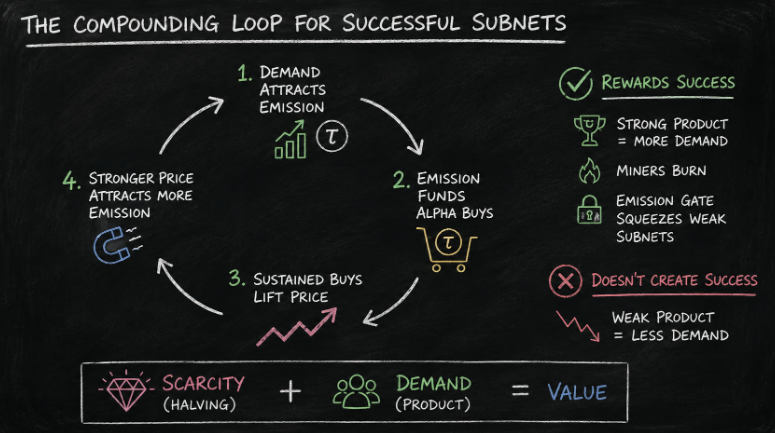
1. Demand attracts emission: Higher moving price earns a larger share of $TAO.
2. Emission funds alpha purchases: More of that $TAO gets routed into buying alpha directly.
3. Sustained purchases can lift prices: Continuous market pressure on the pool.
4. Stronger price attracts more emission: The loop feeds itself.
But the mechanism rewards successful markets; it does not create success where none exists. Weak products still lose demand, while miners burn and the emission gate can squeeze weak subnets toward almost nothing.
Scarcity creates value only when paired with demand: the halving creates scarcity, but the product creates demand.
The Market Chooses, the Code Pays, the Supply Tightens
Bittensor was designed to evolve as its markets mature. Young subnets rely heavily on Root support and fresh alpha emissions, and mature subnets become more self-sustaining, with more of their earned $TAO flowing into their own liquidity pools as automated buy pressure.
This does not solve every value-capture question, since the protocol cannot force external revenue back into the network. But it proves Bittensor already has an internal mechanism that turns subsidy into market demand.
The rules are not a temporary buyback campaign or a marketing announcement. They are built into the protocol’s math: the market chooses, the code pays, and supply tightens.
Enjoyed this article? Join our newsletter
Get the latest TAO & Bittensor news straight to your inbox.
We respect your privacy. Unsubscribe anytime.
Enjoyed this article?
Join our newsletter
Get the latest TAO & Bittensor news straight to your inbox — every morning before markets open.



No comments yet — be the first.