


Introduction:
Bandwidth has always been one of those quiet bottlenecks. Cloud providers charge real money for egress, routes are fixed by policy rather than performance, and a lot of spare capacity sits idle.
Beam (Subnet 105 on Bittensor) tries to fix that by turning bandwidth into something measurable, competitive, and programmable.
It coordinates independent operators who move data between S3, Cloudflare R2, Google Cloud, Salesforce, custom endpoints and more. Performance is verified, rewards follow real delivery, and the whole thing sits on Bittensor’s incentive layer.
The project has been live on mainnet for roughly six months (as of early September 2026) and is already handling meaningful volume.
This piece walks through the current state without the usual hype.
1. Quick Overview
- Purpose: An open coordination layer that lets independent operators move data across clouds, storage systems, P2P networks and AI workloads, with rewards tied to verified performance.
- Launch / Registration: Registered 9 November 2025; mainnet identity and sustained activity from the March 2026 period onward. Six-month mainnet mark noted publicly on 10 September 2026.
- TAO price (20 September 2026 at 7 PM UTC): Trading roughly in the $250–$265 range on the day.
- Subnet Alpha price (Գ): Around 0.0053 τ, which works out to roughly $1.30–$1.45.
- Market Cap / FDV: Circulating market cap sitting near $3.52 million; fully diluted valuation around $29.77 million on a 21 million max supply.
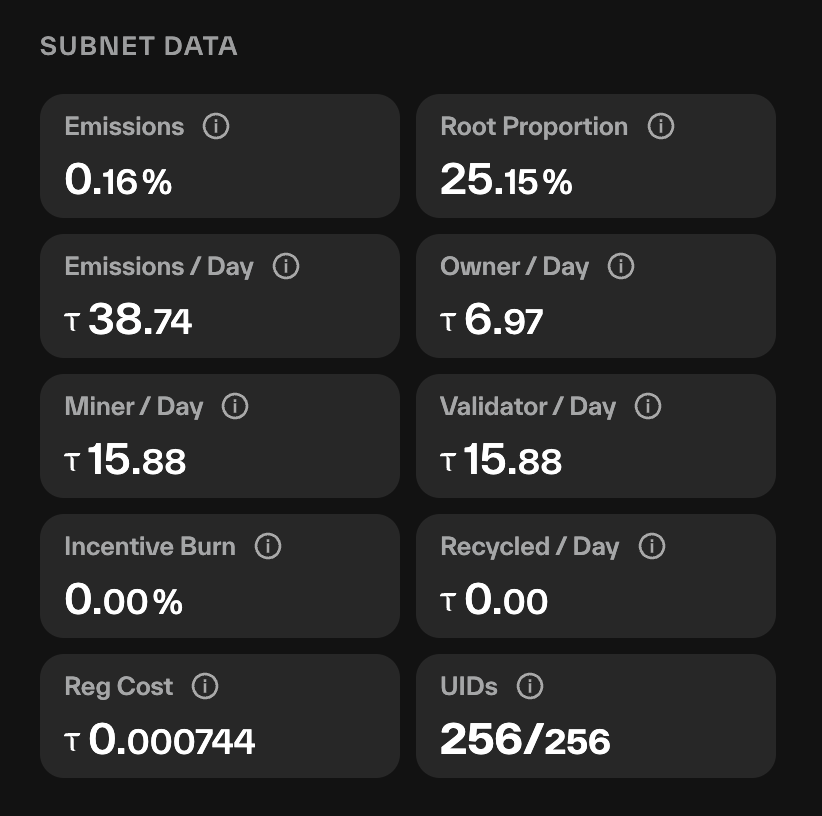
- Emissions %: Currently about 0.18 % of network emissions.
- Root proportion: Varies with staking; ~ 25.15% at the moment.
- Volume / MC: 24-hour volume has been in the $680k–$800k area on recent active days, giving a relatively healthy turnover versus market cap.
Note: Subnet metrics (especially emissions %, volume, and exact alpha price in τ) move every tempo. Always check live explorers for the absolute latest numbers.
2. TL;DR
What is Beam (SN105)?
Beam turns bandwidth into something you can measure, route and reward. Clients ask for data to be moved; the network finds operators who can actually deliver it.
How it works
Clients talk to BeamCore. Orchestrators organise pools of workers and decide the best way to chunk and send the data. Workers do the heavy lifting. Validators check the proofs (PRISM scoring plus verified bytes) and set the weights that decide who gets TAO emissions. Performance determines reward.
Why it matters
AI pipelines and multi-cloud setups burn a lot of money on egress. Beam tries to make that movement competitive and programmable instead of locked to one provider’s price list.
3. Product and Features
Miners (Orchestrators + Workers)
- Orchestrators manage the pools and routing logic. Workers move the actual bytes and can switch pools if another one pays better or performs better. Rewards follow real throughput and reliability rather than just showing up.
Validators
- They read the performance records from BeamCore and set the on-chain weights. The design is meant to favour operators who keep delivering clean transfers.
Core functionality
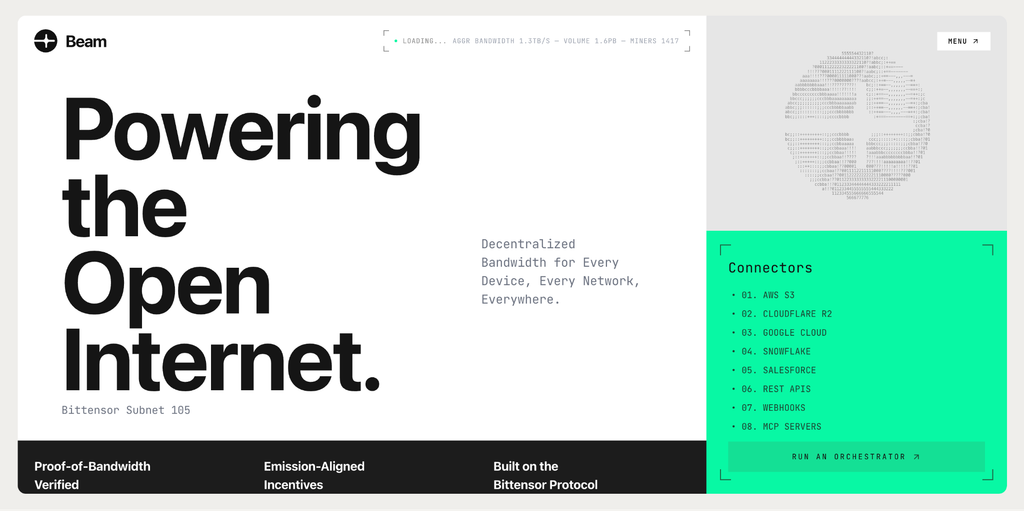
- Parallel transfers (one-to-one, fan-out, aggregation, mesh)
- Connectors already live for AWS S3, Cloudflare R2, Google Cloud, Snowflake, Salesforce, REST APIs, webhooks and more
- Proof-of-Bandwidth / PRISM scoring
- P2P tunnels, rooms and streaming workloads
- Recent public claims include continuous high-volume work and transfers measured in terabytes.
4. Moats
- High-performance transfer: Data moves in parallel across multiple paths, dynamically optimized for real-time conditions. Particularly valuable for large datasets, AI pipelines, and cross-region systems.
- Resilient delivery: Distributed across multiple workers and orchestrators, with automatic recovery from network issues.
- Programmable routing: Define intent (source, destination, constraints) and the network determines the best execution strategy.
- Cost efficiency through competition: Participants compete to deliver data, aligning cost more closely with actual performance.
5. The Team Behind It?

Nic (@Nic_B1m) is publicly identified as Founder & Operator. The project has received support and acceleration from Yuma Group.
The team presents as experienced with enterprise data movement problems and has been building in public with regular technical updates.
Detailed full team bios beyond Nic and the public acknowledgements are limited on the open channels.
6. Code Quality
- Repo: https://github.com/Beam-Network/beam
- Last Commit: Ongoing commits for orchestrator, worker and validator components.
- Languages: Primarily Go (orchestrator/worker) and Python (validator).
- Stars / Contributors: 3 stars, 3 contributors.
- Hardware: Standard requirements; network access, registered Bittensor hotkey on netuid 105, Go 1.24+ and Python 3.10–3.12.
- Forkable?: (MIT) freely forkable
- Quality: Clean separation of roles (orchestrator / worker / validator), public scoring logic (PRISM), production settings documented. Still a relatively young public codebase; community review continues.
7. Social Sentiment
Activity concentrates on the official @b1m_ai account and related Bittensor circles.
Posts about technical milestones (TB-scale transfers, Salesforce connector, protocol upgrades, Novelty Search appearances) generally receive solid engagement from the subnet community.
Sentiment leans constructive and performance-focused rather than pure price speculation. Broader crypto Twitter awareness remains moderate compared with larger subnets.
8. Whale and Conviction Activity
- Team locked 93k Alpha in conviction perpetually in early July.
- Followed it up a week later with another 100k conviction lock.
- Owner-locked Alpha currently sits around 180–185k.
- Over 7,000 unique holders. Most are still underwater on a cost basis.
- Recent sellers are exhausted, ~90% of them fully emptied their bags.
- Pool liquidity sits at roughly 4.6–5.2k TAO.
Bottom line: the team is the clearest whale so far. Distribution looks decent and free float is getting tighter.
9. Valuation Model
Is it undervalued?
Hard to say cleanly. You’ve got live transfers, connectors and actual volume at a few million market cap, so some people call it cheap. Others may say it’s fair for something still proving real demand beyond emissions. It’s a pure judgment call.
Whales and support
The team has locked Alpha a few times (including perpetual locks). Owner-locked sits around 180k. Liquidity is a few thousand TAO and holders are in the thousands. Support is there, but concentration looks normal for a young subnet.
Validator stake and uptime
Only a handful of active validators right now. Stake follows the usual Bittensor pattern. Their scoring system rewards actual delivery and uptime more than pure size, but numbers move daily so check live.
10. Technical Chart Snapshot
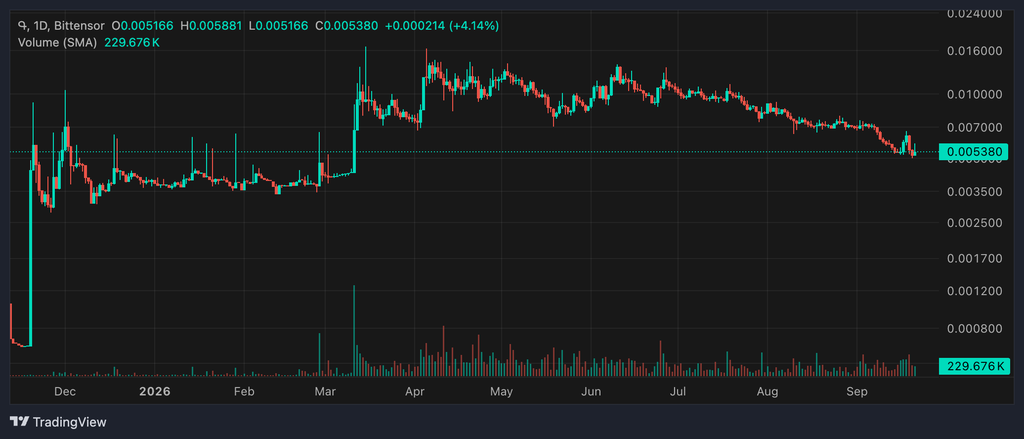
- Trend: Clear downtrend from the April 2026 high near $4.70–$4.90
- Current Phase: Range-bound chop after the selloff, sitting well below prior highs
- Support: Around $1.30–$1.35
- Resistance: $1.55–$1.70 zone, then the bigger $2.50+ area
- Volume: Decent on active days but not aggressive enough for a strong recovery
Note: Needs a clean break and hold above $1.70 with volume to change the picture; loss of $1.30 keeps the downtrend intact
11. Thesis
Bullish
- Unique use case: decentralized programmable bandwidth that moves data across clouds, storage, P2P and AI workloads without the usual expensive egress fees.
- Real products already live: terabyte-scale transfers, continuous workloads on R2/S3/GCP, public dashboard, and working connectors.
- Team skin in the game: nearly 200k Alpha locked by the project itself, including perpetual locks.
- Low relative valuation: ~$3M market cap / ~$30M FDV with actual usage already happening.
- Active development: open-source repo, regular updates, and six months of measurable progress since mainnet.
Bearish
- Still early and emissions-dependent, real recurring revenue has to prove itself beyond the current transfer volume.
- Price has been in a clear downtrend since the April highs near $4.70–$4.90.
- Liquidity is modest (a few thousand TAO in the pool), so big moves can still be choppy.
- Holder base is broad but most tracked wallets remain underwater on cost basis.
- Enterprise and agentic demand is promising but still largely speculative at this stage.
12. Final Verdict
🟡 Speculate
Beam has moved past the slide-deck stage. There are live transfers, public code, working connectors and a visible team shipping updates.
At the same time the market cap is still small and the risks are the usual early-subnet ones.
Suitable only if you understand how Bittensor emissions and Alpha tokens work and can size the position accordingly.
13. Glossary
- Alpha / Գ: The subnet token of SN105
- PRISM: Beam’s performance scoring system for orchestrators
- Orchestrator: Manages worker pools and routing
- Worker: The node that actually moves the data
- Proof-of-Bandwidth: The verification layer that records real transfer results
- Egress: The fee cloud providers charge when data leaves their network (Data transfer out).
- Yuma Group: The Bittensor-focused accelerator that helped bring Beam (SN105) to mainnet.
14. Sources
- Official site: https://b1m.ai/
- Documentation: https://data.b1m.ai/guide/intro
- GitHub: https://github.com/Beam-Network/beam
- Live market and subnet data: https://www.tao.bot/explore/subnet/105
- Official account: https://x.com/b1m_ai
- Founder account: https://x.com/Nic_B1m
15. Disclaimer
This is not financial advice. Subnet tokens are extremely volatile and you can lose everything you put in.
Numbers change constantly; verify everything on the primary sources linked above before making any decision.
More on Beam (SN105):
Enjoyed this article? Join our newsletter
Get the latest TAO & Bittensor news straight to your inbox.
We respect your privacy. Unsubscribe anytime.
Enjoyed this article?
Join our newsletter
Get the latest TAO & Bittensor news straight to your inbox — every morning before markets open.
No comments yet — be the first.