


If you’ve been feeling like things are moving fast in Bittensor, you’re not imagining it. The OpenTensor Foundation and core contributors have been shipping protocol upgrades that touch incentives, emissions, capital flows, and network hygiene.
Here is a report on what is happening, why it matters, and what it changes for holders, validators, and subnet teams.
First, Why These Changes Are Happening Now
Before getting into the individual upgrades, it helps to understand the thinking behind all of them. On June 21, Bittensor’s co-founder posted a longer piece laying out where the network is and where it’s going, and it puts everything else in context.
Bittensor is intentionally not fully decentralized yet, and that’s a deliberate choice. The comparison drawn is with Bitcoin. Bitcoin had to be fully decentralized from day one because it launched into a mature, heavily controlled financial system where any central point of control was a direct risk. AI is different. It’s still early, and the world hasn’t even worked out how to own or steer intelligence at scale, legally or culturally. So the network is taking a build-it-right-first approach instead of decentralizing a system before it’s strong enough to survive on its own.
What’s already decentralized:
- No pre-mine.
- More than five years of organic ownership distribution to real builders.
- Permissionless access. Anyone can build, mine, or use subnets without permission or ID.
- Strong validator teams and 128 subnet teams running live ecosystems.
Const then highlighted the things still needed before full decentralization (which would happen in roughly 18 months):
- Root Reborn, turning validators into competitive allocators. Already in discussion.
- Symmetrical liquidity pools, including shorting and borrowing, so the market can’t be easily manipulated.
- Full Conviction, giving alpha-token holders real power based on long-term commitment.
- More fine-tuning of TaoFlow and the emission algorithms.
- More active removal of teams that are purely extracting value instead of building.
The Big One: Root Reborn
This has been the main conversation of the past week, and for good reason. It’s the biggest proposed change ever to Bittensor’s root layer.
Here’s the problem it’s trying to fix. Right now, when you stake to a root (Subnet 0) validator, your yield gets paid in a particular way: the protocol automatically swaps subnet alpha tokens into TAO every block and hands it over.
That sounds harmless until you see what it does at scale. The network is constantly selling the very subnet tokens that give it value. Root currently pulls in roughly 1,000 TAO/day worth of alpha from subnets and then mechanically sells all of it. That creates steady sell pressure, hurts price discovery for subnets, and wastes potential compounding.
Root Reborn changes the mechanism. Instead of auto-selling, each root validator sets allocation weights across subnets, basically choosing a portfolio. The yield that would have been dumped gets reinvested into that basket of subnet tokens, compounds over time, and is staked back under the validator. Stakers still earn, and can still redeem to TAO whenever they want.
The flow of money flips: the mechanism that used to be a constant sell becomes net buying that supports subnet prices.
What it means in practice:
- Validators can optionally reinvest root yield (alpha) back into subnets instead of auto-selling.
- It turns validators into transparent allocators competing on TAO-denominated returns to their stakers.
- Your stake stays yours, with per-staker baskets and no single escrow risk.
- The current default behavior doesn’t change. If you want to stay passive, you stake, earn, and claim TAO like before.
- Deferred claiming could cut up to roughly 33% of root-induced sell pressure annually.
Const went point by point, addressing the common concerns: the opt-in is real, validators have skin in the game, and the market checks bad allocators.
Root Reborn is not live yet. The proposal is submitted to GitHub aimed at testnet first, and it’s out for community discussion.
The Pushback: Yuma Says Slow Down
Yuma, one of Bittensor’s largest contributors and one of the network’s top validators, published a detailed public critique arguing that Root Reborn carries substantial risks that may outweigh the benefits. The main worries:
- Conflict of interest. Validators would gain real influence over where capital flows. Nothing stops them from steering allocations toward subnets they already hold positions in, or toward subnets quietly offering incentives to attract that capital.
- Moral hazard. Yuma compared the setup to the LIBOR scandal, where a small group of participants ended up controlling a benchmark everyone relied on. Validators, they argue, should be expected to maximize their own returns, which won’t always line up with the interests of their delegators.
- Measurement problems. Because validators don’t control when stakers enter and exit, holding target allocations and fairly judging validator performance becomes difficult.
Their ask: more testing, real risk analysis, and a formal upgrade roadmap before anything ships to mainnet. You don’t have to pick a side to see why this matters. A decentralized network should have its biggest players publicly stress-testing a change this consequential.
Read more below:
Emissions Housekeeping: Inactive Subnets Trimmed (June 22)
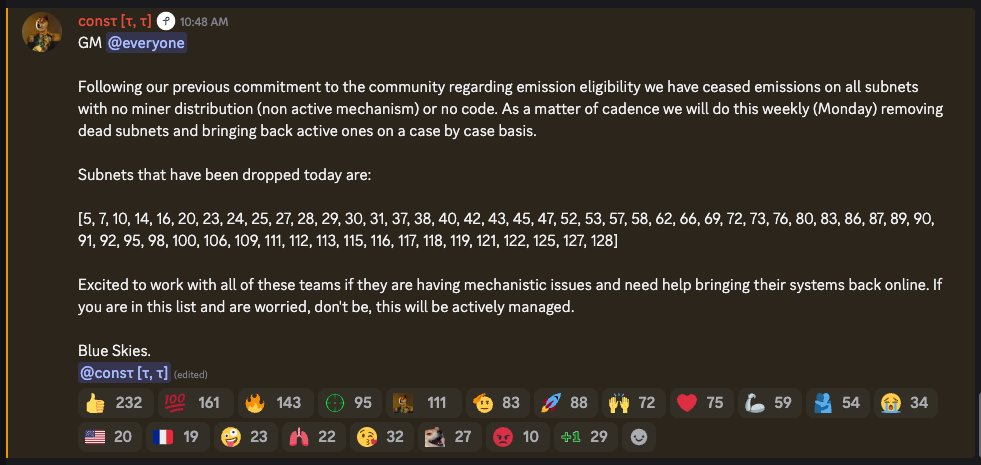
Separate from the Root Reborn debate, a weekly cleanup started yesterday. The OpenTensor Foundation ceased emissions on subnets with no miner distribution (non-active mechanisms) or no working code.
Here’s the full list of subnets dropped:
5, 7, 10, 14, 16, 20, 23, 24, 25, 27, 28, 29, 30, 31, 37, 38, 40, 42, 43, 45, 47, 52, 53, 57, 58, 62, 66, 69, 72, 73, 76, 80, 83, 86, 87, 89, 90, 91, 92, 95, 98, 100, 106, 109, 111, 112, 113, 115, 116, 117, 118, 119, 121, 122, 125, 127, 128.
This is routine Monday maintenance where dead weight comes off, active subnets get brought back case by case, and the foundation has said it’s happy to work with teams to get things running again.
It’s worth understanding why this matters, because the trimming is helping the ecosystem in very positive ways. Emissions are a finite pool. Every block, a fixed amount of TAO and alpha gets distributed across the network, so any emission flowing to a subnet with no miners or no working code is emission not reaching subnets that are producing something useful.
Cutting the dead weight tightens that loop. It pushes rewards toward useful work, keeps the network lean and competitive, and removes a quiet drain on the system. It also keeps the subnet landscape honest. A subnet that wants emissions has to run live code with real miner distribution, not just hold a slot.
And because reinstatement is case by case rather than permanent removal, teams that go quiet for a while aren’t punished forever. They just have to come back online to earn their place again.
What Does All This Mean?
Bittensor is tightening itself into a sharper incentive machine. The updates focus on reducing wasteful sell pressure, making capital allocation smarter and more competitive, cleaning up dead subnets so emissions go to useful work, and giving people real optionality so the passive defaults stay simple.
The protocol isn’t slowing down. Expect more from the OpenTensor Foundation and Const in the coming days.
Enjoyed this article? Join our newsletter
Get the latest TAO & Bittensor news straight to your inbox.
We respect your privacy. Unsubscribe anytime.
Enjoyed this article?
Join our newsletter
Get the latest TAO & Bittensor news straight to your inbox — every morning before markets open.



No comments yet — be the first.