


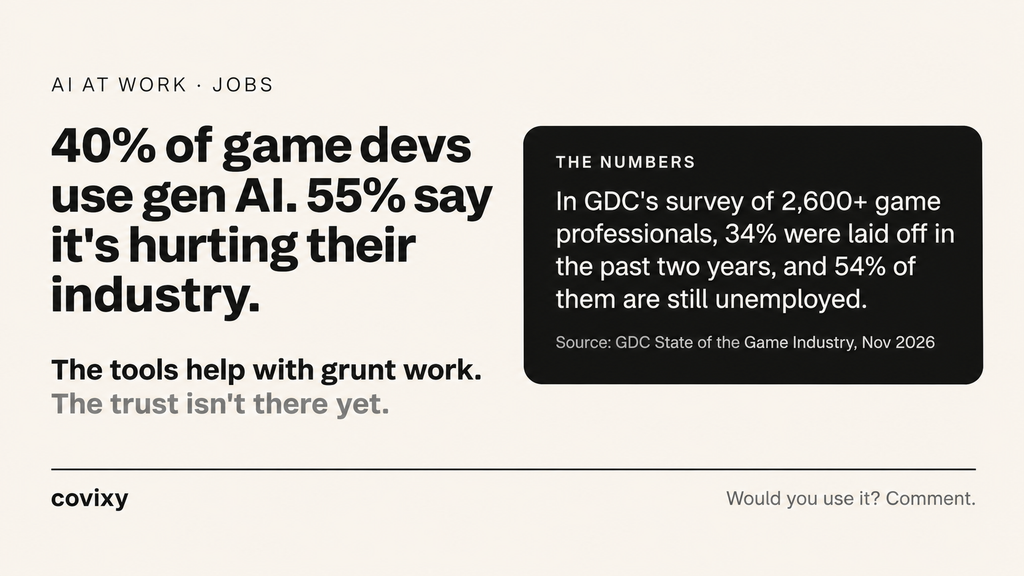
Game developers are already using generative AI even as many question its effect on the industry.
GDC, in a 2026 State of the Game Industry report, noted that 40% of gaming professionals said they used generative AI at work, while 55% believed it was having a negative impact on the industry.
Tools such as Google’s Genie 4, Roblox Cube, Rosebud AI, and Higgsfield are expanding what AI can generate.
For game creators, a practical question follows. How do you turn a generated world into a level you can play, revise, and build on?
404-GEN (SN17) develops AI tools for generating 3D assets and building interactive worlds. Its new game-building harness gives AI agents specific jobs and checks their work before it moves to the next stage.
In two demonstrations, 404-GEN tested whether that process could turn a one-sentence brief into a playable prototype.
From a Single Sentence to a Cyberpunk Rooftop
“An FPS samurai game that involves parkour in a cyberpunk world.”
From that brief, the agents built a first-person level with a 70-metre rooftop course, a Japanese shrine, a torii gate, and a sentry drone.
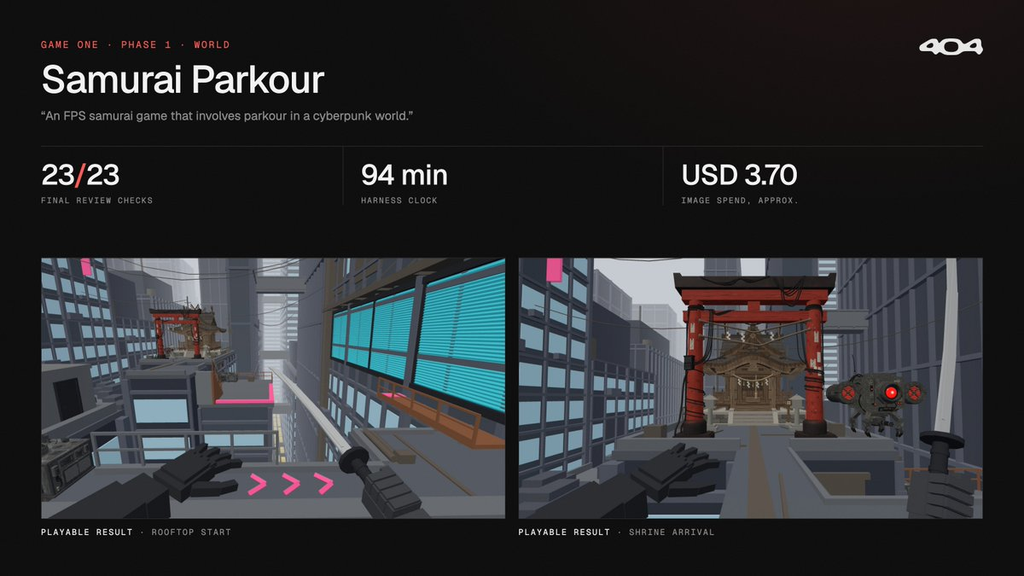
They built the environment entirely in Three.js, a JavaScript library for rendering 3D scenes in a browser, without importing any 3D models.
The prototype passed all 23 independent review checks in about 94 minutes. 404-GEN reported spending $3.70 on reference images.
How 404-GEN Restyles a Level Without Rebuilding It
The demonstrations cover the first two of 404-GEN’s five planned harnesses. Each handles a different decision about the game.
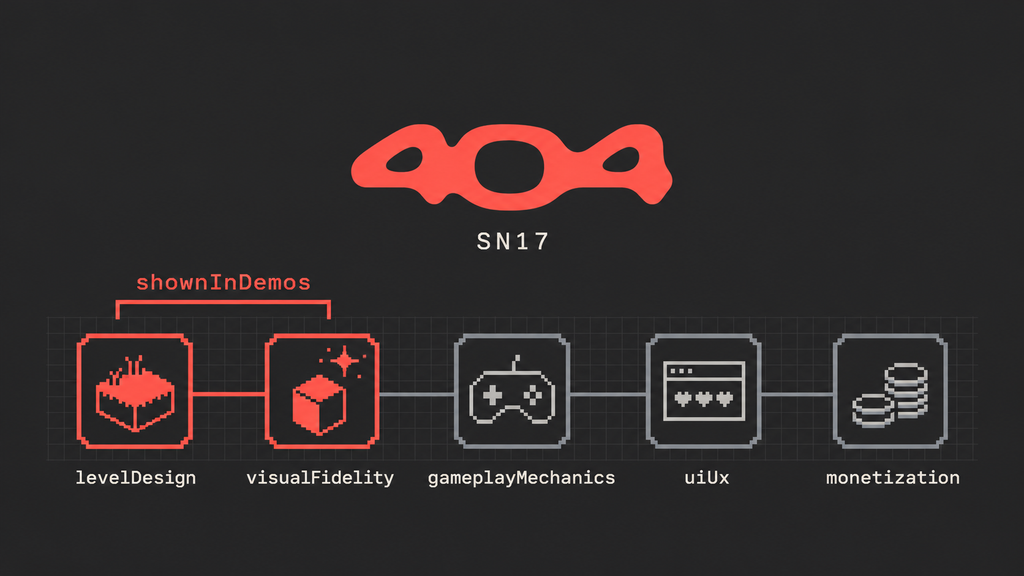
1. Level Design: Agents build the layout, terrain, structures, and key objects. The level goes through independent review before moving to the visual stage.
2. Visual Fidelity: Agents explore different art directions while keeping the geometry and existing gameplay fixed. On the rooftop course, 404-GEN tested a realistic cyberpunk city in the rain and a manga treatment built around ink and neon. Both let creators play the same route and judge the art direction in motion.
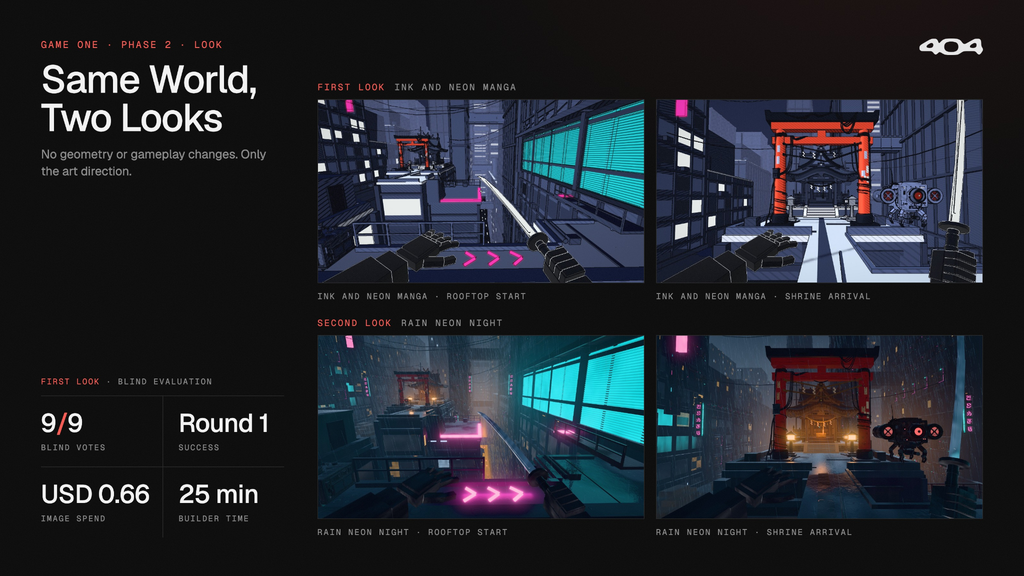
The manga version earned nine out of nine votes in its first blind evaluation. That pass took about 25 minutes and used another $0.66 in reference images.
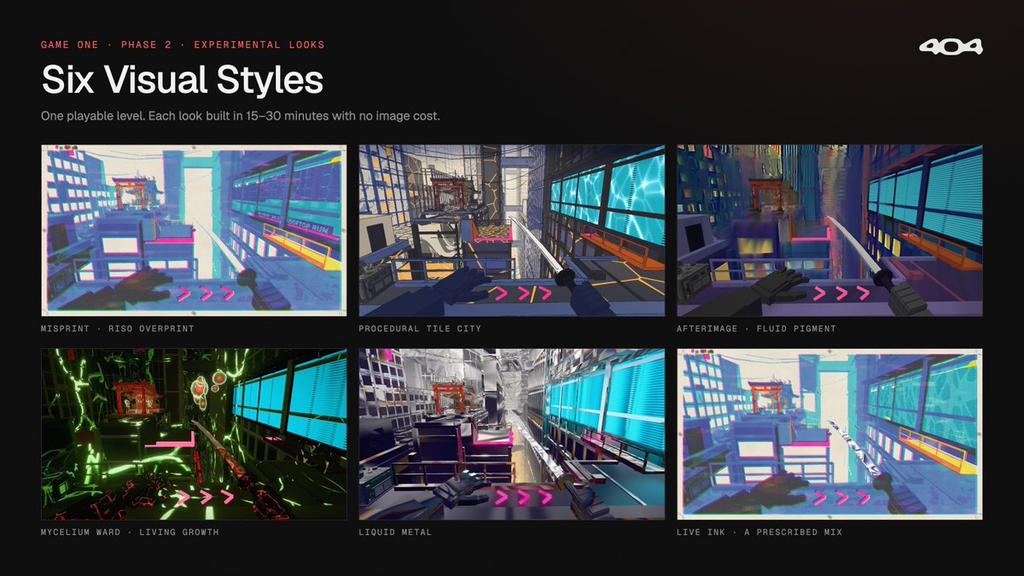
The team produced six further styles in 15 to 30 minutes each using open-source rendering techniques, with no image-generation costs for those variants.
The Same Process Built a Flying Game
For the second demo, 404-GEN shortened the brief to “A sky islands flying game.”
The agents built a third-person gliding adventure among floating islands, ancient ruins, and a ruined temple.
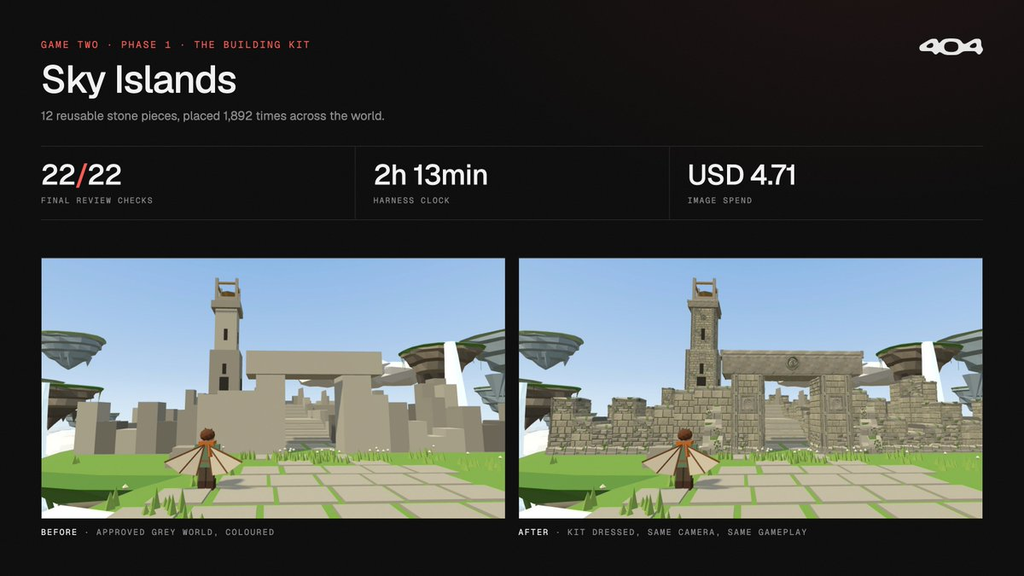
They created 12 reusable stone components and placed them 1,892 times across the level to detail the environment.
The flying prototype passed all 22 independent review checks in two hours and 13 minutes, with $4.71 spent on reference images. 404-GEN went on to produce six additional playable styles for the gliding level.
What Happens After the First Prompt
Both demos are playable prototypes. The three harnesses still in development will cover gameplay mechanics, the player interface and experience, and monetization. As those tools mature, 404-GEN plans to make them available to existing Game Jam creators on its platform.
404-GEN wants creators to be able to save their work at each stage and return to it through conversation with AI agents.
After testing the flying level, for example, a creator could pick up from a saved stage and ask the agents to refine how the glider handles while keeping the world they’ve already built.
In that workflow, the first prompt gives the creator something concrete to play, and the playtest gives them a better idea of what to ask for next.
➛ Access 404-GEN Here.
Explore World’s Largest Open-Source 3D Dataset by 404-GEN (SN17):
Enjoyed this article? Join our newsletter
Get the latest TAO & Bittensor news straight to your inbox.
We respect your privacy. Unsubscribe anytime.
Enjoyed this article?
Join our newsletter
Get the latest TAO & Bittensor news straight to your inbox — every morning before markets open.



No comments yet — be the first.