


Most AI-generated game demos look impressive in a tweet and collapse the moment anyone tries to play them.
404-GEN‘s latest internal experiment goes the other way. The team handed a winning miner’s repository to Claude with a single prompt about Japanese pagodas and flying between islands, and got back a fully playable browser game with over 100 procedurally generated 3D models.
The point is not the game itself but what the subnet’s tooling makes possible when handed to a coding agent.
What Procedural Three.js Models Are
Three.js powers most 3D content rendered in web browsers, from product configurators to in-browser games.
Procedural Three.js models are 3D assets generated by code rather than hand-modeled in software like Blender, with each asset described by rules and parameters the engine resolves into geometry at runtime.
The advantages for anyone building interactive 3D experiences:
a. Infinitely variable, with the same logic producing different but stylistically consistent outputs every run.
b. Small file sizes, since the code is lighter than a baked mesh, keeping web games fast on mobile.
c. Composable pipelines, with generation logic for one asset type combining cleanly with logic for another.
d. Fast iteration, since changing a parameter regenerates the asset instantly.
The catch has always been that writing the generation logic itself requires both 3D math fluency and an aesthetic sense for what makes procedural output look intentional.
This is exactly what 404-GEN’s miners have been competing to solve.
The Experiment: A Japanese Pagoda Game From One Prompt
The team tested whether the miner output was composable enough for a coding agent to assemble into something playable.
Setup was minimal: Claude got access to a winning miner’s repo and one instruction to build a flying exploration game.
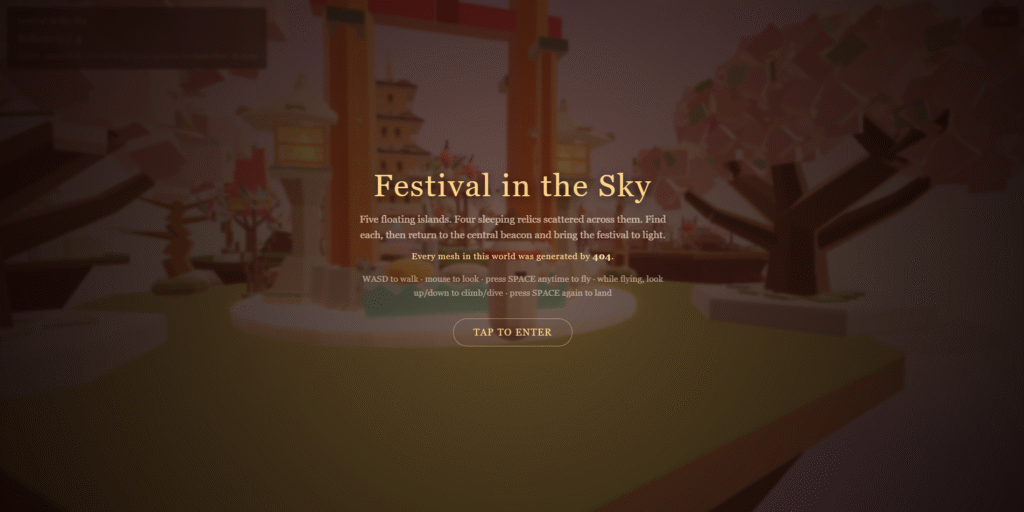
The output is live at “Festival in the Sky” and includes:
a. 100+ unique procedurally generated 3D models covering pagodas, islands, and collectibles.
b. A fully playable exploration loop with flying mechanics, running directly in the browser.
c. Mobile compatibility out of the box, which is the threshold most browser-based 3D experiments fail.
d. End-to-end agent assembly, with scene logic and asset integration handled by Claude rather than a human developer.
The significance is not that it produces a polished commercial game, but that it produces a coherent, playable experience from inputs that would have required a small team of developers and 3D artists working for weeks just a year ago.
Why This Already Outpaces Current 3D Vibe-Coding Platforms
The team noted that this is a very early internal experiment and attempt with no productization work behind it, and it is already outpacing the visual ceiling of current 3D vibe-coded platforms.
The gap matters because the bottleneck for AI-generated games has not been the agent layer or the prompting interface, but the quality of the asset generation the agent has to work with.
Why most vibe-coding platforms hit a ceiling:
a. They rely on pre-baked asset libraries with limited variety.
b. Their procedural generators produce visually flat output.
c. The agent on top is only as good as the assets underneath.
404-GEN’s miner network on Bittensor Subnet 17 has been pushing the asset generation layer forward through open competition, with every winning repository becoming a publicly available building block future miners learn from.
The Japanese pagoda demo is what happens when an agent is given access to the best of that compounding work, and the same approach scales directly to creators who do not write code at all.
Try the demo here.
Putting these tools into creators’ hands is the next step, and it is the step that turns a research subnet into something with a real consumer surface.
Enjoyed this article? Join our newsletter
Get the latest TAO & Bittensor news straight to your inbox.
We respect your privacy. Unsubscribe anytime.
Enjoyed this article?
Join our newsletter
Get the latest TAO & Bittensor news straight to your inbox — every morning before markets open.



No comments yet — be the first.