


While crypto markets weakened, Bittensor’s Novelty Search E095 discussion presented a different picture of activity within the network. Teams reported advances in model training, historical simulation, inference efficiency, and automated research.
The opening argument was that market sentiment was obscuring a significant period of technical progress.
Four model releases or optimizations were highlighted within ~24 hours, including work associated with ChronoLLM (SN38), Reliquary (SN81), and Trishool (SN23).
These were described as improving the balance between capability and computing requirements. Gamma, quantum-resistant wallets, and proxy improvements were also discussed as infrastructure developing alongside the network’s AI products.
Much of the discussion centred on why these results are becoming possible now. Decentralized AI requires reliable coordination, verification, and incentives across machines that may disconnect or behave dishonestly.
Earlier attempts struggled with these conditions, but stronger AI agents and more mature tools are helping teams develop workable solutions.
Gamma was presented as a potential way to connect projects with compute and funding, including for resource-intensive validation.
Reliquary (SN81) provided one example. Previously known as Grail, the subnet was rebuilt following a takeover through a conviction lock.
Its miners earn rewards by finding situations where a model struggles, producing useful experiences for further training. Using Targon (SN4)’s sandboxes and compute from Lium (SN51), Reliquary completed post-training for Teutonic-I-Reliquary, a nine-billion-parameter model reported to outperform its Qwen baseline on several coding and reasoning benchmarks.
The mechanism accommodates smaller GPU operators and could be applied to larger models.
The discussion then connected this work with IOTA (SN9)’s Liquid Compute infrastructure. Its custom software allows training to continue as machines join, disconnect, or become unavailable.
A competitive small decision model was cited as evidence that this approach can deliver results across hardware with varying capabilities and reliability. The two projects address complementary needs, with Reliquary gathering valuable training experiences and IOTA coordinating computing resources.
ChronoLLM (SN38) introduced another question of trust: how to test a model’s historical decisions without letting it know what happened next.
Conventional models may already know about events such as COVID-19, making their apparent predictive ability misleading.
ChronoLLM trains models using information available before specific historical cutoffs. Its new 16-billion-parameter model had completed pre-training, with reported improvements over an earlier AQR model including an eightfold increase in context window and a 12.5% gain on the Open LLM benchmark.
Miners improve ChronoLLM’s models by collecting eligible historical data and submitting better model weights.
Evaluation checks performance and detects information leaking in from later periods, while licensing restrictions limit publication of the dataset.
Applications include testing investment ideas across past market conditions and examining how corporate decisions might have performed during disruptions. The ambition is to develop models that contribute original ideas and learn across decades of historical scenarios.
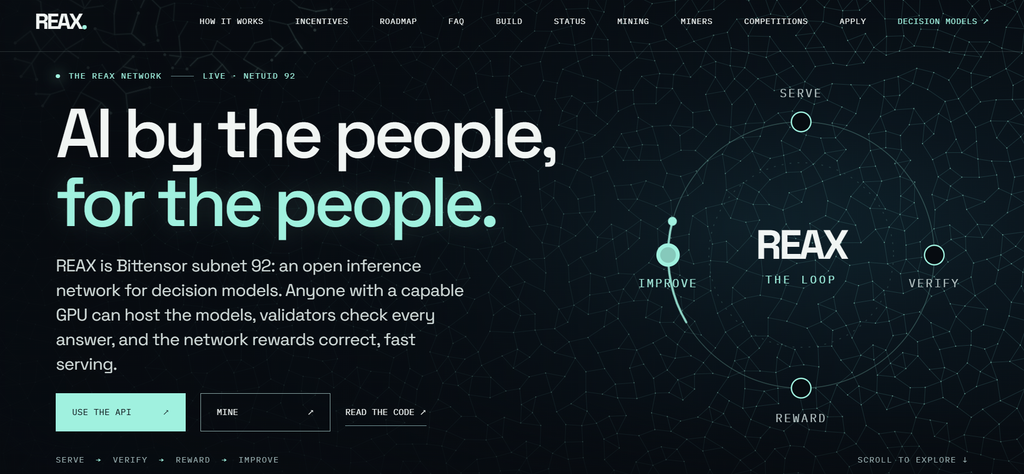
REAX (SN92)‘s significance is speed, verification, and commercial deployment. Its decision models return scores or probabilities for predefined choices, supporting classification, prioritization, and routing.
Validators compare miners’ outputs with a reference model, while a separate competition improves the inference engine.
According to the team’s measurements, the optimized engine achieved approximately 3.6 times the speed of conventional frameworks such as vLLM on the relevant workloads.
A parallel REAX training competition attracted 67 valid entries before being paused to prioritize optimization and customer acquisition while managing selling pressure from rewards.
The subnet reported paying customers before launch, with services spanning hosted APIs, dedicated GPU hosting, and local deployment tools.
It also outlined preconfigured hardware and a European tier addressing data residency and retention requirements.
Elsewhere, Apex (SN1) was simplifying competition creation, OpenRoboto (SN80) was connecting visual data with robotics training, and NOVA (SN68) was linking computational research with automated laboratory testing.
Together, these developments show Bittensor producing systems whose value can be assessed through practical results.
Models can be benchmarked, distributed training tested under disruption, and commercial services measured through customer demand. Reliable evaluation, scale, and sustainable revenue remain essential.
Beneath market volatility, the discussion showed how the network’s incentives are helping turn difficult AI research into tools and services that can be tested and improved.
Enjoyed this article? Join our newsletter
Get the latest TAO & Bittensor news straight to your inbox.
We respect your privacy. Unsubscribe anytime.
Enjoyed this article?
Join our newsletter
Get the latest TAO & Bittensor news straight to your inbox — every morning before markets open.

No comments yet — be the first.