

For nearly three years, the teams behind Nodexo (SN106) and Verathos (SN96) have been working on different parts of the same problem.
How do you pay an unknown machine to run AI and verify that it actually did the work? Nodexo focused on verifying the hardware, while Verathos focused on verifying the computation.
Now, the two efforts are becoming one. On September 28, 2026, the teams announced that Nodexo and Verathos will consolidate under the Verathos name and Subnet 96.
Nodexo’s Subnet 106 will move to a new team, while the original builders shift their engineering, attention, and token activity to Subnet 96.
From Verified Hardware to Verified Inference
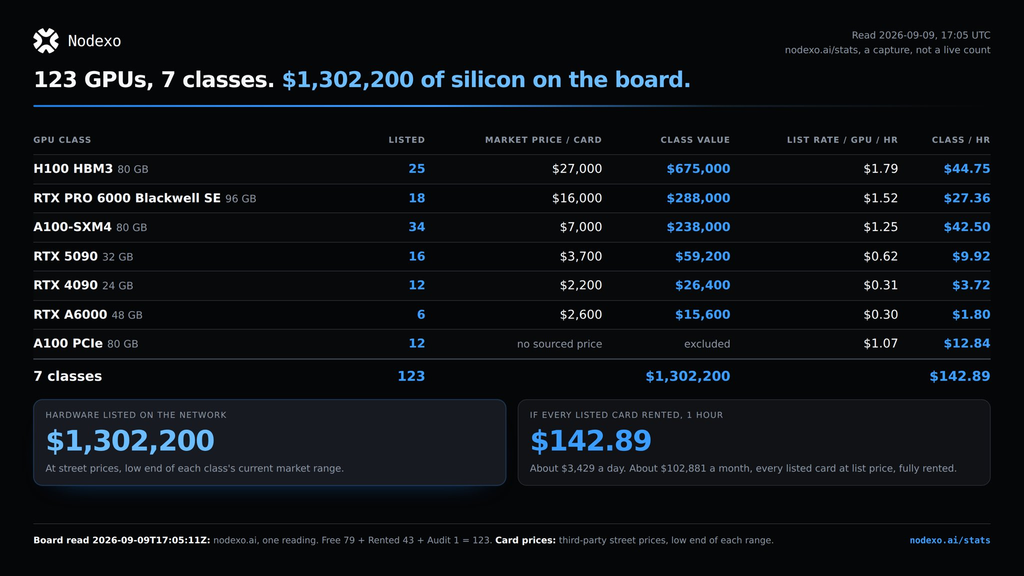
Nodexo started by solving the hardware side of the trust problem. It used cryptographic matrix multiplication challenges to verify GPUs and connect their results to on-chain identities, with more than 120 GPUs passing the verification process at peak.
Verathos took that approach a step further by verifying the computation itself. Model weights are committed under Merkle roots, random layers are challenged using sumcheck proofs, and the resulting proof is returned with the inference response.
This gives users evidence that the requested model actually ran without requiring them to simply trust the operator.
Running both networks showed the team that these two systems worked better together. Nodexo had verified GPU capacity, but renting entire machines left much of that capacity unused, while users increasingly wanted to run models without having to provision machines, manage drivers, or operate their own infrastructure.
Inference also made better use of distributed hardware because requests can be handled independently and retried quickly when a machine fails. Different GPU types can contribute to the same network, while larger models can be split across several machines through the team’s mesh-serving system, Sleipnir.
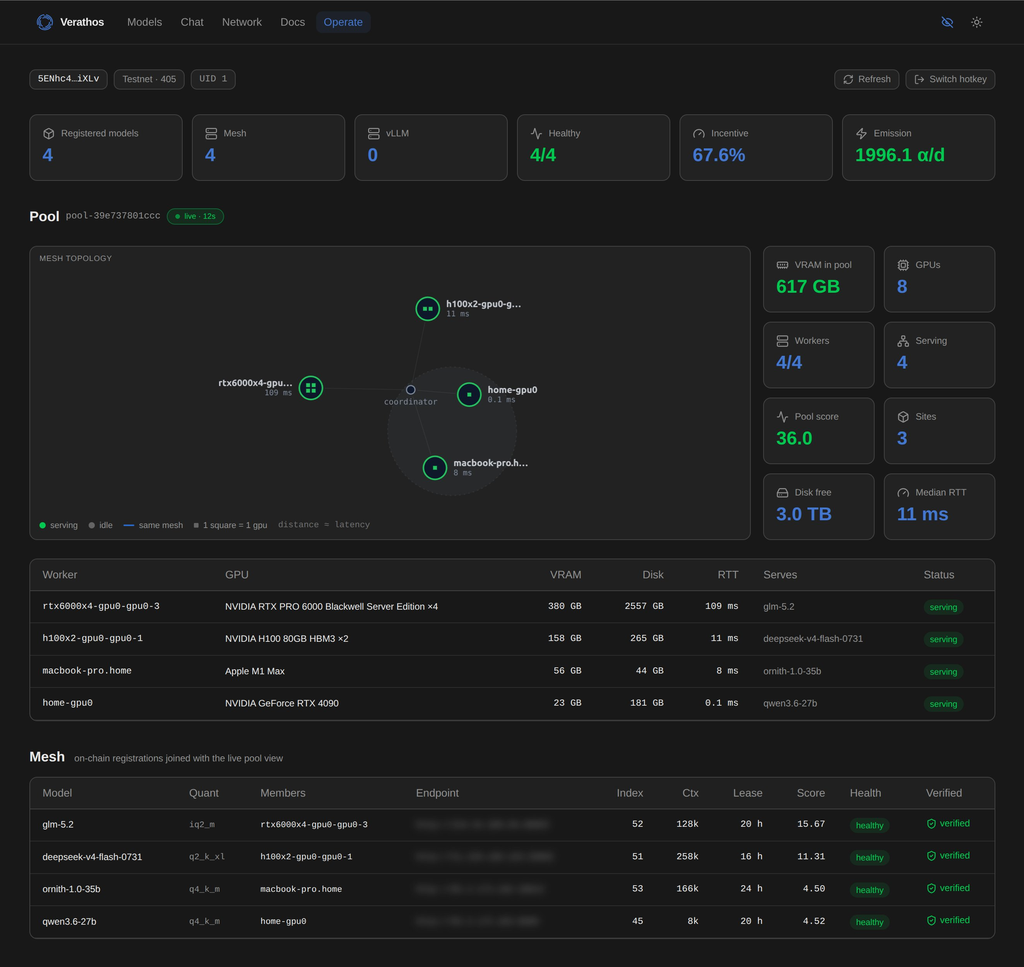
As the infrastructure behind both projects became more closely connected, the separation between the two networks became less useful. The consolidation therefore brings Nodexo’s verified hardware supply and Verathos’s verified inference system into one network on Subnet 96.
What Changes on Subnet 96
The consolidation brings hardware verification, inference, payments, and computational proofs into one network.
- Operators can verify their hardware, serve models, and prove the resulting computation.
- Builders and agents get one OpenAI-compatible API with proof metadata attached to responses.
- Payments can use prepaid credits, accountless x402, or conviction allowances.
- Holders now have one token tied to the combined network, while locked alpha can still provide a daily allowance of verified inference without spending the stake.
Subnet 106 will continue under its new team and the original builders are moving their focus entirely to Subnet 96.
Why the Economics Matter
The team sees an opportunity in hardware that already exists outside major AI data centers, including gaming GPUs, workstations, and idle capacity.
Two barriers have limited its usefulness. Memory limits can prevent a single machine from serving larger models. Sleipnir addresses this by distributing models across multiple machines.
Trust is the other barrier. Users need to know that an unknown operator actually performed the computation they paid for. Verathos addresses this with cryptographic proofs.
That shifts the network’s focus from selling GPU hours to selling verified intelligence. Batching and continuous routing can allow one GPU to serve multiple buyers, while network revenue is used to buy and lock Subnet 96 alpha in perpetual conviction.
Earlier plans for Nodexo had pointed toward a broader compute marketplace.
What Comes Next
The immediate focus is scale, with plans for more models, including models produced by other Bittensor subnets, more consumer GPUs joining shared pools, Apple Silicon support, and trusted execution environments.
The broader thesis is simple; AI capacity is becoming concentrated among a small number of companies, while capable hardware remains scattered across machines that are often underused.
Nodexo proves the machine and Verathos proves the computation, together Subnet 96 is bringing both into one network, turning distributed hardware into a market for AI inference where the work can be verified rather than simply trusted.
Verified inference is already live at verathos.ai.
Enjoyed this article? Join our newsletter
Get the latest TAO & Bittensor news straight to your inbox.
We respect your privacy. Unsubscribe anytime.
Enjoyed this article?
Join our newsletter
Get the latest TAO & Bittensor news straight to your inbox — every morning before markets open.

No comments yet — be the first.