


Nodexo (SN106) published its whitepaper ahead of mainnet on June 23 with the document showing how the team applies Bittensor’s conviction mechanism to compute access rather than yield.
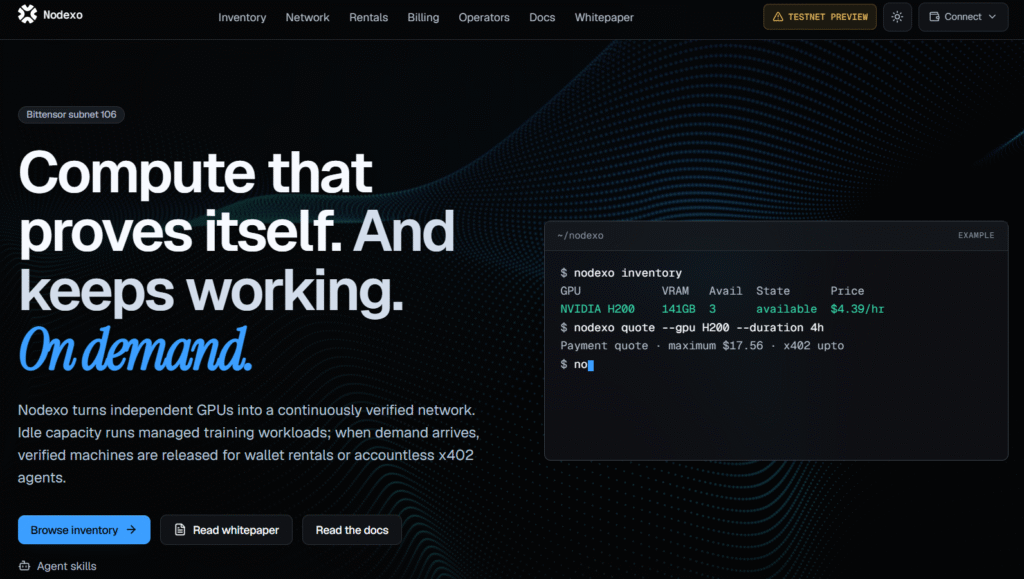
Nodexo is a peer-to-peer GPU rental marketplace where the network continuously verifies that listed machines are real through cryptographic hardware proofs tied to on-chain identity.
The conviction allowance lets $TAO holders lock stake to the subnet permanently and receive a daily compute allowance proportional to their share of the fleet, while normal staking yield stays untouched.
Hardware That Proves Itself
Most compute marketplaces rely on operator trust, SSH access, or dashboard self-reporting to confirm that listed hardware exists and matches what the seller claims.
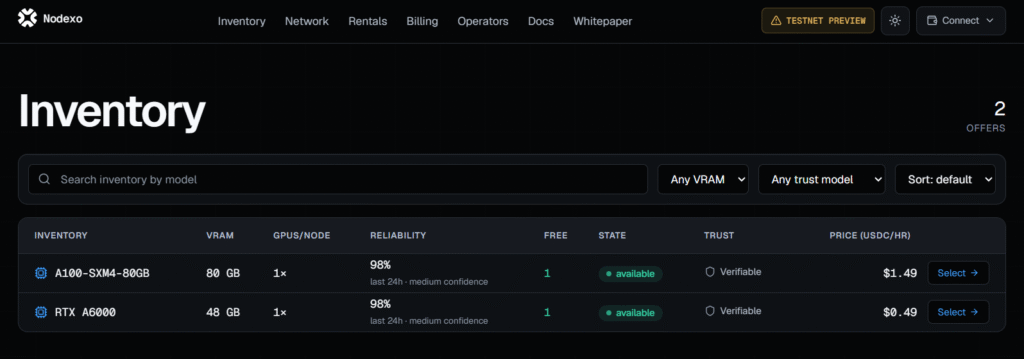
Nodexo runs cryptographic hardware proofs, with each machine bound to an immutable device fingerprint and verified continuously on-chain.
The mechanics:
1. TIMED CRYPTOGRAPHIC CHALLENGES: Real GPUs answer within the time bounds only that class of hardware can hit. Phantom cards or weaker silicon wearing a bigger name fail the challenge and do not earn.
2. DEVICE FINGERPRINTS BOUND TO ON-CHAIN IDENTITY: Every machine is fingerprinted before earning anything. The chain knows which fingerprint maps to which operator and which hardware class.
3. CONTINUOUS VERIFICATION: The proof loop runs continuously rather than as an occasional audit. A machine that drops below its claimed capability stops earning at the moment of degradation.
4. WALLET-SIGNATURE-ONLY ACCESS: No account required to rent, which means AI agents can access compute the same way humans do.
Without this layer, the conviction allowance would be paying out compute against a fleet the network cannot trust. With it, every credit issued is backed by a machine the chain has verified is real.
The Conviction Allowance
The conviction allowance solves a problem DePIN projects have struggled with for years: how to attract long-term capital that does not flee the moment yields compress.
How it works:
1. LOCK $TAO TO SN106 PERMANENTLY: Your stake never gets spent and continues earning normal Bittensor staking yield.
2. RECEIVE A DAILY COMPUTE ALLOWANCE: GPU access is allocated proportional to your share of total locked stake across the subnet.
3. POOL SIZE SCALES WITH REAL FLEET CAPACITY: Sized as a fraction of the fleet’s actual listed capacity each day. If no machines are running, the pool is zero. If the fleet is full, the pool is large.
4. NO ROLLOVER: Unused compute resets daily.
5. LEAVING IS COSTLY: A 60-day half-life applies if you switch to decaying mode. Your stake bleeds out gradually rather than exiting at full value.
The alignment flips the usual DePIN equation: the people receiving free compute are the people who have committed to staying, and their reward is denominated in the resource the network actually produces.
Open Access by Design
The whitepaper’s second important architectural choice is that no single frontend controls access to the network. Nodexo distributes the marketplace itself across validators.
The key pieces:
1. VALIDATORS RUN ON CPU ONLY: Verifying hardware proofs is cheap by construction, so a validator does not need to operate a GPU fleet to participate.
2. ANYONE CAN OPEN A STOREFRONT: Validators can run their own storefronts over the shared fleet. The network does not depend on one team’s website to stay live for compute to be rentable.
3. THREE WAYS TO ACCESS COMPUTE: Per-rental via x402 for agents, prepaid credits, or allowance earned through conviction. Each path serves a different user pattern.
A marketplace with many doors and no central gatekeeper. A validator can fail, a storefront can go dark, and the underlying fleet keeps earning because others can continue serving renters over the same hardware pool.
Wen Mainnet?
Mainnet lands Tuesday, June 23, and the whitepaper is one of the more substantive launches the compute subnet has shipped in months, with the test now being whether the fleet, the allowance, and the validator-run storefronts perform under live load.
If the mechanics work as designed, SN106 becomes one of the first compute subnets on Bittensor with a credible answer to both the verification problem and the long-term capital problem.
➛ Explore Nodexo Here
Enjoyed this article? Join our newsletter
Get the latest TAO & Bittensor news straight to your inbox.
We respect your privacy. Unsubscribe anytime.
Enjoyed this article?
Join our newsletter
Get the latest TAO & Bittensor news straight to your inbox — every morning before markets open.


No comments yet — be the first.