Whether tokens and equity can coexist has been debated in crypto for years, and the usual answer is no. That may be true for most tokens, but mainly because they were never designed to return value to holders.
A handful of proof-of-useful-work networks, including Bittensor, operate differently, linking token value to the cost of producing useful work.
The key question is whether equity funding can strengthen a subnet token instead of weakening it.
Why Most Token and Equity Pairings Break
The usual sequence rarely ends well for holders: A company issues a token, ships a product, finds traction, then raises equity off that momentum.
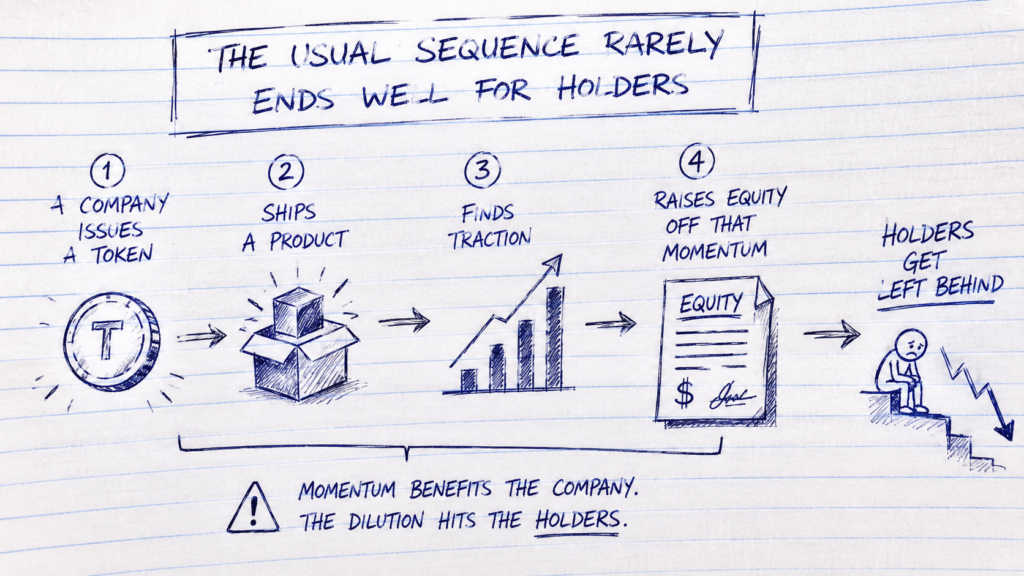
That is when holders learn where they really stand:
1. They own no part of the business
2. They have no claim on its cash flows
3. They have little protection if the company puts shareholders first
Venice AI’s recent $65 Million round followed a similar model, showing how equity and tokens can coexist within the same company.
Tokens built this way can still trade, but their future depends on buybacks, fee routing, or product access controlled by the team.
Value That Flows by Necessity
For a token to hold value without relying on goodwill, its design must force value through it, as Bittensor and a few other proof-of-useful-work networks do.
Subnets pay miners in the token to coordinate work toward an objective, creating a mechanical flow of value.
1. Miners are paid in the token, so its price sets the network’s incentive budget,
2. A higher price gives the subnet more firepower to attract and keep contributors, and
3. Emissions are finite, so paying contributors more over time requires a more valuable token.
Build a company on a subnet, and the token price becomes a lever for production capacity. As demand grows, the need for compute, data, and specialized work grows too, expanding incentives and linking business growth directly to token value.
The Token as a Dial
Every subnet produces something useful, and the token price acts as the incentive dial:
1. Let the price fall and output degrades
2. Raise the price and output improves
3. Remove the token and no miner shows up the next day
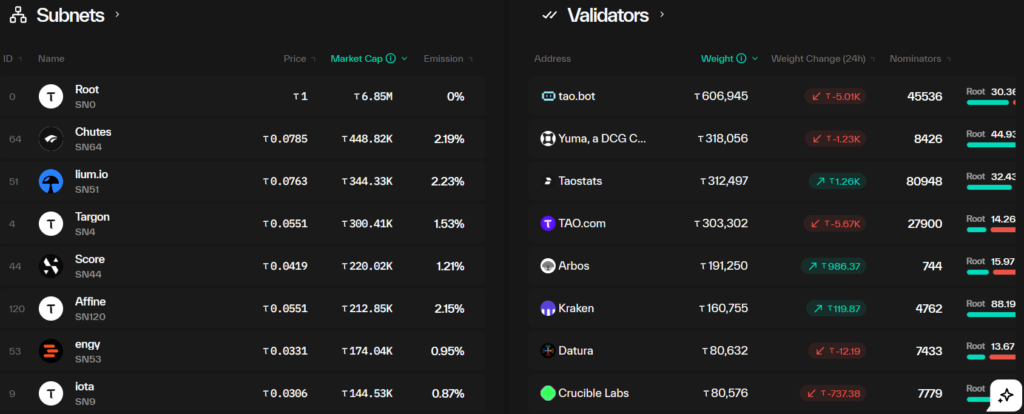
Targon (SN4) proves the point, with Manifold Labs raising venture equity while its subnet token still functions like those without a company behind them. Manifold needs the subnet to source compute for its rental business, making token demand a business necessity as growth requires more capacity.
What Makes the Reliance Real
Value flows through a token by necessity only once the subnet becomes a critical vendor the company depends on. Two paths get there:
1. Cost Advantage: A permissionless supply side with no middleman pushes a commodity toward marginal cost. For a compute-heavy business, Targon (SN4) sourcing the cheapest GPUs becomes its core edge.
2. Non-Substitutability: The output is too specialized to build in-house or buy elsewhere. ORO (SN15) needs traces from diverse agents, and its contributor pool creates that variety in a way hiring alone cannot replicate.
Either way, the company’s growth pulls the token up, because meeting rising demand forces the $USD price to scale.
What Holders Should Expect
The token and the equity were never claims on the same thing:
1. The company owns its equity value,
2. The token owns its production value, and
3. These were never in conflict.
Teams can still do more, sharing revenue or adding utility, but here those moves are additive. They sit on top of a token that already holds value from being the input the work is paid in.
Raise the Equity
The conclusion runs against years of received wisdom about how tokens and equity should coexist. A correctly designed token should make a company with equity behind it better for the token.
Equity capital lets the company scale demand, increasing how much useful work it needs from the subnet. For Bittensor subnet founders, the message is direct: raise equity, because token holders can benefit alongside you.
Enjoyed this article? Join our newsletter
Get the latest TAO & Bittensor news straight to your inbox.
We respect your privacy. Unsubscribe anytime.
Enjoyed this article?
Join our newsletter
Get the latest TAO & Bittensor news straight to your inbox — every morning before markets open.


No comments yet — be the first.