


Stripe finalized an agreement to acquire OpenRouter for more than $7 billion, according to a Bloomberg report published August 16, 2026.
OpenRouter does not build frontier models. It sits between developers and the models, deciding which one handles each request and taking a cut of the flow.
That layer, the metering and switching layer, is now worth more than most of the labs whose output passes through it.
OpenRouter’s revenue grew from roughly $19 million at the end of 2025 to $50 million by March 2026, which means Stripe paid well over a hundred times revenue.
The $7 billion price is a 5.4x markup over the $1.3 billion valuation OpenRouter reached in its Series B just three months ago. A price like that is a bet on owning the position: the neutral point that every AI request has to pass through, and the billing data that comes with it.
A functionally similar product already exists on Bittensor. It is called GM, it does most of what OpenRouter does, it does one thing OpenRouter structurally cannot, and it trades at a market capitalization near $15 million.
That means the market is valuing GM (Bittensor subnet 28) at roughly 1/450th of the reported price Stripe is willing to pay for OpenRouter.
OpenRouter proved the value of the routing layer
OpenRouter solves an increasingly important problem: developers do not want to integrate separately with every AI model provider.
Instead of building different integrations for OpenAI, Anthropic, Google and hundreds of other providers, developers can use one API.
OpenRouter handles the routing.
It has reportedly grown to around 8 million users and provides access to more than 400 models.
Stripe’s reported decision to acquire the company for more than $7 billion therefore represents a massive bet on the infrastructure layer around AI inference.
As models become increasingly interchangeable, the winning company may not be the one that trains the model, but the one that controls how users access them.
That is precisely where GM becomes interesting.
GM is building the same gateway, with a critical difference
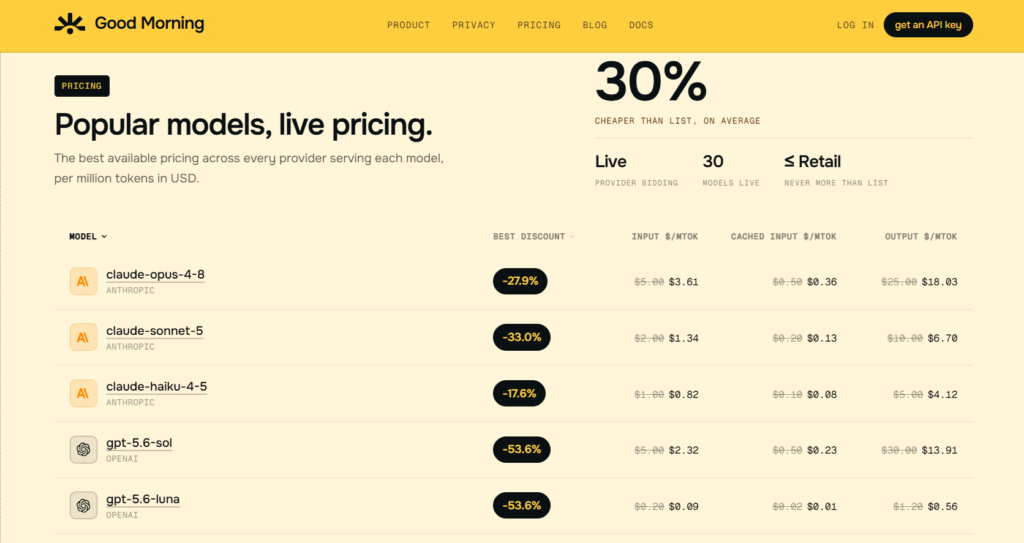
GM gives developers a single, OpenAI-compatible endpoint for accessing frontier models.
Users can point tools such as Cursor, Cline, Claude Code, and other AI applications at GM without rewriting their integrations.
But GM is not simply trying to replicate OpenRouter. Its key differentiator is privacy.
GM routes requests through a hardware-backed Trusted Execution Environment (TEE). Its gateway runs inside an Intel TDX enclave, with remote attestation providing cryptographic verification of what is running inside the environment.
With a conventional centralized gateway like OpenRouter, users ultimately have to trust the operator not to inspect, retain, or misuse their data.
GM attempts to replace that institutional trust with cryptographic verification.
With GM, prompts are decrypted inside the attested enclave, preventing the host and GM operators from seeing the data in transit.
For any developer moving real user data, proprietary code, or regulated information through a model, this closes a hole that plain aggregators leave open.
When you route through OpenRouter, you are trusting a company not to read, log, or repurpose what passes through. That trust just got sold to a payments firm.
A CNBC investigation published July 7, 2026, found that Chinese-origin models captured 46% of US enterprise token usage on OpenRouter, which is a reminder of how much sensitive traffic already flows through a single gateway, and how much a single owner of that gateway can see.
GM’s design removes the question. The operator cannot read your data because the hardware will not let it, and it can prove that to you.
GM Trumps in Permissionlessness
OpenRouter’s original pitch was neutrality: a router that keeps developers from getting locked into one model provider.
CEO Alex Atallah characterized the service as the “Stripe for AI,” emphasizing its role in preventing vendor lock-in. That pitch survives exactly until the router has an owner with its own commercial interests.
With Stripe now owning OpenRouter, the platform also has a new set of interests and priorities to consider. That is a natural difference from an independent gateway, particularly when the same platform sits between users, models, and the underlying usage and billing flows.
GM has no such owner. No single entity can delist a model, rewrite the pricing structure, or quietly hand usage data to a parent company, because there is no parent company and no central gatekeeper setting terms.
Miners enter permissionlessly, compete on price, and get selected by validators scoring performance. The neutrality is enforced by the structure of the Bittensor network rather than promised by a firm with its own interests.
The market may be pricing GM like a subnet when it should be pricing the product
Put the two side by side. OpenRouter has scale, a polished developer experience, brand recognition, proven revenue, and the distribution muscle of Stripe behind it. It is the mature product, embedded in production workflows today, and for most developers it wins on convenience and service guarantees right now. None of that is in dispute.
What GM has is the architecture the market just paid $7 billion to control, plus two things that $7 billion cannot buy: privacy the buyer can cryptographically verify, and neutrality no owner can revoke. The market is pricing GM as though those properties are worth nothing. The OpenRouter deal is direct evidence that the routing layer itself is worth billions.
GM is early, and there are risks. Decentralized systems still have to prove latency, uptime, and reliability against centralized SLAs; the subnet token carries liquidity risk; and the network has to attract enough high-quality miner supply to serve serious demand.
The question is whether GM can convert its architectural advantages into the scale, reliability, and demand necessary to make those advantages economically meaningful. Only time will tell.
More on GM (SN28):
Enjoyed this article? Join our newsletter
Get the latest TAO & Bittensor news straight to your inbox.
We respect your privacy. Unsubscribe anytime.
Enjoyed this article?
Join our newsletter
Get the latest TAO & Bittensor news straight to your inbox — every morning before markets open.


Be the first to comment