

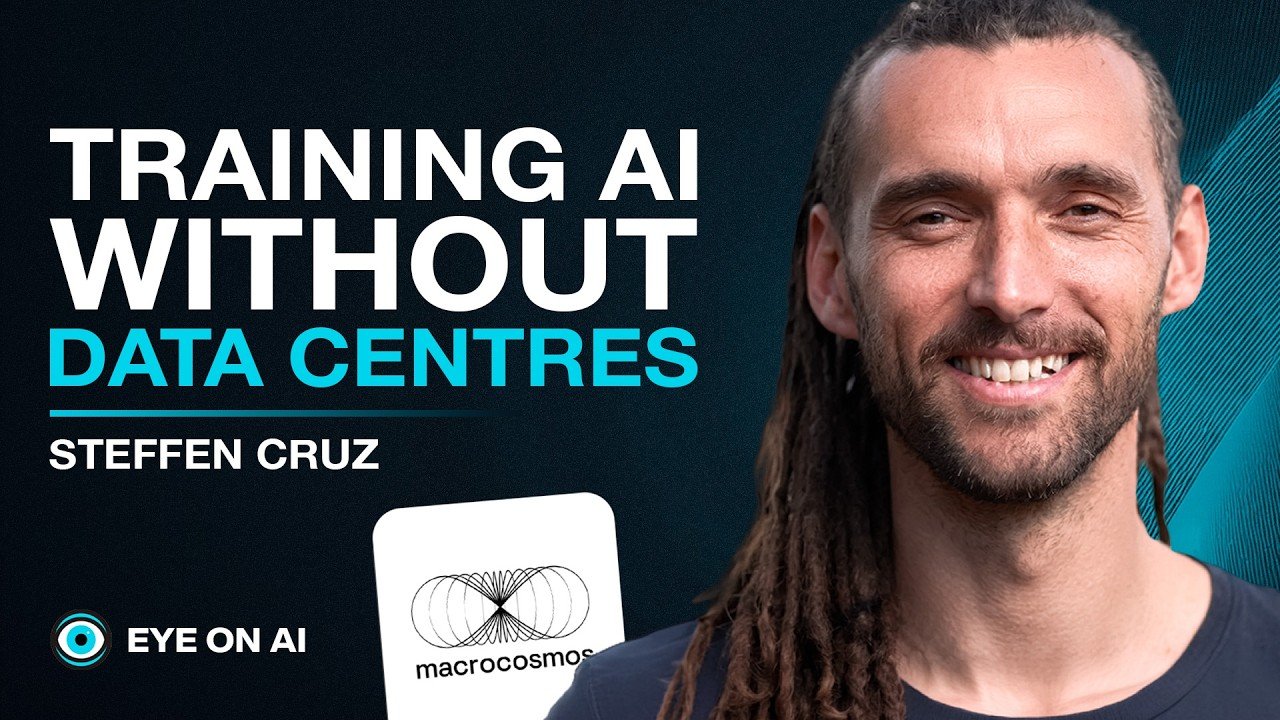
In this Eye on AI interview, Steffen Cruz, co-founder and CTO of Macrocosmos, walks through how his team is building one of the most ambitious projects on Bittensor: training frontier-scale AI models without a data center, using consumer hardware distributed around the world.
It’s a substantive technical conversation that doubles as a clear introduction to what Bittensor does at the infrastructure level.
Who Steffen is and what Macrocosmos does
- PhD in subatomic physics from UBC. Pivoted to AI when it became clear an “entirely new science was being born in real time.”
- ~3 years in the Bittensor ecosystem. Macrocosmos currently operates three subnets on Bittensor (SN1, 9, 13).
- The flagship is IOTA (SN9), the Incentivized Orchestrated Training Architecture, a system for distributed pre-training of large language models.
More on IOTA:
How he explains Bittensor
Steffen’s description is one of the clearest explanations of Bittensor:
- “It’s 100+ projects under a trench coat.” 128 teams building independently on top of a shared base layer.
- Bittensor doesn’t try to solve one narrow problem. It provides the reward mechanism, coordination layer, and synchronization clock, then steps out of the way and lets builders create.
- The blockchain itself is doing something “not revolutionary at all”, providing a transparent, tamper-proof record plus a registry, identity layer, and payout mechanism. The actual compute, data, and models live off-chain.
IOTA: the case for distributed training
The core technical bet. Traditional training requires warehouses with hundreds of thousands of GPUs wired together at extreme bandwidth.
IOTA’s premise: you can train an equivalent model using compute distributed globally, and that approach unlocks things centralized training cannot.
The advantages Steffen highlights:
- No massive capex. Multi-billion-dollar builds like Stargate and Colossus represent a hard ceiling, and eventually, you need a nation-state’s budget. Distributed training avoids the wall.
- Less environmental and community impact. Energy demand spreads instead of concentrating.
- Cost arbitrage. If Iceland has a 12-hour energy surplus, you can target that pocket of cheap compute. IOTA is already doing this, training multiple models simultaneously across geographies.
- The 2028 prediction. Steffen believes that by 2028, the mainstream view of how to train models will shift toward distributed approaches because the centralized scaling path becomes economically and politically unpalatable.
Train at Home: the consumer angle
This is where the story gets practical for individual viewers:
- One-click macOS app. Plug an unused MacBook, Mac mini, or consumer GPU into the network and it contributes to global training experiments.
- Steffen frames it as “Airbnb for your computer”, passive income from compute that would otherwise sit idle.
- Connects to the current trend of people stockpiling Mac minis to run personal AI agents. Those agents don’t need 24-hour compute, leaving room for the device to earn during the off-hours.
- User controls let you set hours: “only run when I’m asleep,” etc. Or your agent itself can decide: “Finished work by 9:15 AM, owner’s out till 5 PM, I’ll go make $20.”
- 2,500 macOS app downloads in the first two weeks of launch. ~500 nodes actively running.
The technical magic: model parallelism
The real engineering breakthrough is that each compute node only hosts a small sliver of the model, not the full thing.
- Comparable to “building a huge LEGO tower out of small pieces.”
- Information gets routed between sections of the model across the network, knitted together as if running on a single machine.
- This is why a Mac mini, with nowhere near enough memory to host a frontier model, can still meaningfully contribute to training one.
- Nine months of research got this from concept to working system.
The two-sided market plan
Macrocosmos is moving from research mode into commercialization. Two customer profiles:
Supply side: anyone with GPUs
- Hyperscalers and near-clouds with surplus capacity they can’t rent out.
- Current alternative: rent at cents on the dollar for inference. IOTA offers better margins because training is a higher-order commodity than inference.
- Even the 2-hour gaps between paid rentals become valuable continuous compute when stitched together.
Demand side: researchers, startups, academia, enterprises
- People who want to train legal, medical, or other domain-specific sovereign models but can’t afford centralized training costs.
- Goal is PyTorch/TensorFlow-level simplicity. Define the model and core parameters, let the system arbitrage the cheapest compute available.
- Target pricing: 10–20% of centralized training cost.
The roadmap
- Mid-year goal: 5,000 compute nodes, large enough to train ~70B parameter models that enterprises can take seriously.
- One to 1.5 years out: 100B+ parameter models, putting IOTA in genuine conversation with centralized labs.
- First paying customers (startups already committed) onboarding in the second half of this year.
The bigger thesis
IOTA isn’t really a model training tool but it’s a persistent compute fabric that happens to be applied to model training first.
- The same orchestration layer could serve bioinformatics, physics, HPC academic workloads. Anything that needs 10,000 nodes for 12 hours.
- The fundamental problem they’re solving is taking unreliable, constantly churning compute and turning it into something stable enough to run serious workloads on.
- His “second law of thermodynamics”: things get more connected over time. Personal devices will keep getting smarter, more autonomous, and more useful when LEGO-bricked together into bigger constellations.
Other Macrocosmos projects worth knowing
- Data Universe (SN13): decentralized social media data scraping at web scale, used for journalism, marketing, brand analysis, and AI model training. The “data” half of the data + compute virtuous cycle.
- Apex (SN1): transparent white-box AI on Bittensor.
Where to find it
iota.microcosmos.ai (or microcosmos.ai for everything they’re working on).
Full conversation here:
Enjoyed this article? Join our newsletter
Get the latest TAO & Bittensor news straight to your inbox.
We respect your privacy. Unsubscribe anytime.
Enjoyed this article?
Join our newsletter
Get the latest TAO & Bittensor news straight to your inbox — every morning before markets open.

No comments yet — be the first.