


Robots are getting smarter, but teaching them to perform everyday physical tasks remains one of artificial intelligence’s biggest challenges.
Unlike language models trained on internet data, robots need information about physical movements, objects, and human interactions.
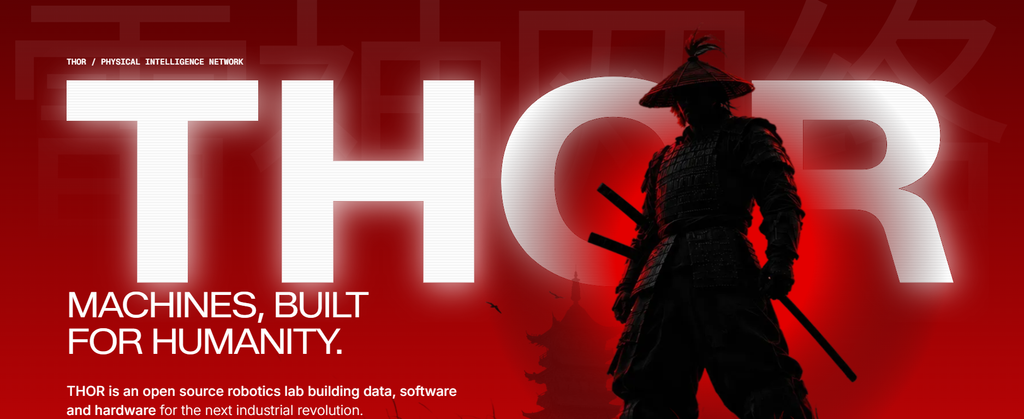
Collecting this information is expensive, and much of it remains locked within private research laboratories. THOR (SN112) wants to change that by building a decentralized marketplace for robotics training data on Bittensor.
What Is THOR?
THOR is a robotics initiative developing an open marketplace for collecting, annotating, and verifying data used to train intelligent robots. Operating through SN112, it connects researchers and robotics companies with contributors who earn rewards for producing high-quality training data.
The project aims to build an open robotics ecosystem where developers can access training data, AI models, simulation tools, and affordable hardware. Ultimately, THOR wants to provide the infrastructure that helps companies develop smarter and more capable robots.
Who Owns THOR (SN112)?
THOR (SN112) is backed by Pylon Partners, an investment holding company focused on open software protocols. On September 23, 2026, Pylon Partners announced that it had signed a definitive agreement to acquire Bittensor Subnet 112 from its previous owners to launch THOR Group, a robotics company focused on building open infrastructure for physical AI.
The initiative is led by Jack Ai-Leung, Managing Partner at Pylon Partners, who explained that the acquisition reflects the firm’s ambition to address major challenges facing the robotics industry, particularly access to training data, AI models, and hardware.
According to Jack, THOR Group was established to promote global collaboration in robotics research. He also confirmed that the company would begin with THOR Data, focusing on human demonstration and simulation data, before expanding into other areas of robotics.
Pylon Partners is no stranger to Bittensor. The investment firm has previously been involved with UR (SN25), a decentralized privacy network. Through THOR, the firm intends to leverage its experience across Western and Chinese research and industrial networks to develop robotics infrastructure with the Bittensor community.
Why Is Robotics Training Data Important?
Large language models benefit from vast datasets of text, images, and code, but robotics lacks the same abundance of training data. For example, a robot learning to prepare a meal must understand how to handle utensils, hold ingredients, and adjust its movements.
Training robots requires detailed information about physical movements, object positions, timing, and interactions that ordinary internet content cannot always provide.
Robotics companies collect this information through human demonstrations, cameras, sensors, and simulations, but THOR aims to make the process more accessible through independent contribution.
How Does THOR Work on Bittensor?
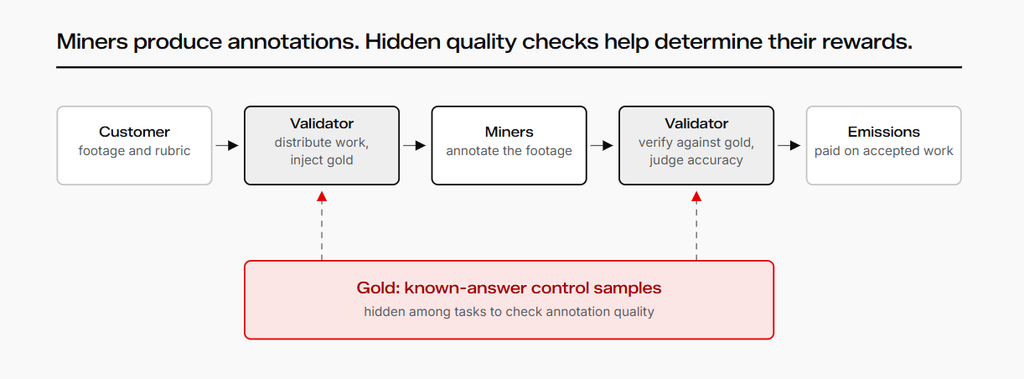
THOR uses Bittensor to coordinate contributors and reward them for producing verified robotics training data. The process begins when a customer, such as a robotics laboratory, submits a request describing the data it needs and the standards it must meet.
The network then coordinates three main participants:
1. Customers: Robotics companies and researchers requesting specific training datasets.
2. Miners: Contributors who collect, annotate, or process data using human expertise, AI tools, or both.
3. Validators: Participants responsible for evaluating submitted work and determining whether it satisfies the required standards.
For example, a robotics company developing a warehouse sorting robot might need annotated videos showing people picking up, moving, and arranging different objects.
Miners would produce these annotations, while validators check their accuracy to ensure the work meets the required quality standards. Contributors whose submissions meet these standards can earn subnet alpha rewards through Bittensor, creating a marketplace where participants compete to produce useful training data.
THOR’s First Product Will Focus on Video Annotation
THOR plans to begin with a relatively simple but important task known as frame-level action captioning. This involves watching videos recorded from a person’s perspective and identifying the individual actions taking place, including when each action begins and ends.
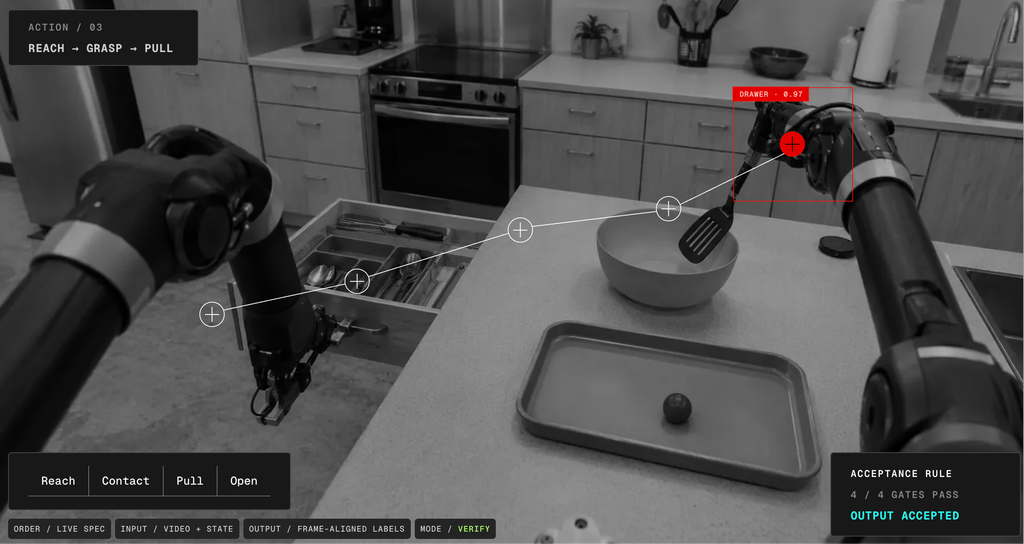
For example, a short video of someone opening a drawer and removing a cup could be labelled as follows:
| Time | Action |
| 0.0–2.0 seconds | Reach for drawer |
| 2.0–4.6 seconds | Open drawer |
| 4.6–8.0 seconds | Remove cup |
This gives a structured record that helps AI models connect visual observations with physical actions. THOR intends to use existing first-person footage, including datasets such as EPIC-KITCHENS, for its initial release. The resulting annotated dataset is expected to be made publicly available for robotics research.
This first product is also intended to test whether decentralized contributors can deliver reliable annotations at a competitive cost.
How Will THOR Ensure Data Quality?
Producing large quantities of data is not enough if the information contains incorrect labels or missing actions, which is why THOR places verification at the center of its marketplace. Its initial requirements include at least 80% video coverage, accurate action timing within half a second, and specific limits on segment duration.
THOR also proposes using hidden test samples, comparisons between independent contributors, and AI models to identify inaccurate submissions, although some of these methods remain under development. This would ensure that contributors earn rewards for producing accurate and useful training data, and not simply submitting large volumes of annotations.
How Does THOR Plan to Generate Revenue?
THOR intends to generate revenue by providing robotics companies with data collection, annotation, verification, and delivery services. Customers would pay THOR for completed projects, while miners receive rewards based on their accepted contributions, with the two payment systems operating independently.
For example, THOR illustrates a hypothetical reward of $5 per accepted hour of annotation work, paid through subnet alpha emissions. Revenue from commercial contracts would support operations, expansion, and equipment investments, combining a traditional robotics data business with Bittensor’s decentralized incentive system.
THOR’s Vision Goes Beyond Robotics Data
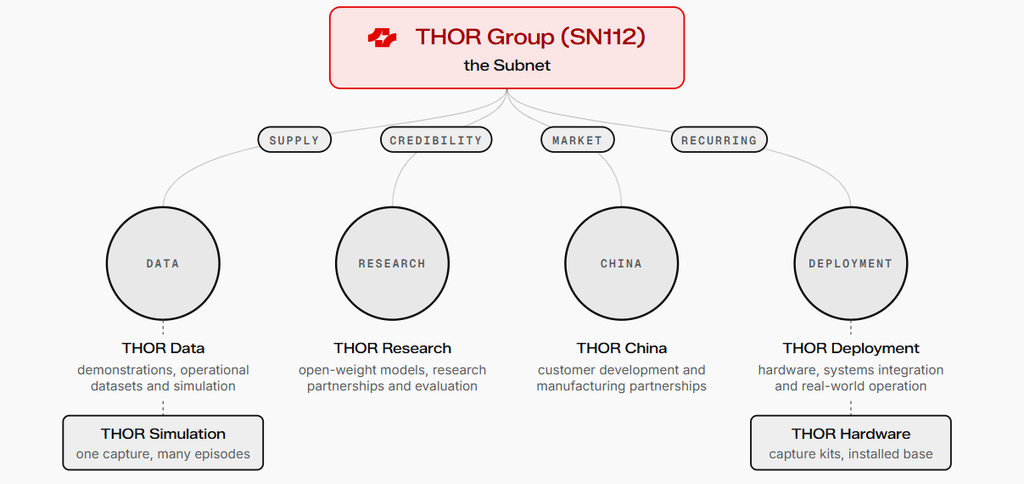
Although THOR is starting with video annotation, its ambitions extend across several areas of the robotics industry. The project has outlined six interconnected divisions:
1. THOR Data: Collecting, annotating, and verifying robotics training data.
2. THOR Simulation: Creating virtual environments and generating additional training scenarios.
3. THOR Research: Supporting the development of open robotics models and research tools.
4. THOR Hardware: Developing accessible data-capture equipment and reproducible robotics designs.
5. THOR China: Building relationships with Chinese robotics manufacturers, suppliers, and research partners.
6. THOR Deployment: Helping businesses integrate intelligent robots into real-world operations.
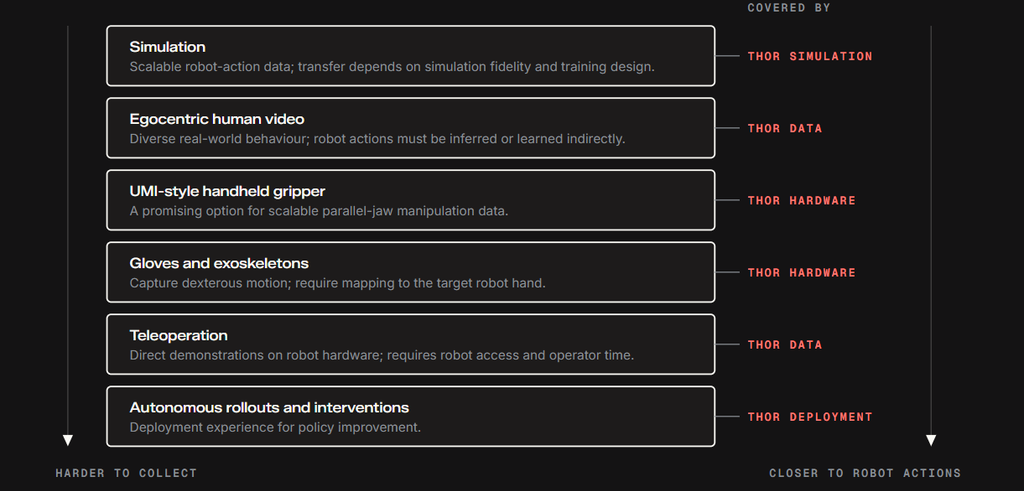
These divisions are intended to support one another. Research would identify problems that require new data, hardware would help capture it, and industrial deployments could generate feedback for improving future models.
THOR also wants to connect China’s robotics manufacturing capabilities with international researchers and developers, making hardware and training resources more accessible across different markets.
THOR’s Ambition to Become the Hugging Face of Robotics
THOR’s biggest ambition is to build an ecosystem similar to Hugging Face, but focused on robotics. Just as Hugging Face provides a platform for sharing AI models, datasets, and development tools, THOR wants to bring that approach to physical AI.
Researchers could access open datasets and models, while businesses commission specialized training data and contributors earn rewards for their work. THOR also plans to support affordable open-source robotics hardware, making robotics research and development more accessible to smaller teams.
What Does THOR Mean for Bittensor?
THOR brings Bittensor’s decentralized incentive system into the robotics industry, where demand for high-quality training data continues to grow. Through SN112, participants can earn rewards for producing verified data that researchers and robotics companies can use.
However, the project remains at an early stage and must prove it can deliver accurate training data at competitive costs. THOR could potentially put Bittensor as an important infrastructure for physical AI and the development of intelligent robots.
Enjoyed this article? Join our newsletter
Get the latest TAO & Bittensor news straight to your inbox.
We respect your privacy. Unsubscribe anytime.
Enjoyed this article?
Join our newsletter
Get the latest TAO & Bittensor news straight to your inbox — every morning before markets open.



No comments yet — be the first.