


Perturb (SN26) released Version 3.0 of its whitepaper outlining plans to build a decentralized marketplace for AI security testing on Bittensor.
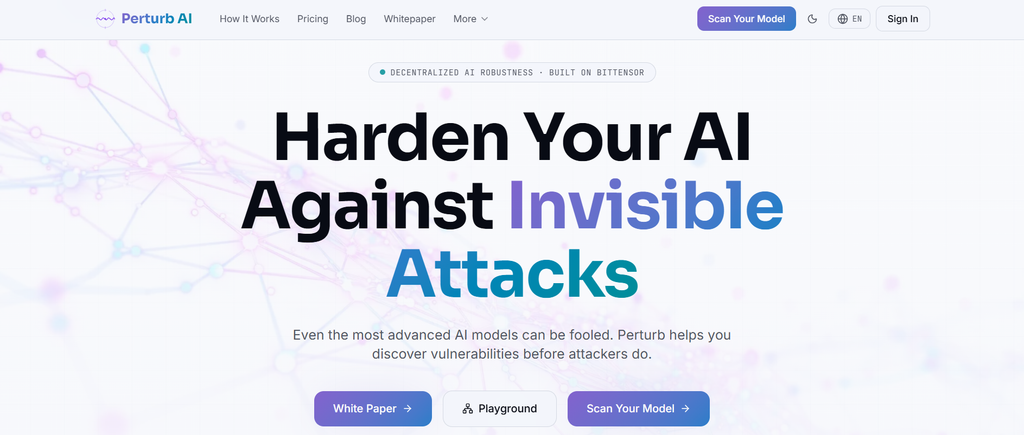
The project rewards participants for discovering weaknesses in AI models and developing stronger defenses against potential attacks.
The whitepaper details how the subnet operates, its incentive structure, and plans to turn adversarial testing into commercial services for businesses.
Why AI Models Need Adversarial Testing
Even advanced AI models can be fooled by small changes to their inputs. A few altered pixels could make an image classifier mistake a stop sign for a speed limit sign, creating potential risks for applications like autonomous vehicles, medical imaging, and fraud detection.
These manipulated inputs are known as adversarial examples. Testing against them helps developers identify vulnerabilities before they cause problems in real-world applications.
However, existing testing solutions can be expensive and technically demanding. Perturb estimates that professional red-teaming engagements can cost between $50,000 and $200,000, while the AI red-teaming market could reach $11.6 billion by 2033.
How Perturb Works on Bittensor
Perturb operates through two competitive miner tracks.
1. Scanning Track (80% of emissions) rewards miners for creating nearly invisible image modifications that cause AI models to make incorrect predictions.
2. Training Track (20% of emissions) rewards miners for improving models so they can withstand these attacks.
Every 120 seconds, the network selects an image from ImageNet-1k, a dataset containing approximately 1.28 million training images. Miners submit modified images, and validators check whether the attacks succeed while meeting strict image quality requirements.
Bittensor’s incentive system rewards measurable performance, encouraging miners to continuously discover new vulnerabilities and develop stronger defenses.
What Perturb Produces
The subnet is designed to generate two commercially useful products.
1. Adversarial Training Dataset: A growing collection of verified attacks published on Hugging Face, giving developers examples they can use to train more resilient AI models.
2. Model Robustness Certificates: Evaluation reports supported by auditable on-chain records, helping businesses demonstrate how their AI models perform under adversarial testing.
Inside the Technical Architecture
The updated whitepaper provides several details about the subnet’s operations.
1. Target Model is EfficientNetV2-L, using torchvision IMAGENET1K_V1 pretrained weights.
2. Task Generation occurs every 120 seconds using images from the full ImageNet-1k training dataset.
3. Attack Verification checks prediction changes, perturbation limits, image quality, and submission authenticity.
4. Daily Evaluations occur at 00:00 UTC, testing trained models against clean images and attacks from the previous day.
5. Network Coordination uses a lightweight API without requiring miners to operate traditional Bittensor axons.
Perturb’s Commercial Services
Beyond its subnet, Perturb offers paid AI robustness testing through its website.
Its Basic plan costs $99 per scan, covering robustness scores, accuracy comparisons, and sample attacks. The Pro offering includes adversarial datasets and model fine-tuning, while enterprise services provide continuous testing, private deployments, and custom threat models.
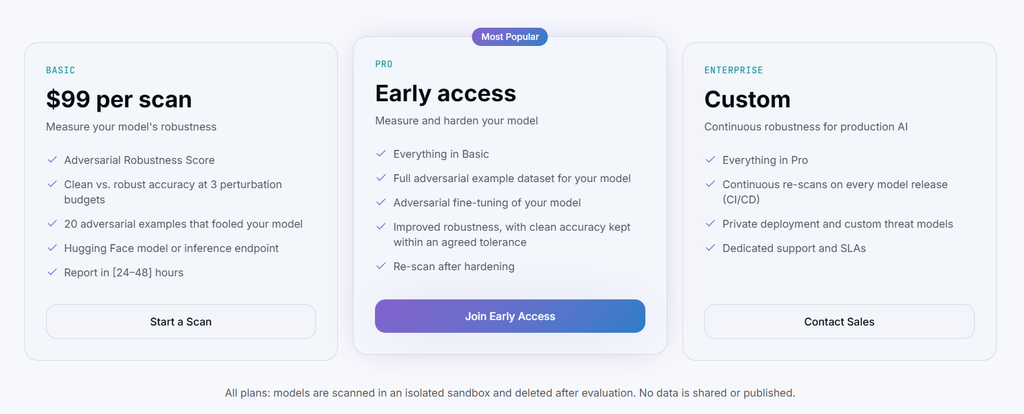
The platform currently supports image classification, with vision-language model testing planned next. Perturb says submitted models are tested in isolated environments and deleted afterward.
The Team and What’s Next
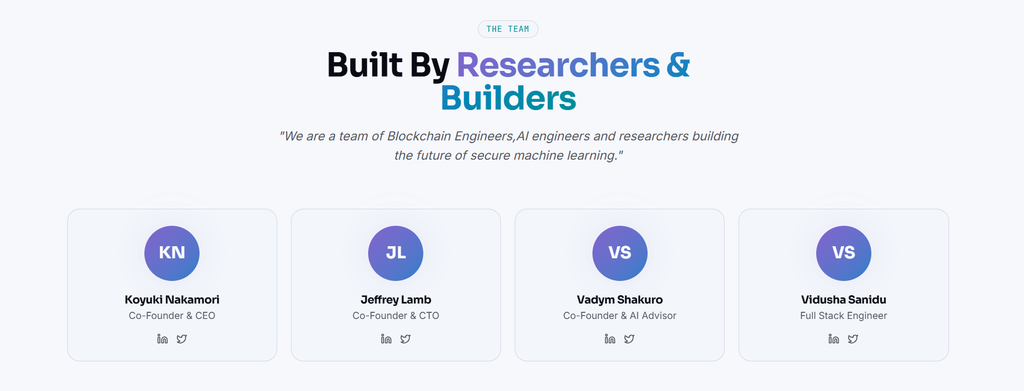
Perturb was co-founded by Koyuki Nakamori (CEO), Jeffrey Lamb (CTO), and Vadym Shakuro (AI Advisor). The project’s goal is to make AI security testing continuous, accessible, and commercially useful.
By combining competitive vulnerability discovery with model improvement, Perturb aims to help businesses strengthen their AI systems while creating demand for services built on Bittensor.
Useful Resources
Keep Up With Perturb Via:
1. Website: https://www.perturbai.io
2. X: https://x.com/perturbaix
3. Discord: https://discord.com/channels/799672011265015819/1501594532016558080
4. GitHub: https://github.com/0xsigurd/Perturb
5. Whitepaper: https://www.perturbai.io/whitepaper
Enjoyed this article? Join our newsletter
Get the latest TAO & Bittensor news straight to your inbox.
We respect your privacy. Unsubscribe anytime.
Enjoyed this article?
Join our newsletter
Get the latest TAO & Bittensor news straight to your inbox — every morning before markets open.



No comments yet — be the first.