

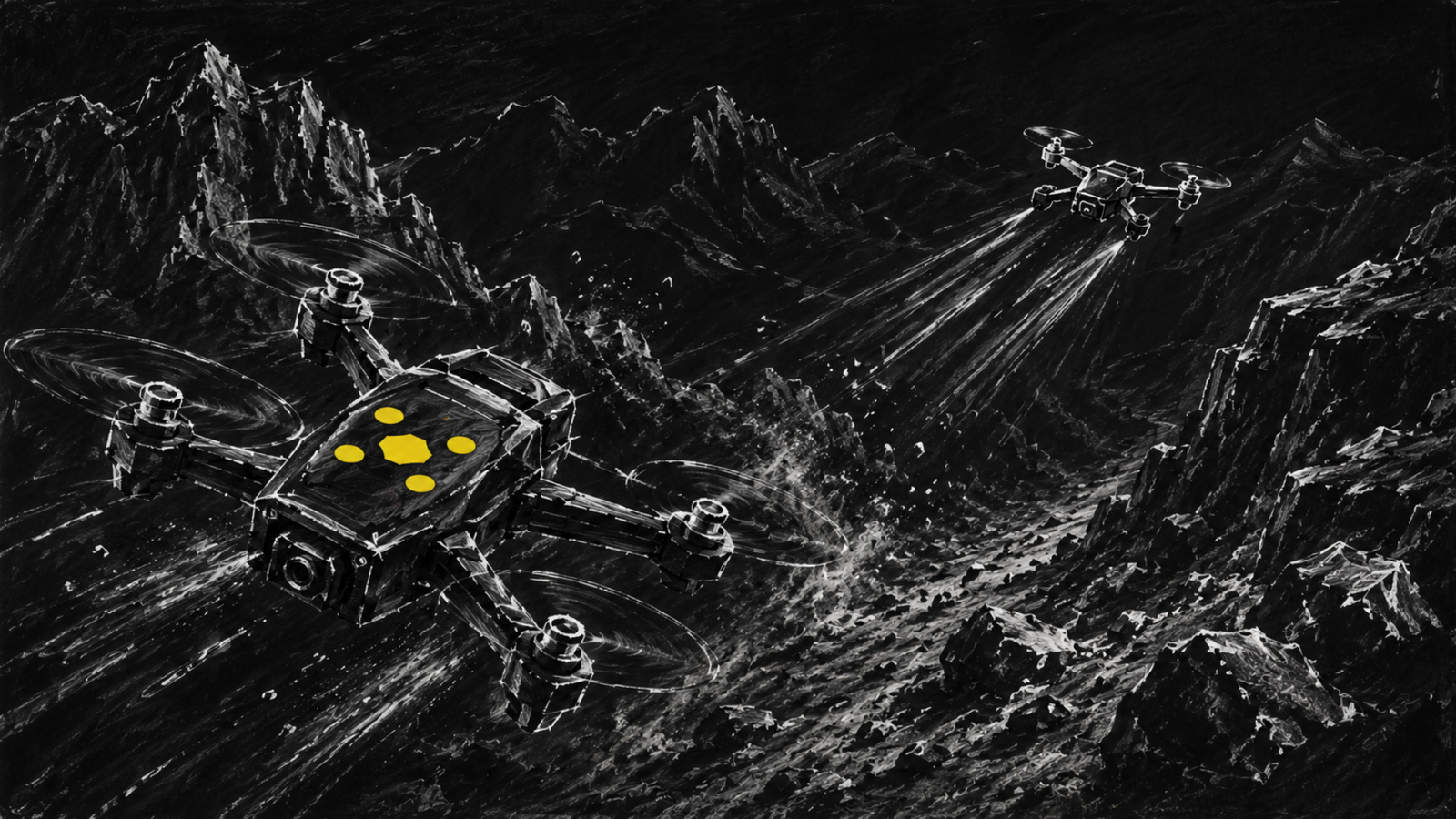
Intercepting one drone with another remains one of the unsolved problems in autonomous flight outside carefully controlled conditions.
Swarm (SN124) published a detailed teardown of a leading model called Swarm Frozen, which has effectively solved that problem on the subnet’s Interceptor benchmark.
Across 1,100 procedurally generated worlds where every scenario was unseen in advance and each model got a single attempt, Swarm Frozen caught the target drone 1,098 times for a final score of 0.9949.
In the article, we explore why this score is significant and could power the next wave of milestones.
The Problem Every Interceptor Model Has to Solve
The Interceptor setup is deliberately built to strip away every shortcut a naive pursuit algorithm might rely on to look good.
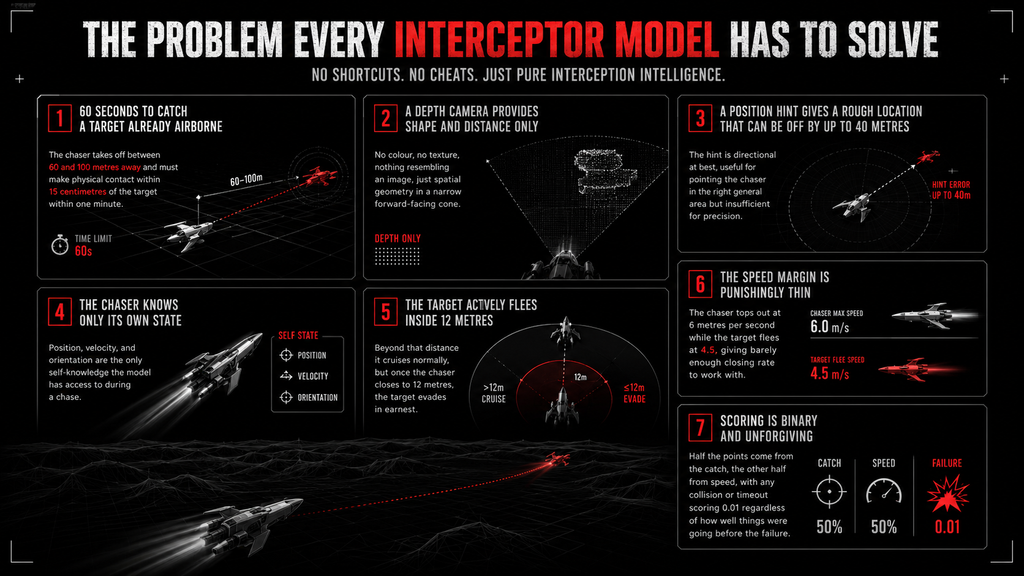
1. 60 seconds to catch a target already airborne: The chaser takes off between 60 and 100 metres away and must make physical contact within 15 centimetres of the target within one minute.
2. A depth camera provides shape and distance only: No colour, no texture, nothing resembling an image, just spatial geometry in a narrow forward-facing cone.
3. A position hint gives a rough location that can be off by up to 40 metres: The hint is directional at best, useful for pointing the chaser in the right general area but insufficient for precision.
4. The chaser knows only its own state: Position, velocity, and orientation are the only self-knowledge the model has access to during a chase.
5. The target actively flees inside 12 metres: Beyond that distance it cruises normally, but once the chaser closes to 12 metres, the target evades in earnest.
6. The speed margin is punishingly thin: The chaser tops out at 6 metres per second while the target flees at 4.5, giving barely enough closing rate to work with.
7. Scoring is binary and unforgiving: Half the points come from the catch, the other half from speed, with any collision or timeout scoring 0.01 regardless of how well things were going before the failure.
The Three Behaviours That Explain Swarm Frozen’s Score
Swarm’s team instrumented the model and ran it through 40 additional fresh worlds, and each observed behaviour maps cleanly to a measurable outcome.
| BEHAVIOUR | WHAT THE MODEL DOES | RESULT |
| Instant Lock Recovery | Never decelerates or re-scans when it loses sight of the target, holding speed and reacquiring visually several times per second | 2,829 losses of lock across 40 flights, roughly 3 per second, every one recovered |
| Rhythm Prediction | Watches the target’s lateral motion for about 1.6 seconds, tests 15 candidate rhythms, and aims where the target is about to break rather than where it currently sits | 98.8% usable rhythm reads; 19.0s median when locked vs 23.8s when not |
| Boundary Reconstruction | Maintains live estimates of the target’s home point and current distance from home, then intercepts at the patrol edge when a stalemate is detected | Boundary estimated within 3 metres of truth in all 40 flights |
Where the Missing 0.0051 of the Score Lives
Once a benchmark result gets this close to perfect, the specific location of the remaining loss becomes worth studying carefully because it defines what the next generation of models needs to optimize for.
1. Only about a third of the missing score comes from the two runs where Swarm Frozen failed to catch the target at all: These are the outright failures across the 1,100 worlds, and they represent the smaller portion of the remaining gap despite being the more visible category.
2. The other two thirds come from flights the model had already won on catch: In these runs, the target was caught successfully but the model took several seconds longer than optimal to close out, losing partial credit on the speed component of the scoring.
3. The frontier has moved from whether the catch happens to how many seconds it takes: Anyone trying to beat Swarm Frozen no longer needs to solve interception as a research problem; they need to solve interception faster than a model that already succeeds 99.8% of the time.
The Benchmark Is Open, and the Challenge Is Set
Every part of the Interceptor benchmark stays open to competing teams under identical evaluation conditions with no retries or hand-tuned configurations.
The environments are public, the code is public, and every miner runs against the same 1,100 procedurally generated worlds that produced Swarm Frozen’s 0.9949 score.
Any team confident they can build a model that catches targets faster or more consistently can start immediately at Swarm’s GitHub, submit their approach, and see where they stack against the current leader.
The bar is high, but it has just been documented in enough detail that beating it becomes a defined engineering problem rather than an open research question.
Enjoyed this article? Join our newsletter
Get the latest TAO & Bittensor news straight to your inbox.
We respect your privacy. Unsubscribe anytime.
Enjoyed this article?
Join our newsletter
Get the latest TAO & Bittensor news straight to your inbox — every morning before markets open.


No comments yet — be the first.