

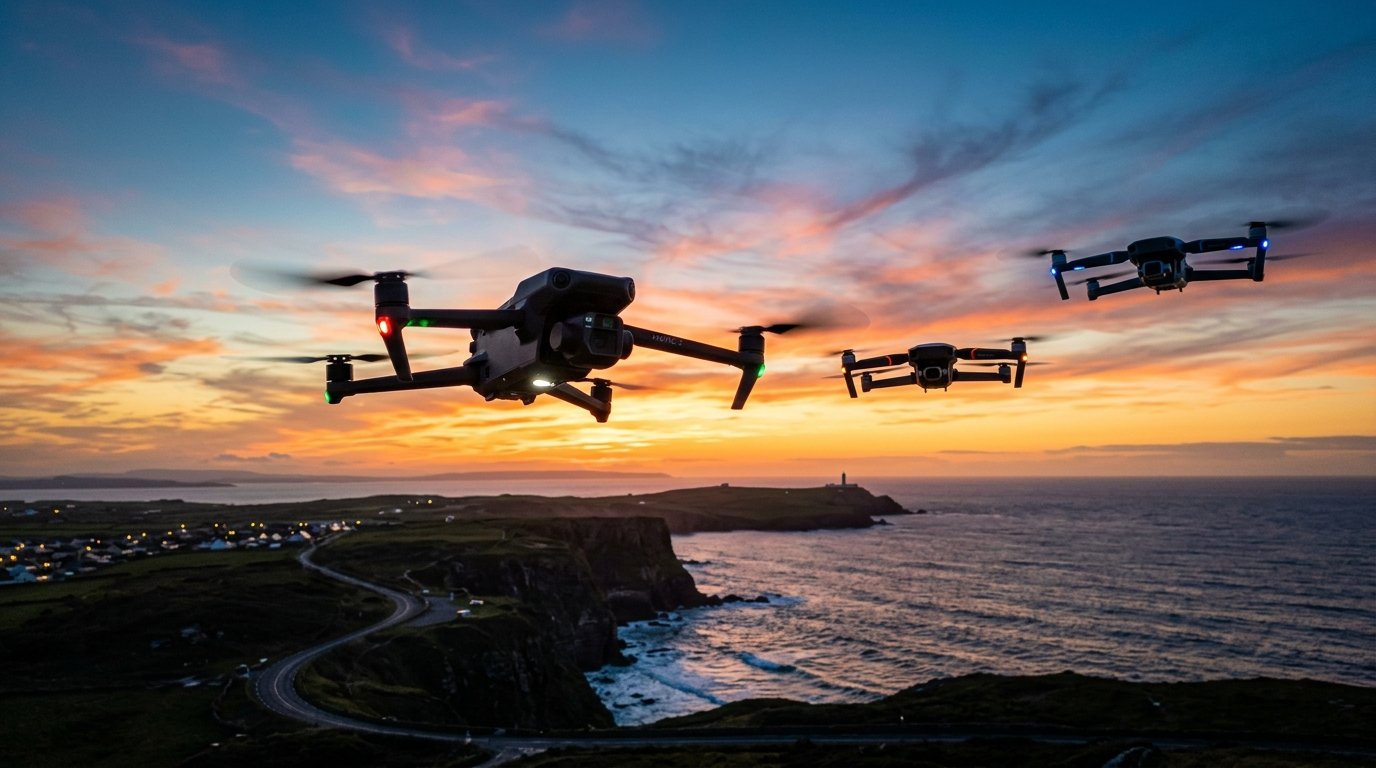
The drone industry’s real bottleneck was never the machine. A capable drone costs less than a car, yet the search for a missing hiker still fails because no trained pilot happens to be free, close enough, and able to fly more than one aircraft at once.
Swarm builds the intelligence that flies the drones rather than the drones themselves, and it trains that intelligence on Bittensor’s competitive mining.
Below is a detailed account of what Miguel (Swarm subnet’s CEO) said in his recent interview with Jared from Beyond Finance.
The Pilot Is the Cost, Not the Drone
The expensive part of the drone industry is the person, not the hardware. The best drones run to around €30,000, and most are far cheaper, but every mission still needs someone awake, available, close enough to reach the site, and trained for that specific job.
By Miguel’s estimate, more than 99 per cent of missions work exactly this way, which means the entire industry runs on human availability rather than capability. Remove the pilot and the economics of every drone job change at once.
Nobody Built the Autonomy Because Everyone Bundles It
There is no Tesla Autopilot equivalent for drones, and the reason is relatable.
At a Polish trade fair, every stand was selling its own drone with its own software welded directly onto it, so the intelligence stays locked to one manufacturer’s hardware and never becomes a standalone product.
Swarm’s approach is deliberately horizontal, meaning it is built to fly anyone’s drone, provided the aircraft can be piloted from outside. That single design choice is what turns autonomy from a feature into a market.
Only Missions Where the Environment Changes Need a Brain
The founder draws a sharp line about which jobs are worth chasing. Inspecting an electrical tower, spraying a field, or mapping a site does not need real intelligence, because you can survey the area, draw the route, and fly a pre-programmed path.
The work that needs autonomy is where the environment changes while the mission runs: a person lost across twenty square kilometres of moved terrain, a drone intercepting another that is actively flying away, a coastline where swimmers are entering the water.
Swarm subnet is not chasing the pre-programmed work, only the missions a fixed flight path cannot solve.
Imperfect Maps Are the Whole Point
Someone on the call asked whether a drone fleet could simply accumulate a perfect map over time, the way ships build a picture of the seabed.
The answer was that the world is already mapped well enough, and it is the changes that defeat you: three metres of ground transformation after an earthquake, fresh snow, a fallen tree, or wind that puts the drone somewhere other than where it thinks it is.
The intelligence has to work despite the map being wrong, not because the map is right. That distinction is what separates genuine autonomy from a predefined flight plan.
Bittensor Is the Actual Defensibility
Miguel admitted that anyone could build this startup, and that the company’s real moat is that its AI is trained on Bittensor.
A conventional firm has to hire a specialist for every environment it wants to fly in, and if that expertise is not among its hundred employees, it simply does not have it.
Swarm (SN124) instead builds simulated environments, lets miners compete inside them, and puts the winning models into real drones.
Miners have already turned up from Australia, China, Bahrain, and Argentina, bringing a spread of approaches no in-house team could match.
The Model Improves in a Loop That Funds Itself
The mining approach on the Swarm subnet is designed to compound. Strong subnet performance attracts more miners, more miners raise the quality of the winning models, better models make better simulations and lab tests possible, and sellable products fund the next round of environments.
Four challenges are running right now: an autopilot crossing six terrain maps without crashing, an interceptor catching a drone that is fleeing, a search-and-rescue agent finding someone lost across those same maps, and swarm versions running anything from two to eight drones at once. Every challenge on the site carries a live score for the top miner, and the lines climb.
Simulation Is the Easy Half; Wind Is the Hard One
Simulation is only half the job; put the model on a real drone, and it crashes, because wind exists and the world is never quite where the simulation claimed.
Closing that gap is why Swarm hired a robotics CTO with roughly ten years building robots, and why they rebuilt their own office as a simulated map they can also fly in for real.
A model that wins in the simulation goes straight into a drone in that same room, measured against what really happens.
Andorra Is a Deliberate Regulatory Advantage
The subnet office being based in a country of around 80,000 people between Spain and France is a strategy. Andorra sits outside the European Union, so Swarm can test whatever it wants very quickly under lighter rules, then take a working product to the EU and homologate it there.
Being large in a small country compounds it: whether a drone flies is one man’s decision, there is no airport and therefore no aviation ministry to clear, and the national ski resort is a direct customer for the avalanche problem. Working with them, the founder says, is like working with the biggest company in the country.
The First Commercial Contract Has Landed
Since the interview, Swarm has closed its first commercial deal today. German Solar Power selected the subnet to build autonomous drone surveillance for solar parks in Greece, where the drones detect intruders, fires, hotspots, and equipment failures, then dock, recharge, and patrol again on their own.
The autonomy the miners have been competing to build now has a customer paying for it to run.
Where This Goes
Swarm calls itself a robotics lab pointed at drones for now, because a drone is one kind of robot and the intelligence tells a machine where to go rather than how to move. Quadrupeds and humanoids are the other verticals they can possibly add later.
The next phase is going outside Bittensor to bring in new clients interested in drone projects. Miguel wants a lab within a year that can take research budgets in the millions and stand as a top robotics operation in Europe.
Switzerland, as he puts it, is not the only place that can do this work.
Enjoyed this article? Join our newsletter
Get the latest TAO & Bittensor news straight to your inbox.
We respect your privacy. Unsubscribe anytime.
Enjoyed this article?
Join our newsletter
Get the latest TAO & Bittensor news straight to your inbox — every morning before markets open.



Be the first to comment