

AI models are starting to look alike in quality, so the real competition has moved toward how cheaply you run them.
That pressure grows every month, since serving models now dominate AI compute as generations lengthen and agents loop through many calls.
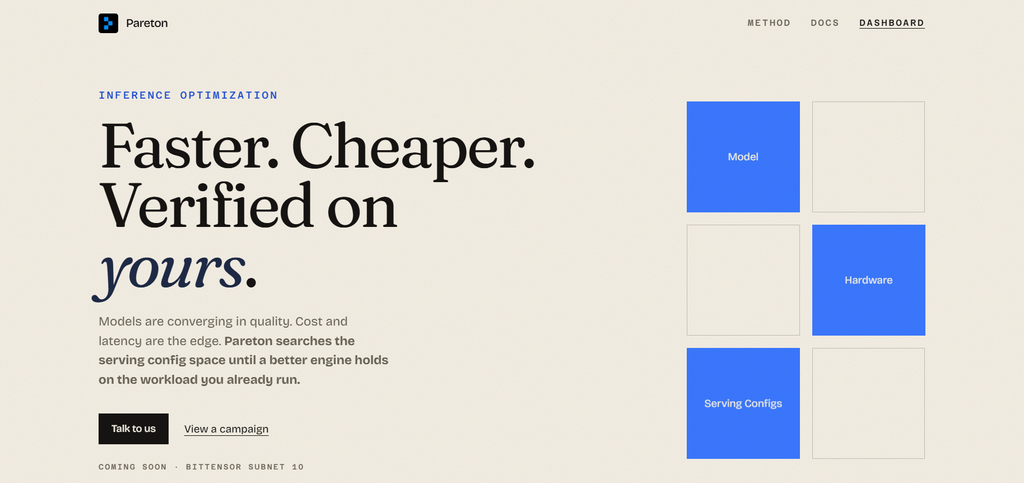
The difficulty is that efficiency depends on a tangle of choices no small team can test by hand alone. Pareton (SN10) searches that space continuously and hands you a serving setup that runs cheaper on your workload.
The Problem Pareton (SN10) Is Built Around
Inference demand keeps compounding faster than efficiency improves, and every new model family or accelerator adds more configurations worth testing by hand.
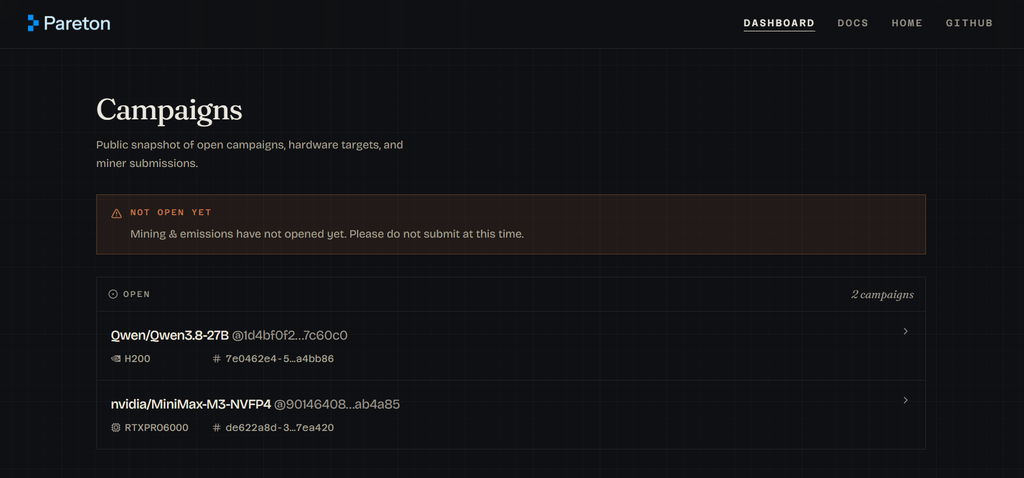
1. Quality has converged, cost has not: With models increasingly matched on capability, the edge now comes from lower cost and latency rather than raw intelligence.
2. Inference is eating the compute budget: Longer outputs, agent loops, and high-volume serving are pushing inference toward the dominant share of total AI spend.
3. The tuning space is too large to brute-force: Kernels, batching, caching, quantization, and scheduling combine into far more permutations than any single team can exhaust manually.
Taken together, these forces widen the efficiency gap on their own unless something searches the space faster than people can.
How Pareton (SN10) Works
Pareton measures every proposed improvement against a frozen snapshot of your production setup, which becomes the metric that every candidate is judged against.
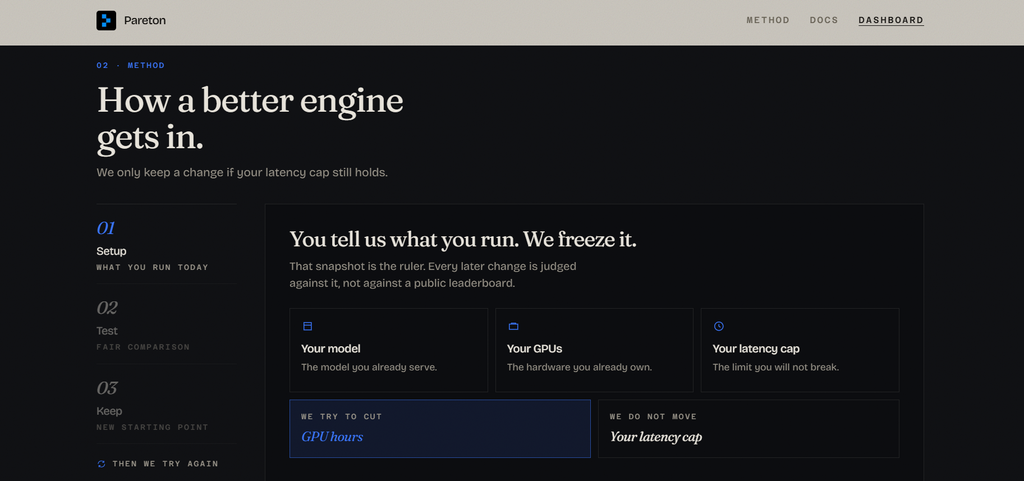
1. You set the target: You lock in your model, your GPUs, your workload, and a latency cap, plus one metric defining what winning means.
2. Miners submit reviewable changes: Contributors propose focused code patches against a fixed baseline engine, so every candidate arrives as auditable code.
3. Validators gate and bench the work: Validators check that each patch builds cleanly and passes correctness rules, then run the leader and up to five challengers identically.
4. A challenger wins only by a clear margin: The incumbent keeps its seat unless a challenger beats it by the required overtake margin, which blocks fragile tricks.
5. A win becomes the new baseline: Once a change wins, it becomes your new starting point and the search continues from there, so the floor keeps rising.
The effect is a closed loop where your own setup defines success and only verified code that beats it is promoted.
The Incentive Mechanism
Pareton attaches a real cost to participation, so the queue fills with serious attempts rather than cheap, throwaway submissions that clog the system.
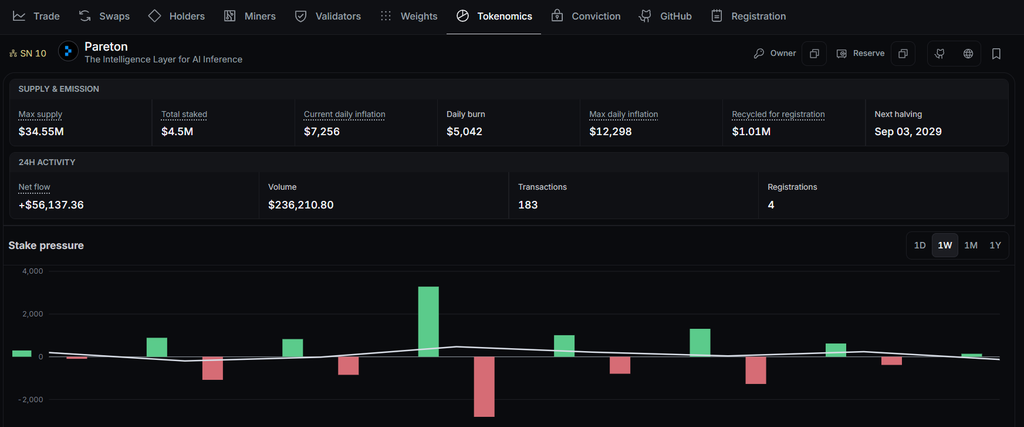
1. Every submission costs 0.05 $TAO: The fee puts genuine skin in the game per patch, which automatically filters spam by making weak attempts expensive.
2. Only the seated leader earns emissions: While a campaign runs, subnet rewards flow solely to the checkpoint holding the crown, and everything else submitted is burned.
3. Validators decide who gets paid: Validators turn each round’s bench results into the on-chain weights that distribute emissions, keeping measurement and payment tied together.
The fee and the burn push in the same direction, since both load cost onto weak submissions while steering reward toward the change that verifiably wins.
Who It Is For
Pareton (SN10) is aimed at the people who own GPU spend and service-level commitments, reporting in the cost terms those buyers care about.
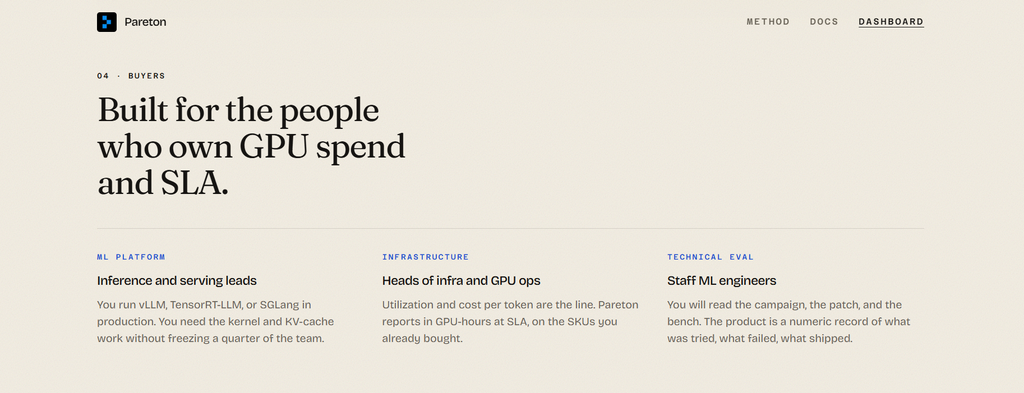
1. Serving and inference leads running production engines who need kernel and cache work done without pulling their team off everything else.
2. Infrastructure and GPU operations heads who are measured on utilization and cost per token across the specific SKUs they already bought.
3. Staff ML engineers who want to read the campaign, patch, and bench as a numeric record of what shipped and why.
What unites these buyers is that they answer for cost and latency directly, so an auditable improvement is worth more than any benchmark.
Why the Approach Holds Up
Pareton (SN10)’s real strength is that it treats your production workload as the benchmark and refuses to call anything a win prematurely.
Because every change arrives as reviewable code scored on conditions you approved, you see exactly what changed, why it won, and what it left untouched.
The search never stops after the first success, so each promotion raises the floor and keeps throughput and latency moving correctly.
It amounts to a continuously running optimization team you never hired, pointed at whether today’s setup can be beaten on its own terms.
Enjoyed this article? Join our newsletter
Get the latest TAO & Bittensor news straight to your inbox.
We respect your privacy. Unsubscribe anytime.
Enjoyed this article?
Join our newsletter
Get the latest TAO & Bittensor news straight to your inbox — every morning before markets open.



[…] on Pareton (SN10) delivered a 3.5× speedup on Qwen3.8-27B, an open-source AI model, during the campaign’s […]
[…] have pushed a Pareton (SN10) optimization upstream, delivering measurable throughput gains for Qwen inference […]
[…] Pareton (SN10) recently showed why it sometimes is not. […]
[…] Pareton (SN10) and Engy (SN53) have teamed up to improve how open AI models are served on Bittensor, with the first deployment already running in production. […]