


ORO, the Bittensor subnet building open-source AI shopping agents, has been accepted into Y Combinator’s Fall 2026 batch, marking what may be one of the most significant moments for Bittensor’s attempt to bring decentralized AI infrastructure into the mainstream startup world.
The acceptance is notable for another reason. ORO is the first crypto project with a live token to enter Y Combinator.
The announcement came on September 8 from ORO’s official account, with the team saying it was “super pumped” to work with YC general partner Christopher Golda and continue building open-source models for agentic commerce.
For Bittensor, however, the significance extends beyond one subnet joining one accelerator. ORO’s acceptance represents an unusual endorsement of a model in which a decentralized network, its token, and the startup building on top of it are all part of the same economic system.
That distinction is important because crypto has long had a complicated relationship with traditional startup financing. Tokens can be viewed as an unnecessary complication, or even a liability, when evaluating a young company.
ORO is presenting a different model of the token being part of the machinery that produces the company’s core asset, which is data for training and evaluating AI agents.
Sami Kassab of Unsupervised Capital described the moment as a first for both ORO and the network.
“ORO is the first startup with a live crypto token to ever get accepted into YC. And it’s on Bittensor.”
Kassab also pointed to the circumstances surrounding the application. Just months earlier, ORO had suffered a major security incident in which 147,000 Alpha tokens were drained after a team member’s Mac was compromised through a fake Microsoft Teams update. The team nevertheless continued building and ultimately applied to YC.
“Bittensor, their subnet, and what they were trying to build caught some attention,” Kassab wrote, describing the YC application as something of a “Hail Mary” following the setback.
Chris Davis, also of Unsupervised Capital, argued that the significance goes deeper than simply having a Bittensor project in the YC batch.
“YC underwrote ORO, evaluated the Bittensor model, and came to understand the subnet as a structural advantage and the token as accretive to the company’s capital structure.”
From a subnet to an AI training engine
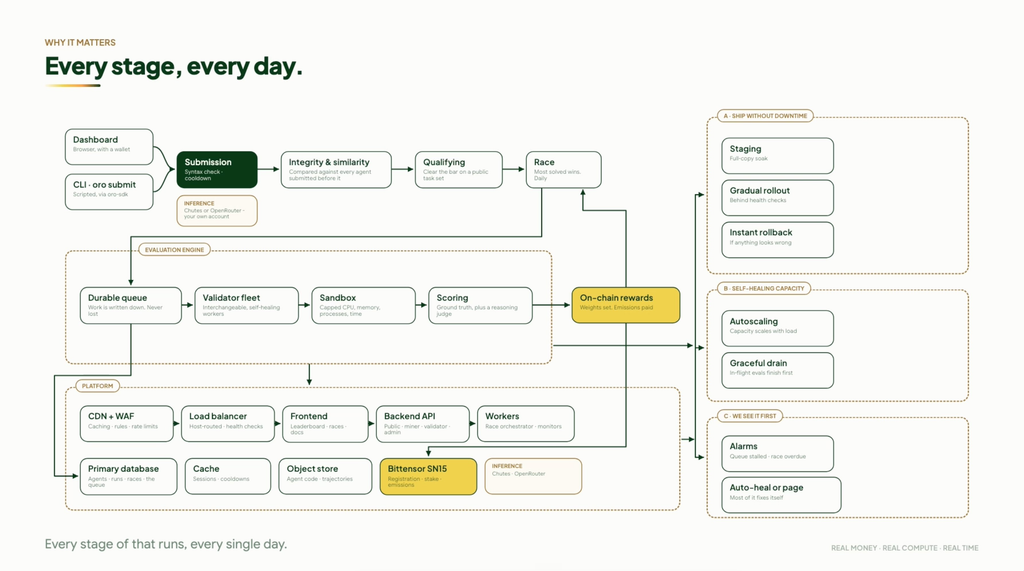
ORO operates Bittensor Subnet 15 as an open competition for AI shopping agents.
Developers submit Python-based agents capable of searching for products, comparing alternatives, applying constraints such as budgets and retailers, and completing shopping tasks through tools. Independent validators then run those agents in sandboxed environments against ShoppingBench, ORO’s benchmark built around millions of real products.
The agents are scored, and the best-performing systems receive emissions.
But the competition produces something more valuable than a leaderboard.
Every successful run generates an agent trajectory, a record of how the system approached and completed a task. Those trajectories become training data that can be used to improve future agents.
The benchmark also changes its problems daily, preventing agents from simply memorizing a fixed set of tasks.
This creates the flywheel at the center of ORO’s strategy. More competition produces more agent behavior and training data; better data produces better agents; better agents raise the standard of the competition, generating even more useful data.
The ultimate goal is not simply to build an AI that can recommend a pair of shoes or find the cheapest laptop. ORO is targeting what the industry calls agentic commerce, AI systems capable of carrying out complex, long-horizon shopping tasks on a user’s behalf.
That distinction is becoming increasingly important as AI moves from answering questions to taking actions.
Why YC matters
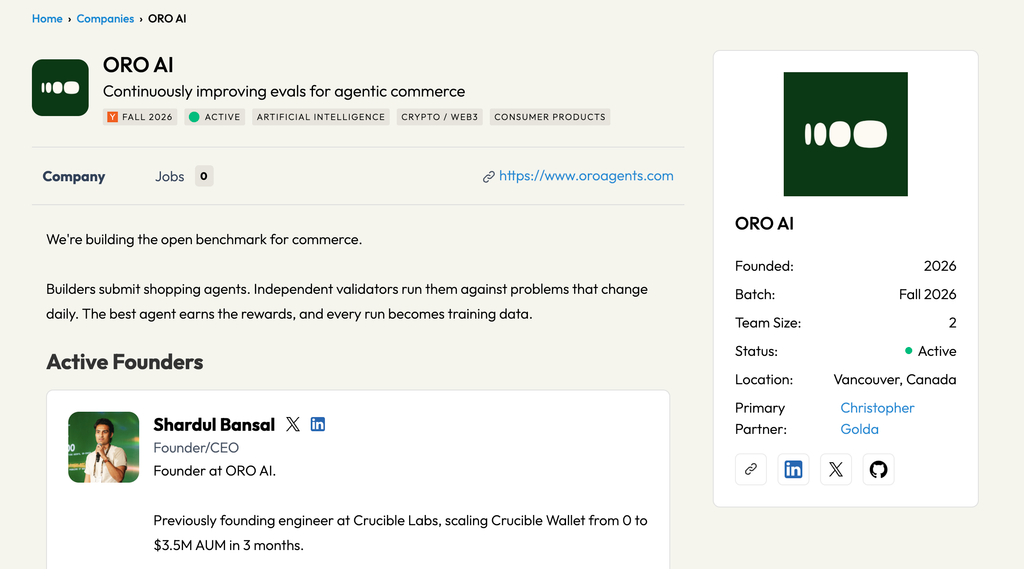
Y Combinator’s description of ORO is worth paying attention to. The accelerator describes the company as building “the open benchmark for commerce.”
The YC acceptance puts an established Bittensor subnet inside one of the world’s most influential startup ecosystems at precisely the point where AI agents are becoming a major area of competition.
The company itself remains remarkably small. ORO was founded by Shardul Bansal, its CEO, and Seth Schilbe, its CTO. Both founders have backgrounds in distributed systems at AWS, while Bansal previously helped scale Crucible Wallet. The company is based in Vancouver.
Bansal said he will spend the next three months in San Francisco and is looking to connect with people working on evaluations, continuously improving benchmarks and reinforcement-learning environments for long-horizon tasks.
A different path for Bittensor startups
The acceptance has already prompted speculation about whether ORO could provide a blueprint for other Bittensor teams.
Crucible Labs, which has worked closely with ORO, described the team as having shown “ambition, resilience and relentless focus on building real products for agentic commerce” and called the YC acceptance a moment of pride for the project.
Within the Bittensor ecosystem, the reaction has been monumental too. ORO is viewed by some as a potential beachhead for a new kind of Bittensor startup that uses the network for its decentralized infrastructure and incentive layer, while relying on a traditional accelerator to help turn that infrastructure into a venture-scale company.
That model could prove particularly important for Bittensor.
The network has no shortage of technically ambitious subnets, but turning a subnet into a widely adopted product remains one of the ecosystem’s biggest challenges. ORO’s approach suggests that the two pieces do not necessarily have to happen inside Bittensor.
The decentralized network can provide the competition, incentives, and data-generation engine. A conventional company can then build the commercial product around it.
That is part of what makes ORO’s YC acceptance so significant.
There’s still a lot of work to be done
The YC acceptance is a major milestone, but for ORO, it is the beginning of a much bigger chapter. The team has already built a live decentralized marketplace for AI agents, with the competition, incentives, and data infrastructure needed to push agentic commerce forward.
Now, the challenge is turning that foundation into a product that can operate at the scale ORO is aiming for.
Over the next three months in San Francisco, ORO will have the opportunity to sharpen its product, expand its network, and build the company around an infrastructure that is already running on Bittensor.
Enjoyed this article? Join our newsletter
Get the latest TAO & Bittensor news straight to your inbox.
We respect your privacy. Unsubscribe anytime.
Enjoyed this article?
Join our newsletter
Get the latest TAO & Bittensor news straight to your inbox — every morning before markets open.



[…] Teutonic (SN3) is among his preferred subnet plays, alongside Engy (SN53), Targon (SN4), Lium (SN51), GM (SN28), Bitcast (SN93), Minos (SN107), Hippius (SN75), RedTeam (SN61), and Oro (SN15). […]
[…] shopping agent can ace the same benchmark every day without becoming any better at shopping. ORO (SN15) is tackling that problem by making the benchmark itself harder to […]