
Miners on Pareton (SN10) delivered a 3.5× speedup on Qwen3.8-27B, an open-source AI model, during the campaign’s first week of operation.
Response times dropped from 727ms to 190ms on the same hardware, as the model now answers almost four times faster than before.
Reliability jumped from 3% to 100%, so the model now meets its target speed on every single request, up from just 3 out of 100. Answer quality stayed identical to the original, so the speedup came without any drop in what the model produces.
The Week-One Numbers
Every speed and reliability measure that AI agents care about improved together in the same campaign cycle.
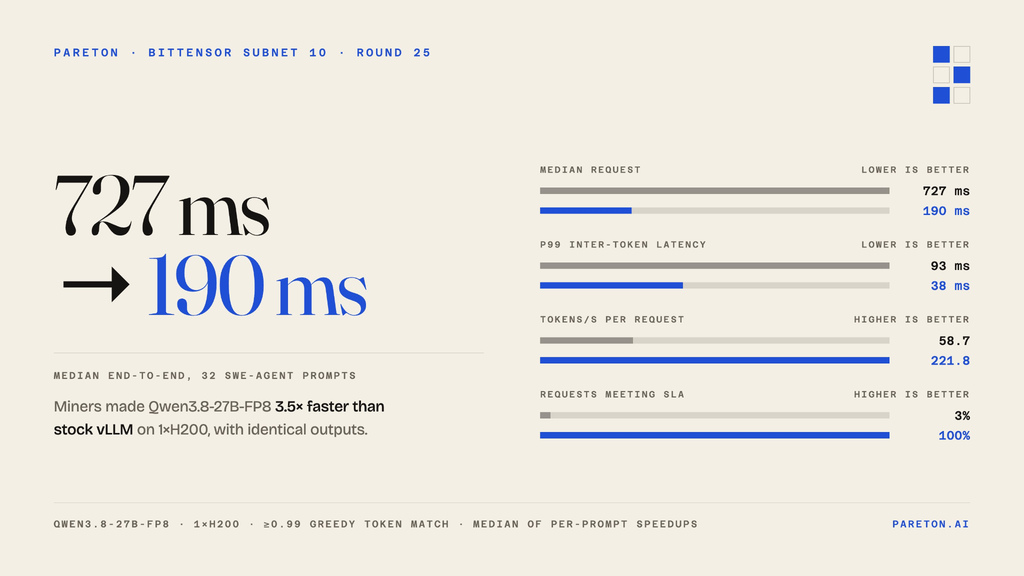
1. Response time dropped from 727ms to 190ms on the same hardware: A 3.5× improvement while serving identical answers to the original baseline the model was measured against.
2. Throughput climbed from 58.7 to 221.8 tokens per second: Users now experience the model responding almost four times faster during typical coding tasks and agent workflows.
3. Slow-response tail dropped from 93ms to 38ms between tokens: The worst-case delays got cut by more than half, which matters most for agents running multi-step tasks.
4. Reliability jumped from 3% to 100% of requests meeting the target speed: The improved setup now hits the deadline on every request, as against fewer than 3 in every 100.
None of the gains came at the cost of answer quality, which stayed identical to what the original model would have produced.
How Miners Produced the Result
31 miners submitted 74 improvements across 25 rounds, competing to beat each other on the same benchmark.
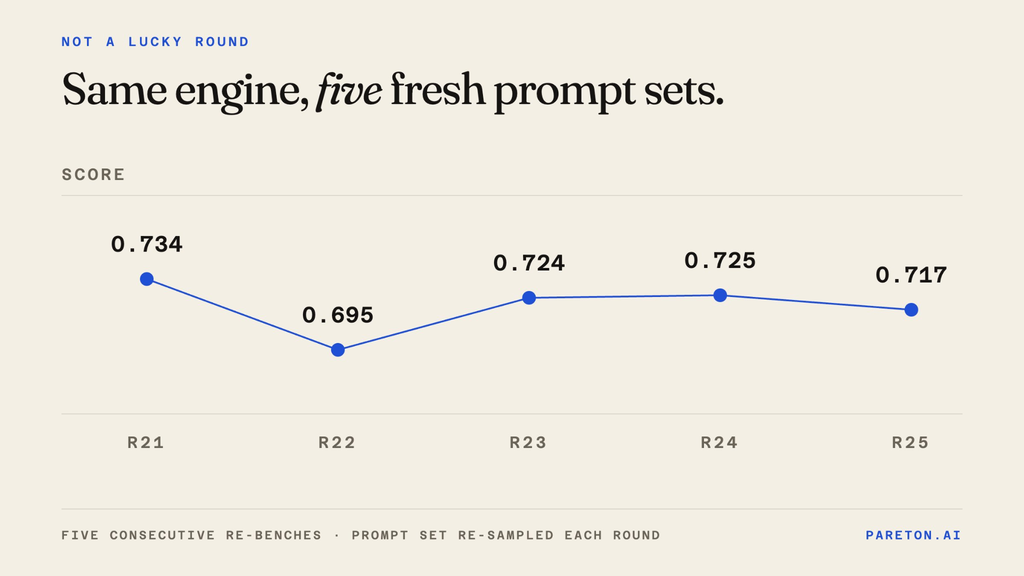
1. Every round uses a fresh test set nobody sees in advance: Miners cannot game the benchmark by tuning for specific questions they know are coming next.
2. Every submission must produce the same answers as the original model before speed counts: Correctness gets checked first, so no shortcut wins by generating different outputs.
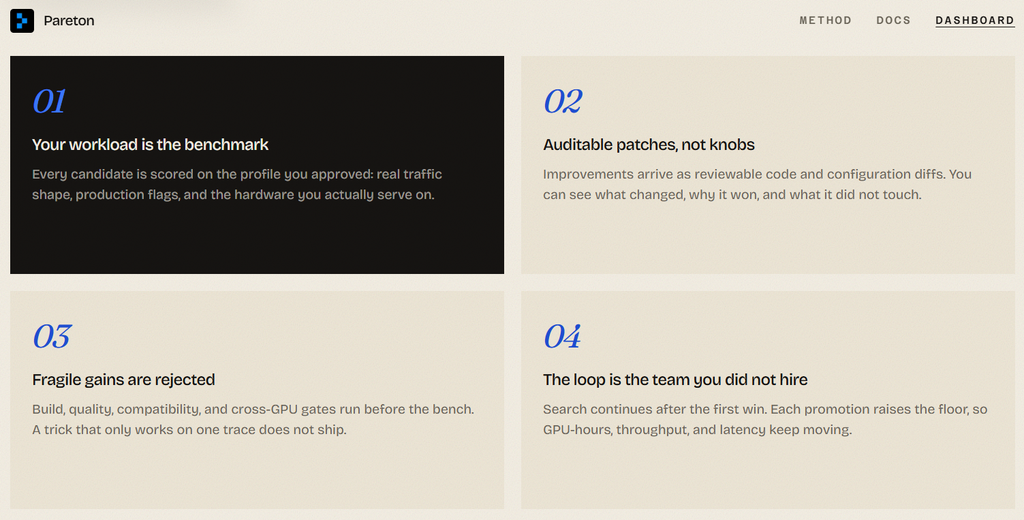
3. The winning improvement touched roughly 1,000 lines of code and nothing else: No architectural rebuild, no model retraining, just targeted optimization of the serving software for this specific setup.
One Workload Down, Others Coming
The current campaign focuses on coding-agent traffic, that is, short questions with short answers under tight speed requirements.
Other Pareton campaigns will cover different workload types like long-form generation and different hardware setups as the network expands.
The Week 1 result holds while the current winner keeps its position, with the next round of improvements arriving through continued competition.
What Pareton just proved is that miner competition produces real speed gains buyers can measure directly against their own baselines.
Enjoyed this article? Join our newsletter
Get the latest TAO & Bittensor news straight to your inbox.
We respect your privacy. Unsubscribe anytime.
Enjoyed this article?
Join our newsletter
Get the latest TAO & Bittensor news straight to your inbox — every morning before markets open.


No comments yet — be the first.