


Lium, Bittensor’s Subnet 51, has published a benchmark that puts a concrete number on one of the network’s biggest infrastructure bets. It is showing what cheap, permissionless access to high-end GPUs can look like in practice.
On September 6, Lium reported 14,499 output tokens per second running Qwen3.6-35B-A3B-FP8 on a single rented NVIDIA B200.
The benchmark used vLLM 0.28.0, 256 concurrent streams, and 512 output tokens per stream. Lium calculated the GPU cost at $0.107 per million output tokens.
That is significantly below the $0.70 per million output tokens currently listed by OpenRouter for Qwen3.6-35B-A3B.
Lium then published the benchmark setup for teams to use and test themselves. The repository contains 36 runs across five GPU classes, including B200, H200, H100, RTX PRO 6000 Blackwell, and RTX 5090.
Where Lium Sits in the Field
The GPU market Lium is entering is already crowded, but the products are not identical. Against managed APIs like OpenRouter, Together, and Fireworks, it trades one-HTTP-call convenience for full control of quantization, engine version, and batching. Against raw GPU markets, the peer set looks like this:
| Provider | Market | Main advantage |
|---|
| Lium SN51 | Decentralized GPU rental | Specific GPUs, open serving stack, permissionless supply |
| Vast.ai | P2P GPU marketplace | Broad marketplace and aggressive pricing |
| RunPod | GPU cloud | Easier deployment and productized infrastructure |
| AWS | Hyperscale cloud | Enterprise reliability and ecosystem |
| Chutes SN64 | Decentralized inference | Buy model inference directly, without managing GPUs |
The Bittensor products in this space are complementary. Chutes (SN64) provides serverless inference endpoints, where users pay for tokens. Targon (SN4) provides confidential compute using TEEs for companies that cannot run sensitive workloads on public providers. Lium (SN51), meanwhile, provides the GPU itself. It sells the GPU-hours that produce those tokens, and other subnets can use that compute as an input.
Lium Is Building a Profitable Business
The benchmark is only part of the Lium story. The subnet has also been showing strong growth on the business side.
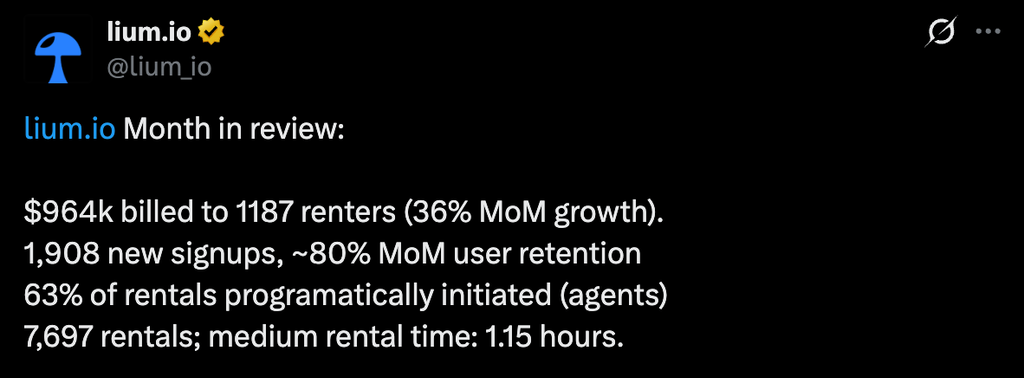
In its latest monthly review, Lium reported $964,000 billed to 1,187 renters, up 36% month over month. It added 1,908 new signups, retained around 80% of users, and recorded 7,697 rentals with a median rental time of 1.15 hours. Around 63% of rentals were initiated programmatically by agents.

Lium also announced a $1 million burn of SN51 alpha tokens, funded with roughly five weeks of product revenue.
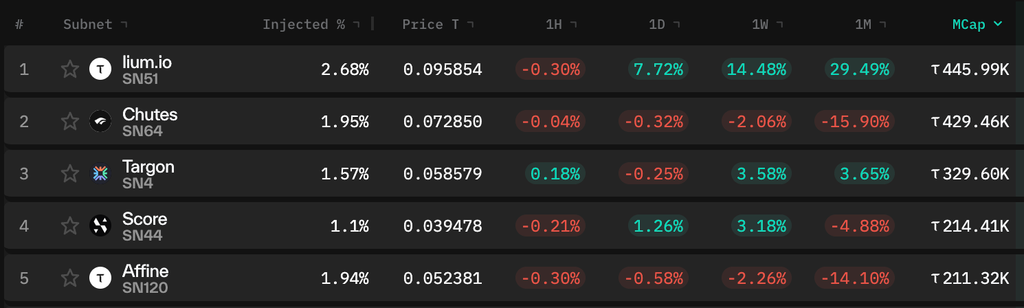
The growth is now reflected in the subnet’s position within Bittensor. Lium has overtaken Chutes to become the #1 subnet by both price and market cap.
Why This Matters
Lium now has two numbers worth watching. The benchmark shows what its infrastructure can deliver, while its revenue, renter growth and token burn show that people are using the product.
The 14,499 TPS result is not a standalone story about GPU speed. It sits alongside a growing rental business, increasing agent usage, and a $1 million token burn funded by product revenue.
For Bittensor, that makes Lium one of the clearest examples of a subnet building both infrastructure and a business around it. Lium is a subnet to watch closely.
Enjoyed this article? Join our newsletter
Get the latest TAO & Bittensor news straight to your inbox.
We respect your privacy. Unsubscribe anytime.
Enjoyed this article?
Join our newsletter
Get the latest TAO & Bittensor news straight to your inbox — every morning before markets open.



[…] million buyback and burn funded by roughly five weeks of product revenue. Shortly afterwards, Lium overtook long-standing leader Chutes to become Bittensor’s largest non-root subnet by both price and market […]
[…] the 128 subnets, 23 now have paying customers. Lium (SN51) has become the most successful GPU incentive network to date, with thousands of dollars per day in […]
[…] hands-on evaluation compared Lium (SN51) and Green Compute (SN110) under the same conditions to see how easy their GPUs are to rent with an […]
[…] powerful GPUs can be expensive when they sit idle without paying customers. Lium (SN51), a decentralized GPU marketplace, helps owners earn from their […]
[…] Lium, a decentralized GPU rental marketplace, is trying to remove those friction points, and its latest numbers show the platform is growing fast. […]