

Every Bittensor subnet reduces to a single elegant idea: two roles working against each other on purpose. Miners produce the output the subnet is built to deliver, and validators score that output to decide who gets paid.
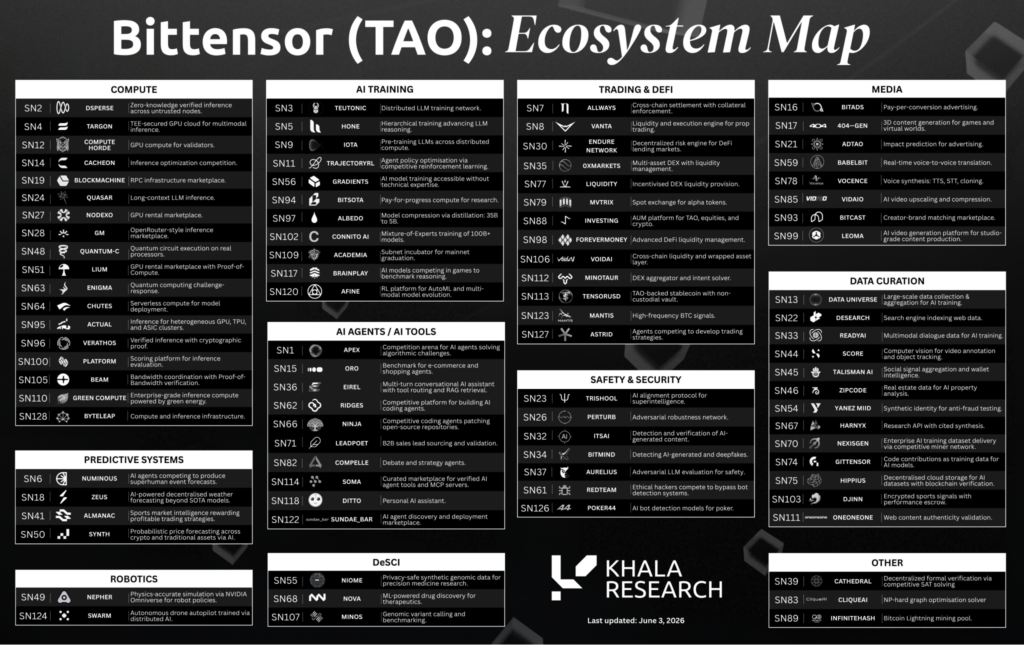
That split is what turns raw compute into ranked intelligence, and understanding it is the difference between watching Bittensor from the outside and actually reading what the network is doing at any moment.
Miners: The Ones Doing the Work
Miners are the production layer. Every model run, every query answered, every dataset generated on a subnet comes from a miner somewhere on the network competing to be the best at that specific job.
1. They compete on quality, not participation: The chain does not pay for showing up. It pays for output that outranks every other miner attempting the same task in the same window.
2. They cover their own costs: GPUs, electricity, colocation, and infrastructure all sit on the miner’s balance sheet, not the subnet operator’s. Nobody hires them. They opt in.
3. The task defines the miner behavior: Inference subnets have miners running language models. Genomics subnets have miners identifying mutations. Vision subnets have miners classifying images. The subnet mechanism sets the target, and miners chase it.
4. The strongest solutions earn: When 256 miners work the same problem for the same reward, only the top of the distribution captures meaningful emission. Weak submissions earn little and stop being profitable to run.
The competitive pressure between miners is what makes Bittensor produce better output than a centralized team could build for the same money. A subnet team hiring internally is choosing from a local talent pool. A subnet running on Bittensor is choosing from a global one that self-selects for the specific task.
Validators: The Ones Grading the Work
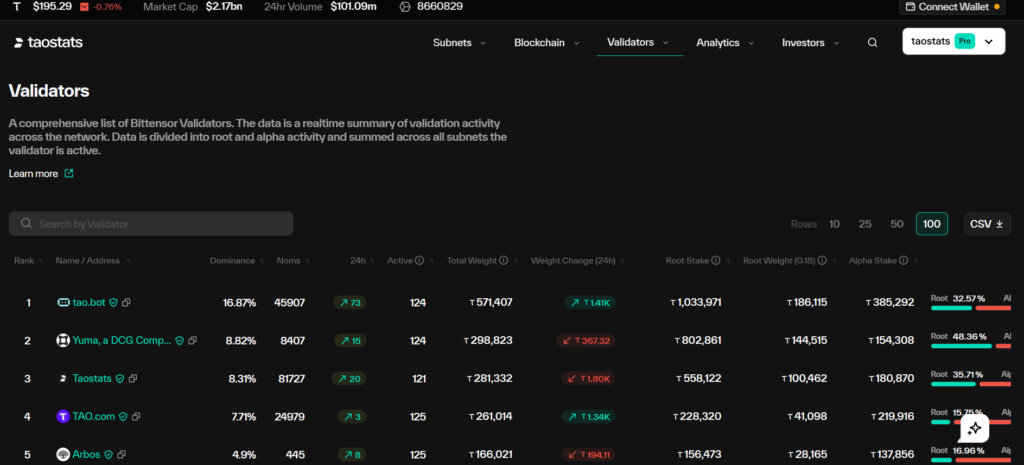
Validators are the scoring layer. Every miner submission runs through a validator that evaluates it against the subnet’s benchmark, and the resulting scores determine how the chain distributes emission across the miner set.
1. They define what quality means: The validator’s evaluation criteria are effectively the specification of what the subnet rewards. Change the criteria, change the behavior.
2. They rank every submission: Miner output gets scored, sorted, and paid out on the resulting curve. Top performers capture the largest share. Bottom performers capture none.
3. They keep the incentive layer honest: Without validators, miners could game their way into rewards by producing plausible-looking output that fails on real tasks. Validators are the mechanism that ties reward to actual work.
4. Multiple validators cross-check each other: No single scoring authority controls a subnet. Independent validators score the same submissions and consensus emerges from their overlapping views.
Validators are why the network’s incentive economics work at all. They translate raw output into a rank, and the chain uses that rank to route $TAO. Nothing else about a subnet functions if the validation layer is compromised.
Two Jobs, Checked Against Each Other
The reason Bittensor works is that miners and validators have different incentives and different jobs, and both are visible on-chain in real time. While miners want their output to score well, validators, on the other hand, want their scoring to reflect quality accurately, since their own rewards depend on staying aligned with the truth of what miners are actually producing.
Subnet operators sit above both, defining the task, tuning the mechanism, and eventually selling the product the miners generate.
Everything else Bittensor is (dTAO markets, subnet economics, chain buys, conviction locks, deregistration) sits on top of this simple two-role split. Get the split right, and a subnet compounds intelligence at a rate no centralized team can match.
Enjoyed this article? Join our newsletter
Get the latest TAO & Bittensor news straight to your inbox.
We respect your privacy. Unsubscribe anytime.
Enjoyed this article?
Join our newsletter
Get the latest TAO & Bittensor news straight to your inbox — every morning before markets open.



No comments yet — be the first.