

NOVA Blueprint is moving its molecular scoring over to Boltz-2, a development that relocates where the real work sits.
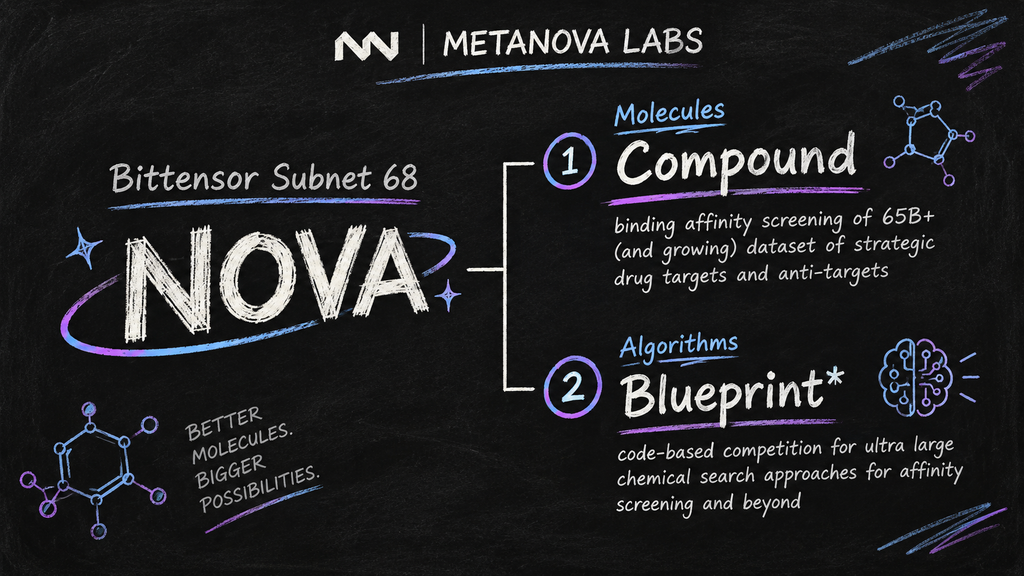
NOVA Blueprint is an open algorithmic challenge on NOVA (SN68) that competitively searches enormous chemical spaces for candidate molecules.
It runs repeated cycles that collect the best candidates and build on the strongest approaches through tokenized incentives open to anyone.
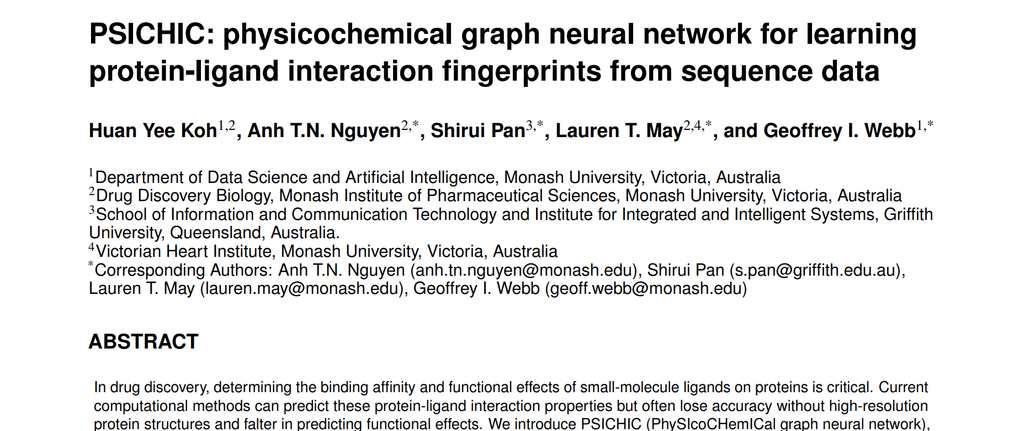
Until now, the scoring workhorse has been PSICHIC, which rates protein-ligand pairs for binding affinity without needing 3D structures.
That keeps it cheap and fast enough for early triage across huge datasets that would otherwise be unmanageable.
NOVA (SN68) has since fine-tuned it into sharper domain-specific variants, though those remain a refinement on the same underlying engine.
Boltz-2 is the upgrade layered on top, a structural biology model predicting biomolecular structure and binding affinity with higher fidelity.
The trade-off is compute, since Boltz-2 inference costs more to run than the lighter PSICHIC scoring does. That expense is why search now carries more weight than it did under the older, cheaper setup.

Blueprint’s algorithms must decide which regions of chemical space deserve the costly Boltz-2 look in the first place.
Cheap algorithmic exploration narrows the vast field first, and expensive inference then concentrates only where it genuinely counts. Better search decides what deserves a closer look, and better models make that closer look worth taking.
➛ Read More on NOVA (SN68) Here.
Enjoyed this article? Join our newsletter
Get the latest TAO & Bittensor news straight to your inbox.
We respect your privacy. Unsubscribe anytime.
Enjoyed this article?
Join our newsletter
Get the latest TAO & Bittensor news straight to your inbox — every morning before markets open.



[…] Bittensor subnet, NOVA (SN68), is moving beyond predicting potential drug candidates to producing and testing them in real […]