

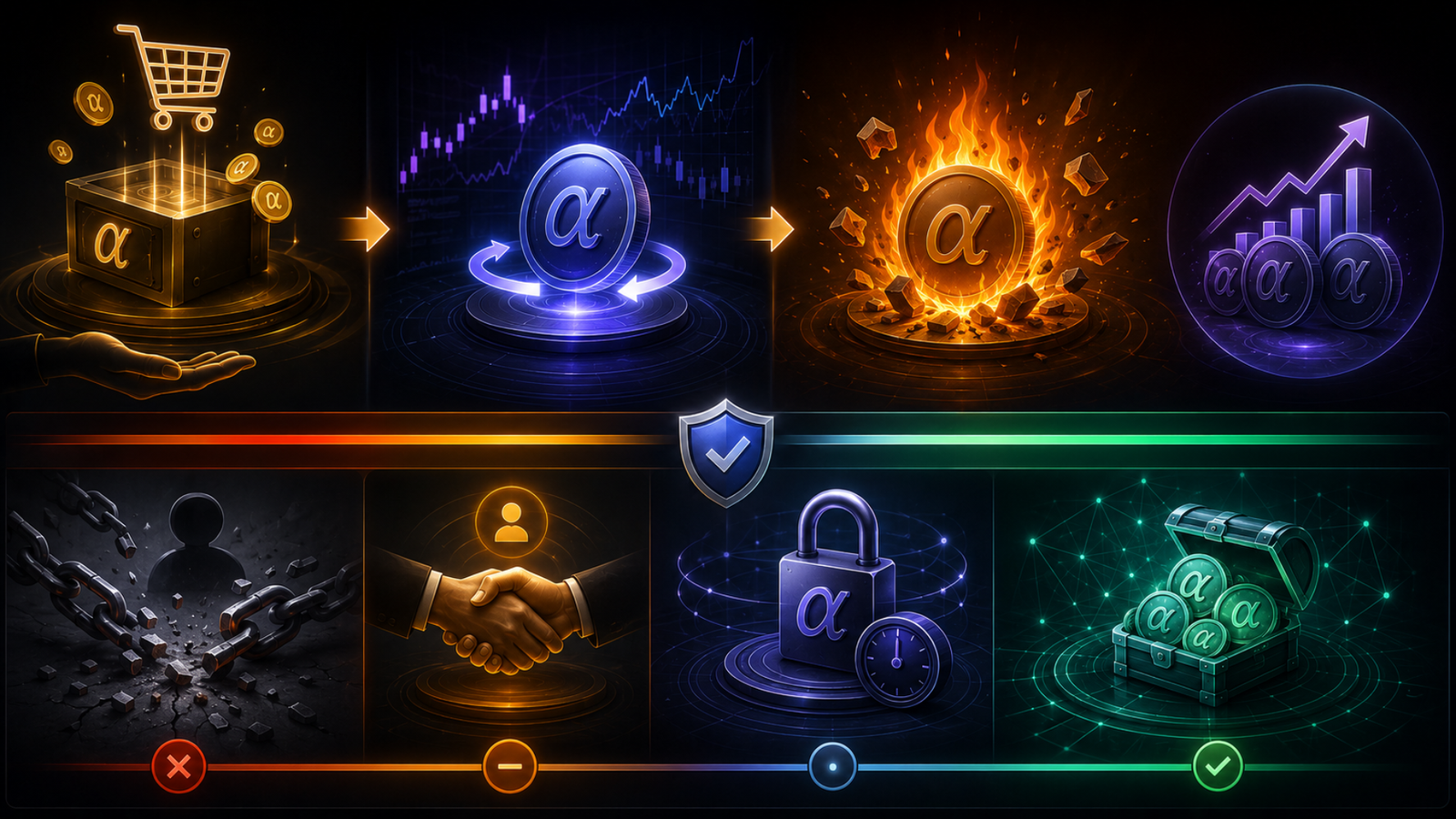
Backing a Bittensor subnet means handing capital to someone whose only assurance is that they will keep driving value to the subnet ‘$ALPHA’ token long after you have staked. Almost every reassurance a subnet offers is a promise about the future, and promises quietly reverse once the money is committed.
The mechanisms that inspire real conviction are the ones that prove commitment on-chain instead of pledging it, since those cannot be forged. Ranked from strongest to weakest, what separates them is simply how much trust each one still asks you to extend.
How Buyback and Burn Works
Buyback and burn turns real income into permanent scarcity, and the loop only closes if the subnet is genuinely earning.
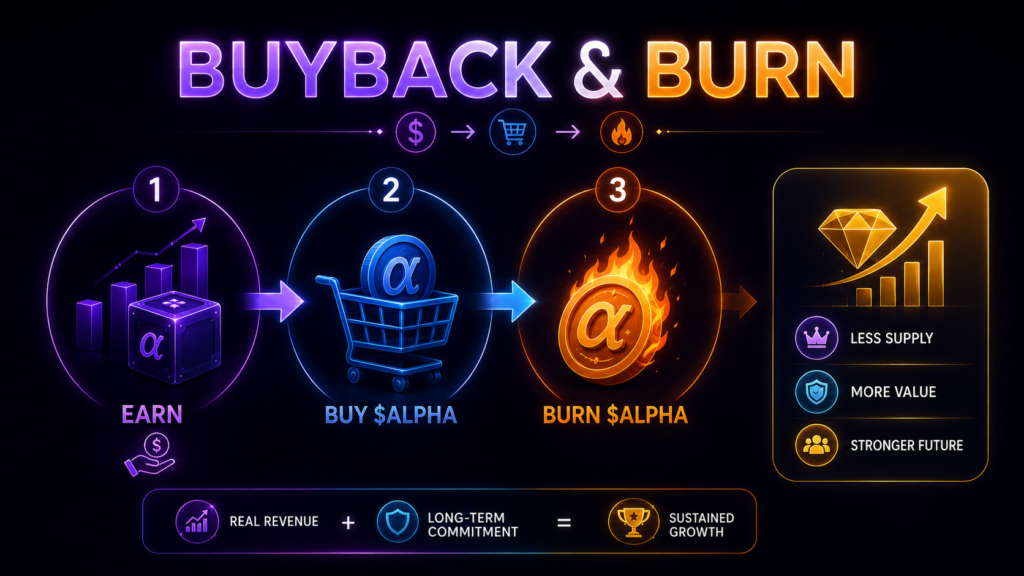
1. Sell the commodity the subnet produces to a buyer who wanted it, generating revenue.
2. Buy the $ALPHA on the open market with that revenue.
3. Burn it, cutting the maximum supply and pushing value into every token left.
A sustained burn proves two things at once: the subnet has revenue, and the owner spends it on longevity rather than pocketing it. That is why it holds up even when the owner is anonymous, as with Subnet 51 (Lium), whose operator has no public identity yet keeps contracting supply through consistent burns.
You never need to know who runs it, because the value driven in is visible and impossible to fake.
Why the Alternatives Ask for Trust
Some argue an owner should reinvest revenue to grow the subnet faster instead of burning it, and there is real merit to that. The catch is it requires trusting the owner to follow through, which the source bluntly relabels “buyback and trust me, bro.”
It beats doing nothing, but it still asks the staker to carry risk on faith, and the economics show why that matters. An owner pays a one-time fee for a slot, then never funds miner emissions, since those come from Bittensor itself.
1. The owner’s real costs are marketing, sales, and code, not paying the miners producing the commodity.
2. Emissions flow out regardless, so the value has to come from somewhere.
3. When an owner isn’t burning or covering emissions with revenue, it comes from new stakers buying in, quietly making them the exit liquidity.
The New Layer: Conviction Locks
Conviction locks are the newer mechanism, letting owners lock their own $ALPHA visibly on-chain to signal they will not dump. The lock is protocol-enforced, so it cannot be quietly undone, and exiting is heavily time-delayed, giving stakers a long heads-up before any large sale is possible.
It answers a different question than burning: not whether value is being driven in, but whether the person steering the subnet plans to leave. A subnet doing both proves ongoing value creation and a committed owner at once, which the source calls the creme de la creme.
The Full Trust Hierarchy
Laid side by side, the mechanisms separate cleanly by how much faith each still demands.
| MECHANISM | WHAT IT PROVES | TRUST REQUIRED |
| Buyback and burn | Real revenue, value driven to $ALPHA | None, fully verifiable |
| Conviction locks | Owner won’t dump, committed long-term | Minimal, protocol-enforced |
| Buyback and reinvest | Possible future growth | High, owner-dependent |
| No communication | Nothing | You are the exit liquidity |
The takeaway is to stop taking a subnet’s word for its intentions and start checking. Tools like TAOflute expose sortable burn and conviction columns, surfacing which subnets burned the most over the last thirty days and which hold the most locked $ALPHA.
Bittensor already has doxxed owners who dumped anyway, so a name behind a subnet was never the safeguard it looked like. If a subnet you hold looks weak on both fronts, the honest move is either to step aside or to ask the owner directly why you should trust them.
Enjoyed this article? Join our newsletter
Get the latest TAO & Bittensor news straight to your inbox.
We respect your privacy. Unsubscribe anytime.
Enjoyed this article?
Join our newsletter
Get the latest TAO & Bittensor news straight to your inbox — every morning before markets open.



No comments yet — be the first.