


Actual Computer is a Bittensor subnet (SN95) building inference software for the hardware people already own.
The product runs large language models on Macs, PCs, consumer GPUs, home servers, and edge boxes, coordinating them as a mixed device fleet rather than forcing a clean datacenter setup.
The idea is that inference moves out of datacenters as open-source models reach near-frontier quality and as the energy demand on datacenters becomes unworkable. SN95 is the Bittensor layer that turns the resulting fleet of consumer machines into coordinated AI supply.
Actual currently ranks #3 among Bittensor subnets by alpha price.
The Thesis that Makes Actual (SN95) Work
The case for local inference rests on a few current realities of the AI industry.
1. Datacenter energy demand is at a building-capacity bottleneck. Based on current projections, max energy buildout looks pinned for a decade-plus. The supply side cannot keep pace with demand.
2. Massive idle compute exists outside datacenters. An estimate suggests there is roughly 4x more compute sitting in homes, offices, and consumer devices than inside datacenter racks. Most of it is unused.
3. Open-source models are now near state-of-the-art. GLM 4.7 benches close to top closed-source models. Kimi K2 and other 1T-class models are deep in capability. The gap between datacenter and home models is shrinking fast.
4. Consumer hardware is finally ready to run them. Apple ships Macs with 512GB of unified RAM. Nvidia’s GB10/Spark uses unified RAM on Blackwell. 5090 clusters run models at high speed. M5, M6, and post-Grace-Blackwell are the next inflection.
The team calls the underlying opportunity TEA: technological energy arbitrage. Turning underused compute and abundant residential energy into AI output instead of renting intelligence forever through subscriptions.
How the Software Works
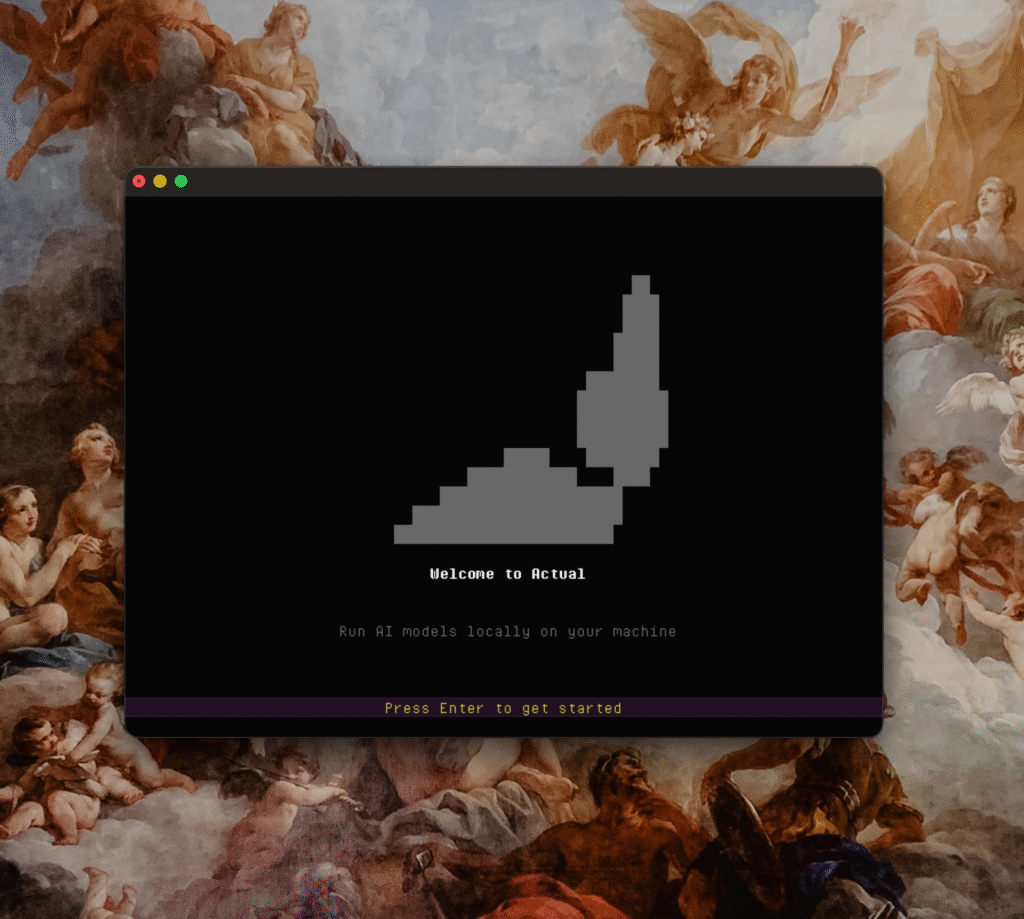
Actual Computer’s software coordinates real hardware as it exists, not as it would look inside a clean datacenter rack.
What the product does:
1. Heterogeneous-first. Runs inference across mixed device fleets. Macs, PCs, GPUs, home servers, edge boxes. Different devices have different strengths and different failure modes, and the software is built to see that rather than flatten everything into a fake homogeneous cluster.
2. (GPT-Generated Unified Format) GGUF-based inference engine. First built on LlamaCPP and the GGUF ecosystem. A custom engine is in development to push record-setting performance across device configurations.
3. One-line install. Sign up, install on Mac, Linux, or PC with a single command, load models through the interface, and access OpenResponses-compatible endpoints. Actual never sees or stores inference requests.
4. Hardware floor: 2017 and later. Anything from a 3060 GPU and up can contribute. The bar is consumer hardware, not datacenter silicon.
5. Always-on home compute. Users can fire up a home cluster running a powerful model and access it from anywhere. Local, global, or both. A consumer machine sleeping eight hours a night can be running model inference instead.
The team positions the software as infrastructure, not a developer tool: “the structure supporting the future of machine intelligence should look like breaker boxes and transformers, less like apps.”
SN95 vs IOTA (SN9): Building Models vs Running Them
Actual Computer (SN95) and IOTA (SN9) often get grouped together because both deal with large language model infrastructure on Bittensor, but they sit at different points in the model lifecycle.
IOTA is a distributed pre-training network coordinating GPUs to train a large language model from scratch (the team has been working on a model in the ~100B parameter range). Actual Computer, on the other hand, is the inference and serving network that takes finished models and runs them efficiently on consumer hardware.
| Dimension | IOTA (SN9) | Actual Computer (SN95) |
| Pipeline stage | Pre-training: building a model from scratch | Post-training: running finished models live |
| Core problem | Coordinating distributed GPUs on a single training run | Coordinating heterogeneous consumer devices on inference |
| What miners do | Contribute training compute toward a shared large model | Serve inference requests across mixed device fleets |
| Hardware target | GPUs capable of contributing to training | Consumer machines from 2017 and later (3060 and up) |
| Output | A larger, more capable open-weight model | Lower-cost, lower-latency inference on existing hardware |
| Time horizon | Months to years (training cycles) | Real-time per request |
| Plain English | Producing the intelligence | Delivering the intelligence |
SN9 is a distributed lab building a model from scratch, and SN95 is a distributed network serving finished models to end users.
Without pre-training networks like SN9, open-source models stop improving relative to closed-source frontiers. Without inference networks like SN95, those models stay locked inside datacenters. The two cover adjacent ground in the same stack, not competing approaches.
The Actual Models Service
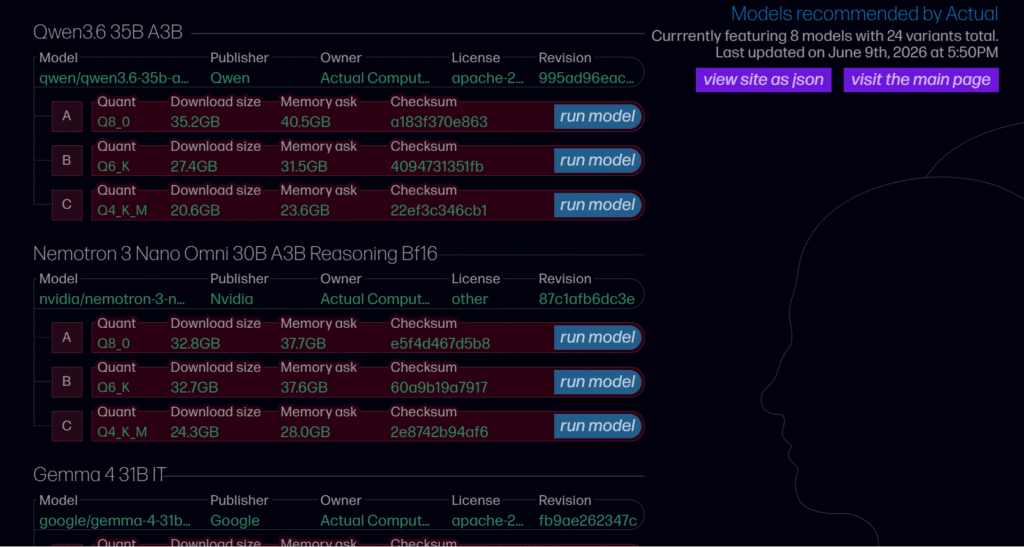
Alongside the core inference software, Actual runs a curated models service. This service offers:
1. Quality imatrix quants of popular open models. The team makes and publishes its own quants rather than relying on whatever happens to be available.
2. 8 models with 24 variants. Three quant levels per model: Q8_0, Q6_K, and Q4_K_M.
3. Featured lineup includes Qwen 3.6 35B A3B, Nemotron 3 Nano Omni 30B A3B Reasoning, Gemma 4 (31B IT, 26B A4B IT, 12B IT, E4B IT, E2B IT), and Qwen 3.6 27B.
4. Sizes range from 4.1GB to 35.2GB download. Memory asks from 4.7GB to 40.5GB.
5. Public checksums per quant. The snapshot attached was last updated on June 9, 2026.
The service removes one of the friction points for users running models locally, which is finding a quality quant in the right size for their hardware.
The Team and the Vision
Actual Computer is based in New York. Tom Lynch is the public face of the company and runs SN95. Lead designer Jack Vodka handles art direction and UI.
The team’s vision of where this is going:
1. Actual Computer becomes the next Microsoft. The fundamental software layer that sits between consumer hardware and how people interact with their computers daily.
2. Large language models as they exist today are effectively irrelevant within five years. The transformer architecture may still be core, but the LLM as a category has a limited lifespan in its current form.
What Investors Should Weigh Before Buying the Alpha
Despite all of the above, consider this before you buy in.
The idea holds and the team is ambitious, but the on-chain and operational reality is worth looking at closely before going in.

- A 38% alpha whale. A single wallet holds roughly 38% of the alpha. That is a concentration huge enough that one decision moves the whole market.
- Almost no conviction locks to offset the whale. There is very little locked conviction underneath that position. Nothing meaningful stands between the whale wallet and the door, so the usual reassurance that large holders are committed for the long haul does not apply here.
- No code to audit. There is no public codebase. For a subnet whose entire pitch is coordinating inference across heterogeneous consumer hardware, the absence of auditable code means buyers are trusting the claim rather than verifying it.
- Subnet identity not being maintained. The subnet identity isn’t being kept up to date, which is a low-effort signal of attentiveness that most serious teams handle as a matter of course.
- Miner emissions have never been switched on. Not once. That means the incentive mechanism, the part of any Bittensor subnet that is supposed to be stress-tested by real miners competing for rewards, has never run live.
It’s also worth flagging that the beta runs as an unaudited install on the tester’s own machine, with no public code and no miner-performed work as Bittensor intends. Anyone testing should proceed as they would with any unaudited software.
None of this dismisses what the team is building. It’s simply a note of caution for investors and enthusiasts going in.
➛ Join Actual Computer (SN95) Beta By Requesting Access Here
The Heterogeneous Bet
Actual Computer (SN95) is onto something huge. The energy argument (datacenters bottlenecked, consumer power abundant) and the hardware argument (open-source models near frontier, consumer chips finally ready) compound into the same conclusion: inference moves to where the hardware and electricity already live.
The software layer to coordinate heterogeneous consumer compute has been the missing piece. Actual is building that layer, and SN95 turns the resulting fleet into useful supply.
Enjoyed this article? Join our newsletter
Get the latest TAO & Bittensor news straight to your inbox.
We respect your privacy. Unsubscribe anytime.
Enjoyed this article?
Join our newsletter
Get the latest TAO & Bittensor news straight to your inbox — every morning before markets open.


No comments yet — be the first.