

AI agents are getting better at remembering users, but persistent memory creates a less obvious question: where does all that data live? For Ditto (SN118), an AI assistant designed to retain context across conversations, the answer is now Hippius (SN75), a Bittensor subnet focused on decentralized cloud storage.
Ditto has moved its core storage from Backblaze to Hippius, bringing user files and growing volumes of agent-generated data onto another subnet within Bittensor. The move looks like a routine infrastructure decision, but it points to the fact that subnets are beginning to use one another as production infrastructure.
Bringing AI Memory Inside Bittensor
Ditto builds a personal knowledge graph from conversations, allowing its agents to retain context across sessions. That system depends on more than conversation history, with documents, images, and agent-generated traces also needing to remain accessible.
The traces alone have reached tens of gigabytes and continue growing with agent activity. Ditto previously stored this data through Backblaze B2. It now uses Hippius for both user files and agent traces, moving a critical part of its AI infrastructure onto Bittensor.
Why the Switch
Backblaze was not failing Ditto. The team wanted lower costs, closer S3 compatibility, and a way to keep infrastructure spending within the network it operates on.
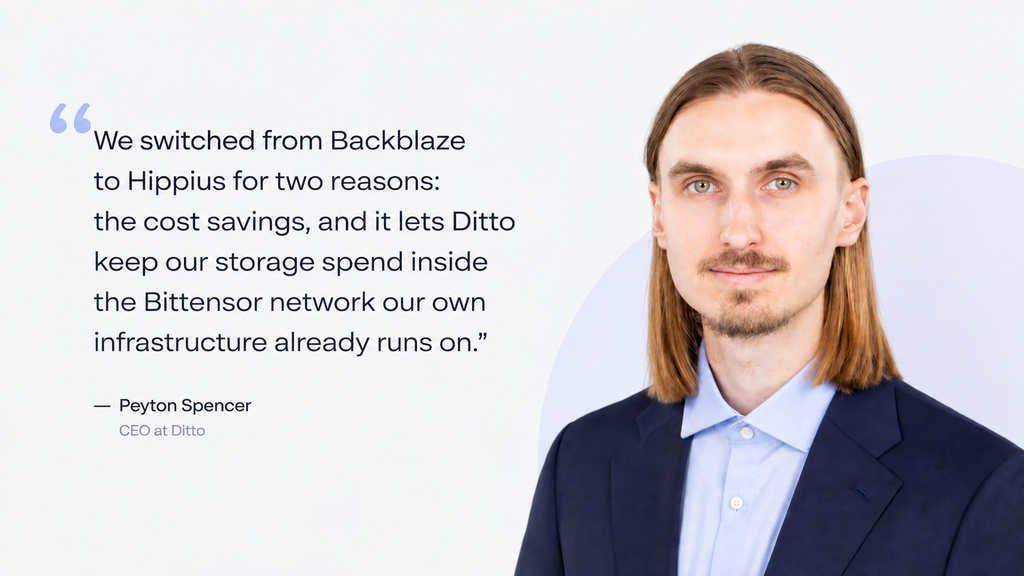
Hippius offered all three. Its decentralized storage network provides S3-compatible object storage, allowing Ditto to maintain familiar workflows while moving its data to a Bittensor-native service.
Ditto noted that its current Hippius storage bill is nearly zero, with user storage still below one terabyte. Ditto runs its AI benchmark, DittoBench, on Bittensor. Its storage layer now comes from another subnet on the same network.
From Separate Subnets to One Infrastructure Loop
Hippius now handles two main workloads for Ditto, viz, user content connected to its persistent memory and the growing traces produced by its agents.
The storage network encrypts and distributes data across miners, while storage activity can be verified through its blockchain infrastructure.
For Ditto, the practical benefits are lower costs and familiar S3 tooling. For Bittensor, the more interesting development is that value is now moving between two subnets through an actual production use case.
That is where subnet interoperability becomes important. A storage subnet can support an AI agent subnet, an inference subnet can serve another application, and a compute subnet can provide resources to a training network.
Each connection creates another source of demand within the ecosystem.
The Bittensor Supercycle
This is the basis for the Bittensor supercycle through subnet interoperability. The idea is that when subnets stop operating as isolated economies and begin consuming one another’s services, activity in one can create demand for others.
Ditto needs storage, Hippius provides it, and the spending stays within Bittensor, while Hippius gains a production workload from another subnet.
Multiply those connections across compute, inference, storage, data, training, and agent infrastructure, and Bittensor starts looking less like a collection of specialized networks and more like an interconnected AI economy.
That matters as agents become more persistent. They generate not only responses, but files, context, logs, execution traces, and other data that require infrastructure beneath the model.
Ditto’s migration to Hippius is one small example of that architecture taking shape.
The bigger story is not where Ditto stores its files. It is what happens when Bittensor’s subnets start becoming customers, suppliers, and infrastructure for one another. That interoperability could be the engine behind the network’s next phase of growth.
Enjoyed this article? Join our newsletter
Get the latest TAO & Bittensor news straight to your inbox.
We respect your privacy. Unsubscribe anytime.
Enjoyed this article?
Join our newsletter
Get the latest TAO & Bittensor news straight to your inbox — every morning before markets open.
No comments yet — be the first.