

From 4 million parameters to over 1 billion, Cascade is preparing its biggest AI model yet.
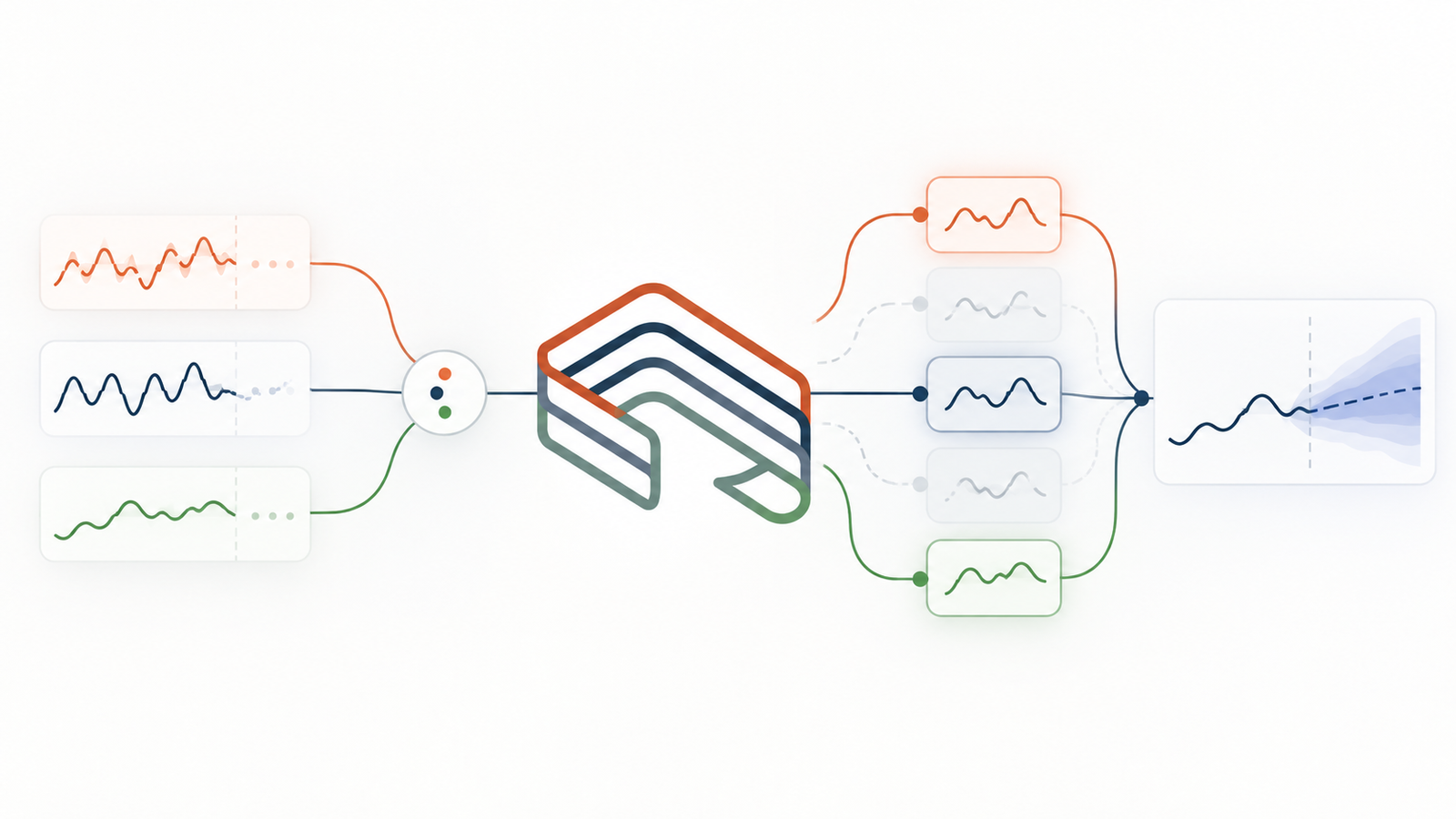
The team has announced Cascade-MoE, a new forecasting model designed to push prediction accuracy further through decentralized training on Bittensor.
Cascade (SN91) is focused on developing time-series foundation models capable of predicting future outcomes from historical data.
These models have applications across finance, energy, healthcare, and business operations, where identifying patterns and anticipating changes can support better decisions.
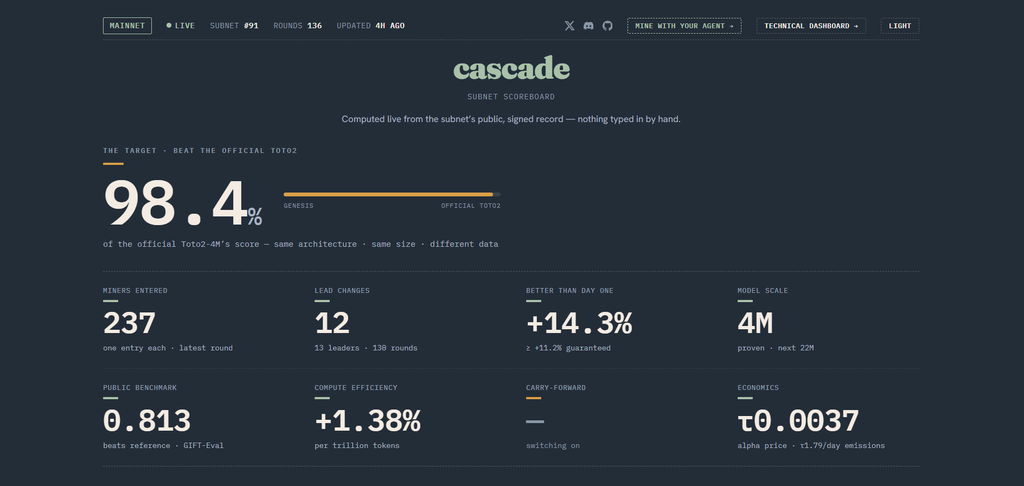
SN91 previously trained a 4-million-parameter forecasting model entirely on synthetic data generated by Bittensor miners.
It achieved comparable performance to Datadog’s Toto 2.0 model of the same size and outperformed it on some forecasting metrics while using substantially fewer training tokens. This demonstrated the potential of decentralized synthetic data generation to produce competitive AI models.
Building on that achievement, Cascade-MoE uses a mixture-of-experts architecture designed to scale beyond 1 billion parameters without activating every parameter during each prediction.
A routing mechanism selects specialized expert networks based on patterns in historical data, allowing the model to improve efficiency while accessing greater computational capacity.
In its illustrative configuration, eight experts are selected from a pool of 256 for each token, while a shared expert remains active.
>>> The Anatomy of Cascade-MOE’s Architecture
Alongside the upgrade, Cascade is expanding how miners contribute to model development. Participants will generate synthetic datasets targeting specific domains and time resolutions, such as hourly or daily observations.
These datasets can train selected groups of experts without modifying the entire model, while validators assess their contributions based on measurable improvements in forecasting accuracy.
Beyond model development, Cascade operates a growing ecosystem of forecasting applications.
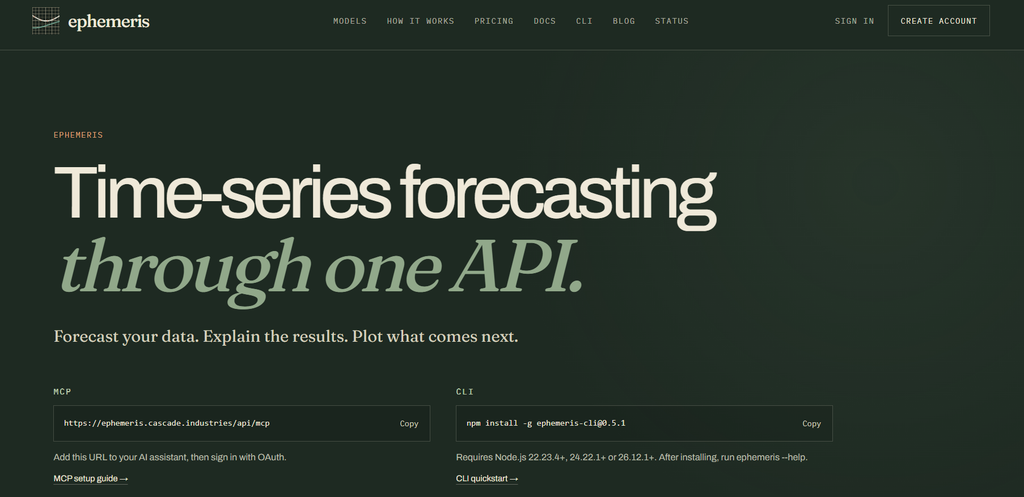
Its products include Ephemeris, an API providing access to time-series forecasting models, and Alphacast, which focuses on TAO and subnet market predictions.
The ecosystem also includes Gnomon, a tool designed to support safer decision making by autonomous AI agents.
Cascade-MoE marks a significant step in the subnet’s ambition to achieve state-of-the-art forecasting performance through decentralized competition.
Cascade is scaling its approach to billion-parameter AI models by combining specialized architecture with miner-generated synthetic data. This could advance Bittensor’s role in real-world forecasting technology.
➛ Explore Cascade (SN91) Here.
Enjoyed this article? Join our newsletter
Get the latest TAO & Bittensor news straight to your inbox.
We respect your privacy. Unsubscribe anytime.
Enjoyed this article?
Join our newsletter
Get the latest TAO & Bittensor news straight to your inbox — every morning before markets open.


No comments yet — be the first.