

When people hear the word forecasting, they usually think about stock prices, weather, sales, or the economy.
But forecasting can be much more personal than that.
One user recently took years of their Spotify listening history, gave it to an AI agent, connected the agent to Cascade’s Ephemeris forecasting API, and asked a fun question.
What could my Spotify Wrapped look like in 2027?
The goal was to predict things like how many minutes they might listen to music, how many artists they could discover, how often they might skip songs, and which artists could dominate their listening next year.
It is a simple experiment, but it shows something much bigger about what Cascade (SN91) is building.
Forecasting does not have to stay inside trading desks, weather stations, or big companies. If you have enough data showing how something changes over time, there may be something useful to forecast.
Your Spotify History Is Already a Time Series
A time series sounds complicated, but the idea is very simple.
It is just information recorded over time. Your listening minutes each month are a time series. So are your daily steps, a shop’s weekly sales, monthly electricity use, website visitors, traffic levels, hospital visits, and the temperature outside.
Cascade describes the same broad idea in its work on time-series foundation models. Prices, energy load, weather, traffic, sensors, hospital admissions, and industrial data can all be treated as signals changing through time.
Spotify gives users the option to download an extended streaming history. That creates years of timestamped information about what they listened to and when.
Instead of only looking backward at that data, this user wanted to see whether forecasting models could look forward too.
How the Spotify Experiment Worked
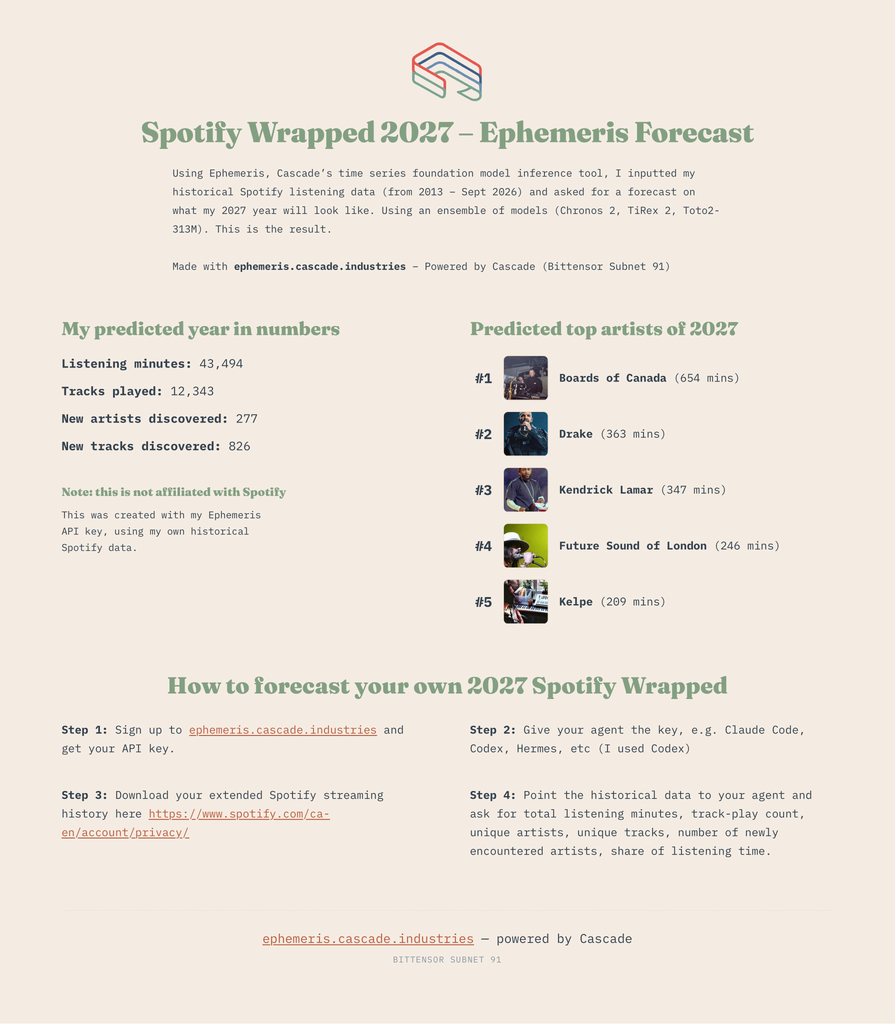
The full setup was detailed, but the basic process can be explained in five steps.
- Get an Ephemeris API key from ephemeris.cascade.industries.
- Download your extended Spotify streaming history from your Spotify privacy settings.
- Give the data to an AI coding agent such as Codex, Claude Code, or Hermes, while keeping the API key private.
- Turn the raw history into monthly trends such as listening minutes, plays, skips, shuffle use, unique artists, new artists, and how much listening went to favorite artists.
- Send those time series to Ephemeris and forecast them through the end of 2027.
The user also had the agent build separate histories for individual artists so it could estimate which artists already in the person’s listening history might receive the most listening time during 2027.
The forecast could also estimate things like total listening time, qualifying plays, unique artists and tracks, skip rate, shuffle use, new artists, and how concentrated or diverse the person’s music taste may be.
Check the full guidelines below:
Ephemeris Makes the Forecasting Part Easier
The tool behind the experiment is Ephemeris, Cascade’s public forecasting API.
Instead of requiring someone to download, run, and manage several forecasting models themselves, Ephemeris gives developers and AI agents one place to send time-series data and request forecasts.
At launch, Ephemeris listed six supported models and three ways to use them. A user could choose one model, let the system select one, or use ensemble mode to combine compatible models. The available models included Chronos 2, TiRex 2, and Toto2-313M, which were among the models used for the Spotify experiment.
An ensemble can be useful because one model may see a pattern differently from another. Combining several forecasts can give a stronger estimate and, where supported, a range showing how uncertain the prediction is.
What Cascade Is Building on Bittensor
Cascade is Bittensor Subnet 91 and is focused on improving time-series foundation models.
The subnet takes an unusual approach. Instead of asking miners to build completely different models, Cascade keeps the model setup controlled and asks miners to create better synthetic training data. Those data generators create many different patterns that a forecasting model can learn from.
The idea is that better and more varied training data can make forecasting models better across many kinds of problems.
This approach has already produced an interesting early result. In August, Cascade reported that one of its 4 million parameter models roughly matched Salesforce’s much larger 91 million parameter Moirai-Base model on the GIFT-Eval benchmark, including a slightly better CRPS score. Cascade’s model had been trained from scratch using synthetic data.
Forecasting Can Be Much More Than Finance
The Spotify experiment makes Cascade easier to understand because music is something almost everyone can relate to.
But the same basic idea can move into many areas.
A shop could study years of sales and estimate when certain products will be needed most. A creator could look at views and subscriber growth. An app could forecast traffic so its team knows when demand may rise. A building could estimate future electricity use from past energy data.
Factories can watch sensor readings over time. Transport systems can study traffic. Hospitals can study patient demand. Hotels can forecast occupancy.
Even personal data can become interesting if enough of it is collected over time. And Cascade can help you make sense of it.
Enjoyed this article? Join our newsletter
Get the latest TAO & Bittensor news straight to your inbox.
We respect your privacy. Unsubscribe anytime.
Enjoyed this article?
Join our newsletter
Get the latest TAO & Bittensor news straight to your inbox — every morning before markets open.


No comments yet — be the first.